
|



WorkOS Pipes: More context makes for smarter products (Sponsored)
 |
Users expect apps and agents to reach the tools they already work in. Every integration that gets you there is a different OAuth flow, a different token lifecycle, weeks of infrastructure before you write a line of product code.
WorkOS Pipes handles it with one API call. Pre-built connectors for GitHub, Slack, Salesforce, Google Drive, and more. Pipes handles OAuth, token refresh, and credential storage. You call the real provider API with a fresh token, every time.
Over the last few years, three of the biggest food delivery companies rebuilt their search systems around LLMs. DoorDash, Instacart, and Uber Eats were solving the same problem of trying to understand a user’s intent when they type something in search. They were also accessing more or less the same research base. And yet, the architectures they shipped look quite different from each other.
That divergence is one of the most interesting aspects of modern development using LLMs. Once we understand why each company landed where it did, we will have a mental model for thinking about how AI can be integrated into any production system.
Adding an LLM to an existing stack comes down to one question: how deeply should the LLM reach into the runtime?
Ultimately, DoorDash, Instacart, and Uber Eats each answered that question differently, and the specific LLM each chose was secondary. The specific model each company picked was secondary. The infrastructure they already had in place is what determined the answer.
In this article, we will walk through their differing solutions and try to make sense of their choices and understand the pattern behind them.
Disclaimer: This post is based on publicly shared details from various sources. References are present at the end. Please comment if you notice any inaccuracies.
The Problem
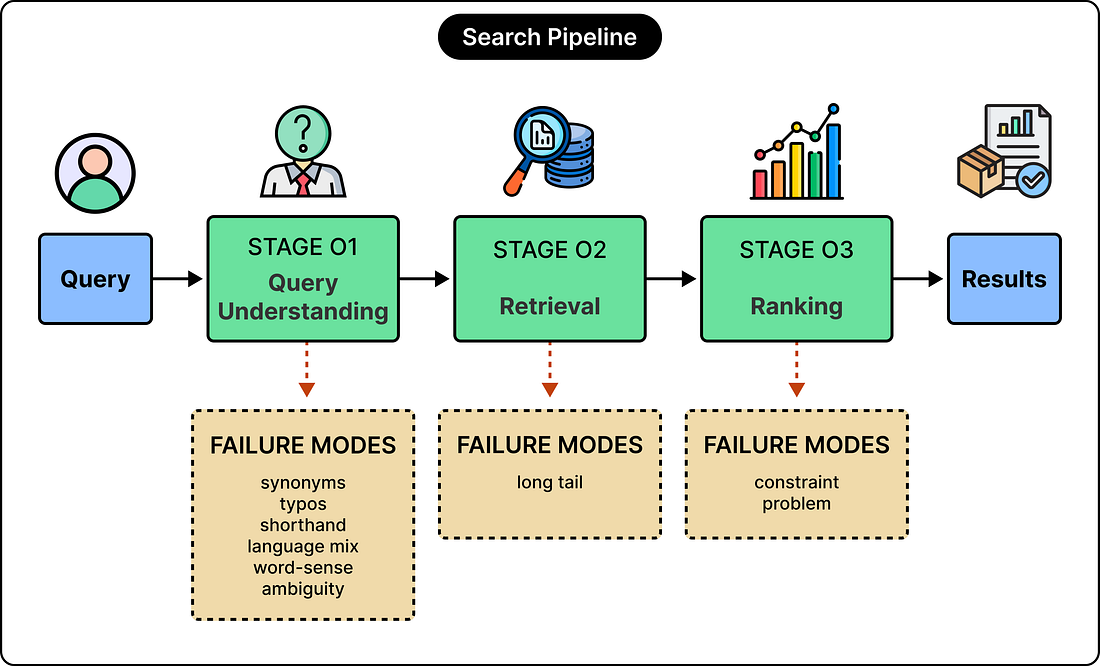
Type “something healthy for a rainy evening” into a food delivery app and watch what comes back. The result we get today is somewhere between useful and impressive. The same query five years ago might have returned a random jumble of items, because keyword search treats the words as a bag of tokens rather than as an intent, and the query offers little for keyword matching.
This pattern repeats across several common failure modes in food search. For example:
Synonyms: “Soda” and “soft drink” describe the same product, but a keyword engine treats them as different tokens.
Typos: “Mozzarela” should retrieve mozzarella results, but the spelling mismatch breaks the lookup.
Shorthand: “Gf pizza” meaning gluten-free pizza requires the system to recognize an abbreviation as a synonym for the full phrase.
Language mix: The Spanish word “pan” means bread, while the English word “pan” means a cooking vessel, so a bilingual search bar has to disambiguate.
Word-sense ambiguity: “Apple” the fruit and “Apple” the company share the same spelling but mean different things, and the right answer depends on context.
Each one is a potential moment where the user’s intent and the catalog’s words fail to line up.
 |
Two harder problems lie beneath this:
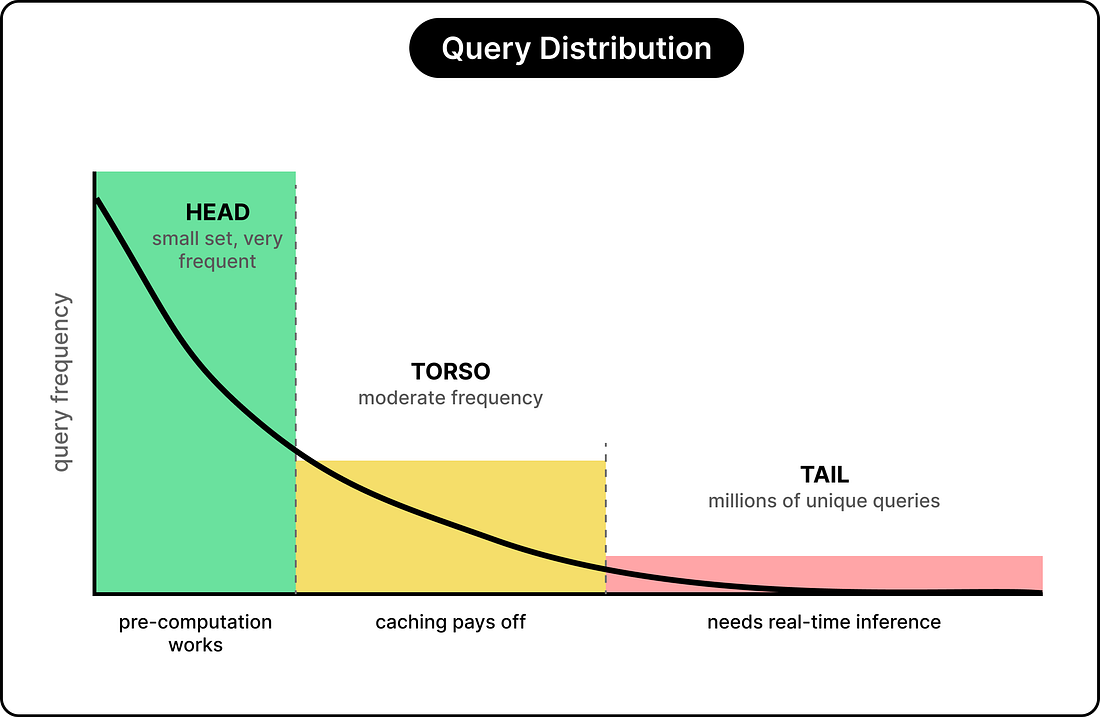
The long tail: Grocery and restaurant platforms see an enormous number of unique queries. Any specialized model trained on conversion data struggles with queries that appear only a handful of times, because rare queries are rare by definition.
The constraint problem: A query like “vegan chicken sandwich” has a hard constraint inside it, and similarity-based retrieval might return a chicken sandwich that violates the constraint, because the similarity score still looks close. Dietary restrictions, allergens, and quantity filters all sit in this bucket.
 |
Food search is the right domain to watch this play out, because all of these failure modes show up at the same time. In the subsequent sections, we look at how different companies handled these situations differently.