





As evidence mounts that the Iran war is strangling the economy—new Commerce Department data shows that annualized growth slowed to 1.5 percent in the second quarter of this year—the war itself continues to expand. Saudi Arabia joined in striking Iran for the first time yesterday, while Iran continues to lash out around the region, including in missile strikes against Jordan and Kuwait and an apparent drone attack in Egypt. Meanwhile, the Strait of Hormuz remains practically closed, and threats of Houthi attacks have slowed shipping through the Red Sea. Happy Thursday.
The Bulwark promises you three things: Facts about the world, honesty about ourselves, and a commitment to freedom and democracy. Support our work by becoming a Bulwark+ member.
 |
Springfield Needs Your Help
by Jim Swift
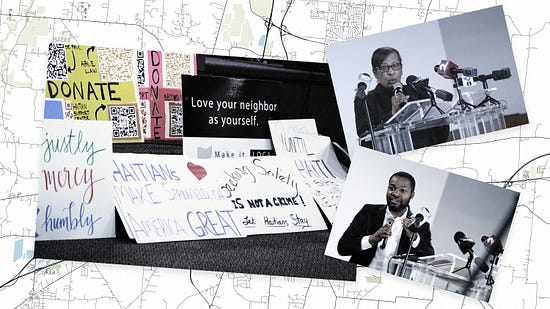
Springfield, Ohio—Most of the routes from Cincinnati to Springfield, Ohio pass by Springfield-Beckley Municipal Airport, home to the region’s general aviation traffic and the Ohio Air National Guard’s 178th Wing. I stopped by on my way to Greater Grace Temple, where members of the G92 coalition, a network of churches that support the local Haitian community, were going to address the media about the imminent expiry of temporary protected status (TPS) for more than ten thousand Haitian immigrants in the region.
As probably always happens when a stranger shows up to a small half-military airport with no luggage and starts taking pictures, an airport employee asked me, politely, what I was doing. I told him I think this quiet airport could soon become the setting of one of the biggest stories in America: deportation flights carrying Springfield’s Haitians. He shakes his head. “I seriously doubt that,” he says. I tell him I hope he’s right.
The consequences of TPS expiring are already rippling through Springfield. Rick, a reader I met earlier this month, texts me about tearful conversations with friends whose Haitian coworkers and neighbors are suddenly being let go.
“People can’t believe this is happening to their friends and neighbors,” he says.
I got to Greater Grace a few minutes early. TV cameras were already lined up. Clergy mingled with reporters, waiting for the event to begin. Before long, eight Christian pastors and a Cincinnati rabbi took turns making the case that Springfield’s Haitian community deserves compassion.
Rev. Carl Ruby of Central Christian Church set the tone: “We’re here to respectfully ask Homeland Security and ICE to do what President Trump has repeatedly promised, and that’s focus only on the worst of the worst.”
“People in Springfield are getting letters asking them to go to Cincinnati for a check-in,” Ruby related. “Once they get there, they are asked to wear ankle monitors.” Similar requirements have drawn lawsuits from immigrant-rights groups elsewhere.
Those who have already lost their TPS and their jobs don’t qualify for unemployment benefits or most forms of government assistance. As Ruby explained, that burden has fallen almost entirely on Springfield’s churches, food pantries, and nonprofits.
Rev. Michelle Boomgaard of Christ Episcopal Church and the Springfield Neighbors United coalition reminded the room: “From our earliest days, Springfield has welcomed immigrants,” she said, noting that the city’s recent economic revival owes much to Haitians and other immigrants.
Marjory Wentworth then read a statement on behalf of Haitian community leader Obed Lafaille. “Behind every policy are real people,” the statement began. “Springfield is more than the place we live. It is the community we have helped build together.” It continued:
We work here. We raise our children here. We worship here. We volunteer here. We contribute to this city’s economy and culture. What will happen to the lives we have built here? What will happen to the businesses that depend on our labor? What will happen to the children who call Springfield home?
Rev. Tim Voltz of Champion City Church challenged those in attendance to imagine the situation in their own congregation. “If tomorrow morning the federal government had taken away the rights of one-third of your church congregation,” Voltz asked, “what would you do? . . . What do you think Jesus would call you to do?”
Pastor Jimmy Pierre of Gospel Grace Baptist Church, who is Haitian, said the uncertainty is taking a toll far beyond immigration paperwork. “The emotional burden is overwhelming,” he said. Many families, he explained, are dealing with anxiety, depression, and emotional exhaustion as they try to navigate an uncertain future. “Some have built small businesses, purchased homes, and invested years of work into this community.”
Pierre pointed out that Springfield’s Haitian community did not create the legal limbo it now finds itself in. TPS does not itself provide a pathway to permanent legal status, he said, so many families have few realistic options as the program comes to an end.
The only shred of hope is that a bill to extend TPS that passed the House might somehow pass the Senate, and then Donald Trump might decide to counteract one of his signature policies. It’s not really even much of a shred.
Pastor Ruby praised Gov. Mike DeWine, who called ending TPS “a mistake,” and Springfield Mayor Rob Rue, for urging Congress to preserve legal protections for Haitians who have built lives in the city. Both DeWine and Rue are Republicans.
Ruby’s attitude toward Ohio’s Senate delegation was, by contrast, righteously indignant and furious.
“Sen. Moreno has made it clear he’s not going to support the bill. That’s between him and his God,” Ruby said. “But Sen. Husted has not yet spoken, and we have a right to know where he stands on that bill, and just want to publicly ask him today to come out with a statement making that clear.” Husted, appointed by DeWine to fill Vice President JD Vance’s vacant Senate seat, faces longtime former Sen. Sherrod Brown this fall.
Asked what would happen if immigration authorities came to Springfield, Ruby said the coalition would encourage peaceful protest and that some were prepared to put themselves “between ICE and people who are targets for detainment and deportation.” He emphasized that any resistance would be nonviolent. “We believe that a part of civil disobedience is a willingness to pay the consequences,” Ruby said. “There are people and pastors in Springfield who are committed to doing that, no matter what it costs.”
Ruby closed with an appeal for immediate financial help. G92 itself was not seeking donations, but local organizations are: the Haitian Community Help & Support Center, St. Vincent de Paul, and Second Harvest Food Bank were facing enormous demand. “These are all people who wanted to support themselves and who were supporting themselves,” Ruby said. “But now we have to come up with money to pay rent. We have to help families put food on the table.”
Asked how long local groups could keep providing that support, he was blunt: “Money’s running out quickly,” adding that “they need millions of dollars.”
“We can’t do this long-term.”
Trump’s New Lows
by William Kristol
As