| | In this edition: Greenpeace threatens legal action over Dangote’s Lamu refinery, South Africa’s emba͏ ͏ ͏ ͏ ͏ ͏ |
| |  Lamu Lamu | Antananarivo | Pretoria |
 | Africa |  |
| |
|
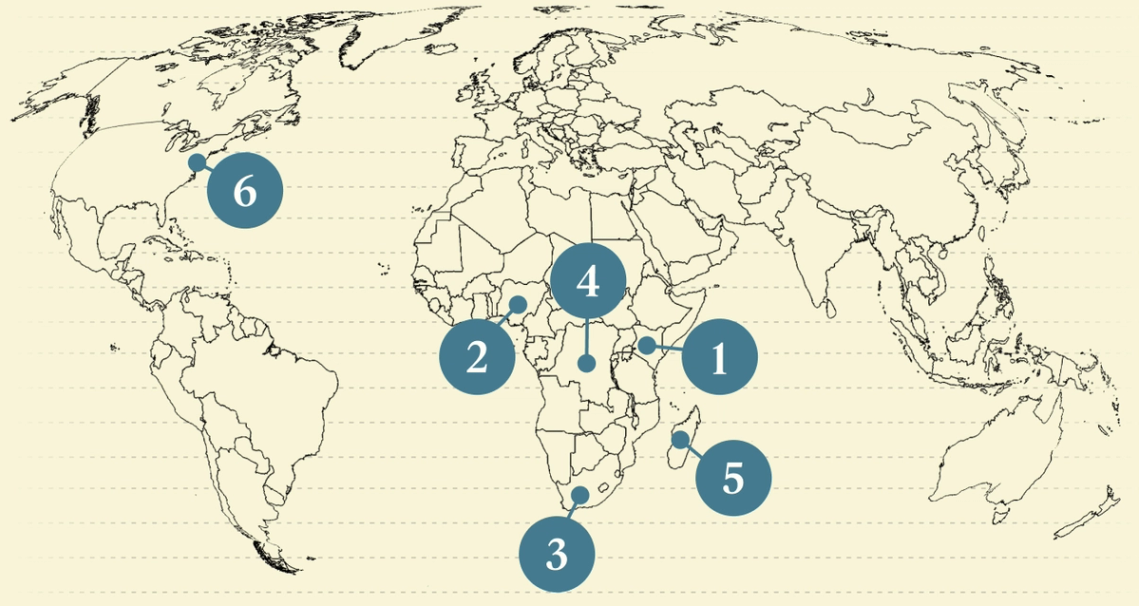 - Greenpeace vs Dangote
- A push for fuel imports
- S. Africa fund gets new chair
- Belgium backs DRC plant
- US backs Madagascar metals
- Ebola response scrutiny
 Weekend reads, and Comoros tackles wedding-fueled work leave. |
|
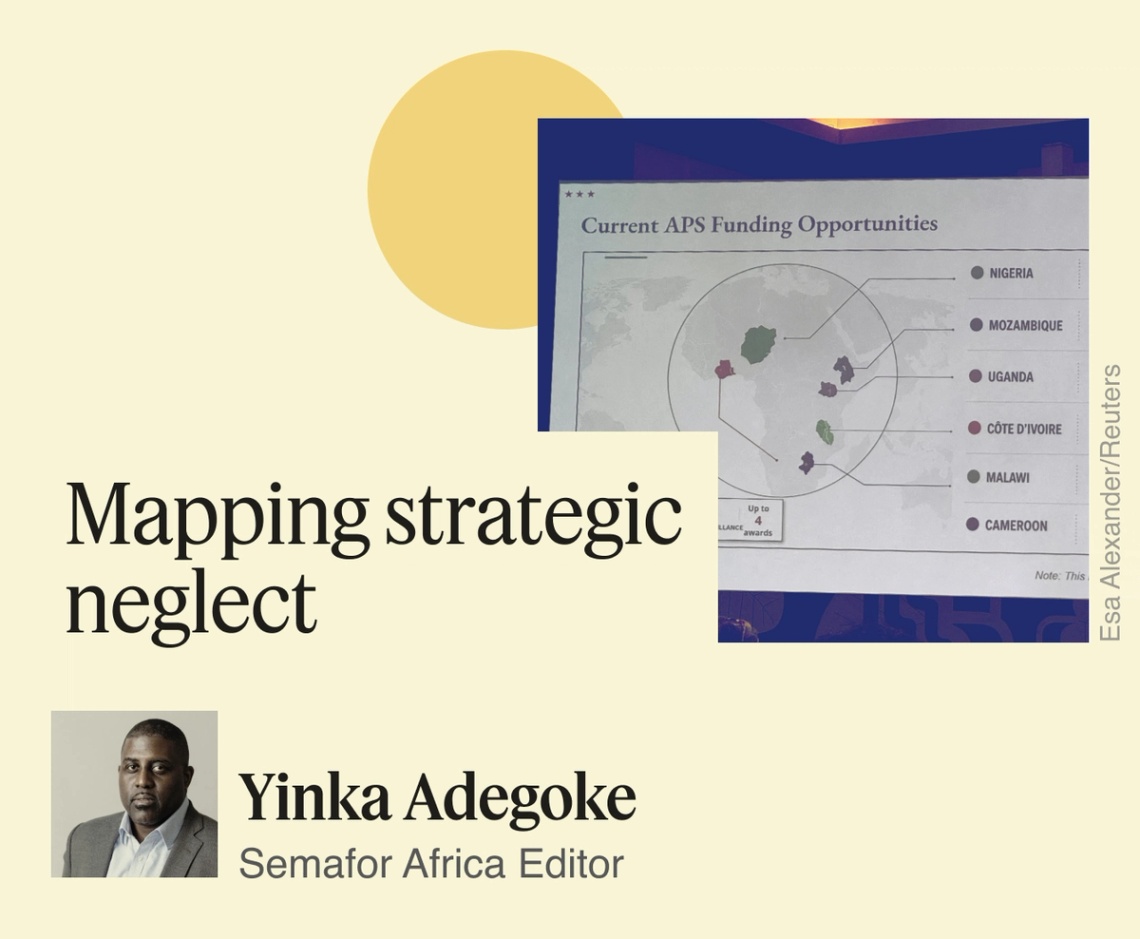 Screenshots of a US State Department map of Africa that mislabeled every country quickly ricocheted through WhatsApp groups and inboxes of Africa policy specialists this week, prompting a mix of disbelief, gallows humor, and embarrassment. The State Department apologized for the error on the reportedly AI-generated map, which was presented at a global conference in Brazil. For many current and former US officials who have worked on African affairs, the mistake itself was less remarkable than what it appeared to reveal. After the initial amusement and horror came genuine concern that the State Department — the US government’s primary institution for day-to-day engagement with African countries — is no longer as capable as it once was after 18 months of reconfiguration under the current Trump administration. The department has lost somewhere between a fifth and a third of its staff, depending on whose estimates you believe, while senior diplomatic representation across the continent has also been hollowed out. “You can draw a straight line between the lack of 37 ambassadors and the map screw-up. It points to understaffed vetting processes,” said Witney Schneidman, who has spent four decades working on US-Africa policy in and out of government, under both Democratic and Republican administrations. The map itself was an embarrassing mistake. But what makes it consequential is that it reinforces a broader perception that Africa is no longer receiving sustained attention from Washington, just as the US says it wants deeper partnerships on critical minerals, security, and trade. Diplomacy may seem less tangible than investment deals or military cooperation, but it is the infrastructure that makes those ambitions credible and weakening it is an own goal. Every vacant ambassadorship, every depleted Africa desk, and every avoidable blunder makes it easier for China to present itself as the more consistent and attentive partner. Washington says it is competing with Beijing for influence across Africa, but moments like this inevitably fuel doubts in African capitals that, despite the rhetoric, the continent still isn’t being taken as seriously as US officials claim. |
|
Semafor Exclusive Dangote’s Lamu refinery under fire |
| |  | Martin K.N Siele |
| |
 Developments at Lamu Port in Kenya. Presidential Press Service/Handout via Reuters. Developments at Lamu Port in Kenya. Presidential Press Service/Handout via Reuters.Greenpeace Africa said it is mulling a potential legal challenge to stop the issuance of approvals for the construction of a multibillion-dollar Dangote Refinery on the Kenyan coast. The government hopes the $17 billion project, which is expected to produce 700,000 barrels-per-day when finished, will create tens of thousands of jobs and boost the region’s energy autonomy. But it has also drawn ire from activists. Greenpeace argues the Kenyan government made political and financial commitments before undertaking an Environmental and Social Impact Assessment or extensive public participation around the proposed site in Lamu. The plan comes with political weight: Sources close to the Lamu governor told Semafor that with national elections coming in August 2027, the administration is keen on the project’s success. The piece of land expected to host the project has already been designated, and Lamu expects to approve various operational licenses required for construction to begin. |
|
Nigeria urged to build fuel reserves |
 Sodiq Adelakun/Reuters Sodiq Adelakun/ReutersNigerian energy retailers called for the state to create local strategic reserves of petrol and other fuels to buffer from supply shocks in the global oil market. An influential trade group that favors the importation of refined products is leading the charge, in a move that would undermine Africa’s richest man Aliko Dangote, who says his 650,000 barrels-a-day refinery can meet Nigeria’s energy needs. Increased domestic refining has made Nigeria significantly less reliant on importing refined petroleum products, with nearly 80% of petrol supply in the country from January to June this year coming from domestic sources. However, a 6% year-on-year drop in total petrol supply during the period has raised concerns about relying entirely on domestic refining. The trade group said that while the Dangote Refinery has achieved “impressive production levels,” it was concerned that maintenance and technical issues meant Nigeria should retain a “diversified supply framework” supported by domestic sourcing. Lawmakers held a hearing this week on the existing tension between importers and refiners, where the energy marketers reiterated their stance on building reserves using both imports and locally refined stock. — Alexander Onukwue |
|
South African fund gets new chair |
 Reuters ReutersSouth Africa appointed a deputy minister in the presidency office as chair of the state-owned $200 billion pension fund, as part of a complete board overhaul following weeks of governance turmoil. Seiso Mohai’s appointment, whose candidacy was first reported by Semafor, shifts political oversight of the fund into President Cyril Ramaphosa’s office and breaks a decade-long tradition of handing the gavel to the deputy finance minister in the National Treasury. Mohai will lead a new bench of seven directors at the Public Investment Corporation — the lifeblood of South African capital markets, holding roughly 20% of the Johannesburg bourse. Former African Development Bank vice president Bajabulile Swazi Tshabalala is also among the appointees, injecting development finance expertise. The new bench inherits a fire to put out after the suspension of PIC’s CEO over a botched airport transaction sparked a wave of board resignations and shone a harsh spotlight on the fund’s policy-driven venture arm, where 40% of its $6 billion portfolio is on life support. — Tiisetso Motsoeneng |
|
Belgium backs DRC germanium |
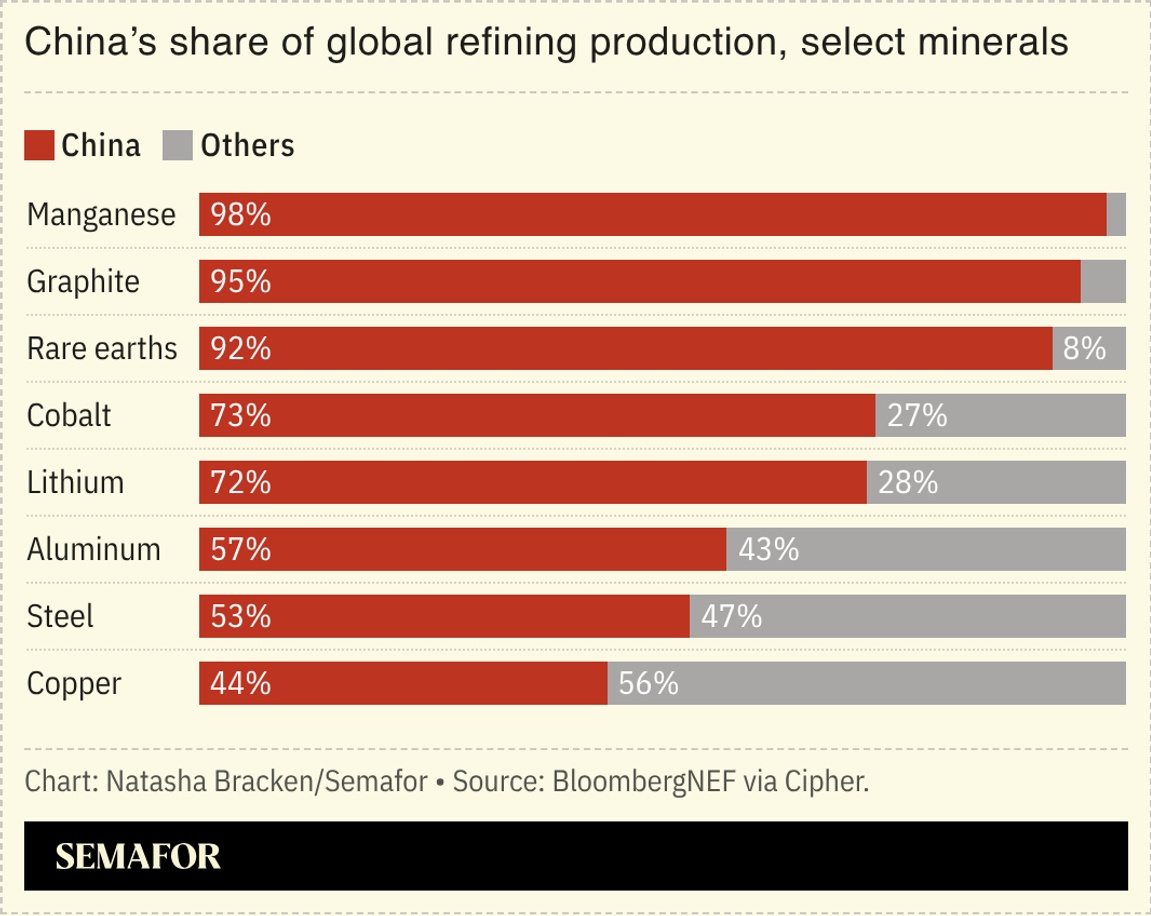 Belgium has approved a state guarantee to help cover advance payments for future germanium supplies from DR Congo. The pact backs a plant that, once at full capacity, could supply up to 15% of the world’s demand for the critical mineral, as Europe seeks to reduce its reliance on China. The guarantee would allow Umicore, a major Brussels-based refiner, to pay upfront for future germanium supplies under terms still being negotiated, while shifting part of the commercial risk to the Belgian state. Supply of germanium, used in fiber-optic networks, infrared defense systems, and semiconductors, is dominated by China, which produces about 60% of global output and has restricted exports since 2023. “We cannot count on China,” Peter Handley, a former European Commission official who worked on the EU’s critical minerals policy, told Semafor. A unit of DR Congo’s state miner Gécamines supplies Umicore from a plant capable of producing around 30 tonnes a year. It began commercial shipments in late 2024 and produced an estimated four to five tonnes of contained germanium last year. — Ruben Nyanguila |
|
US backs Madagascar rare earths project |
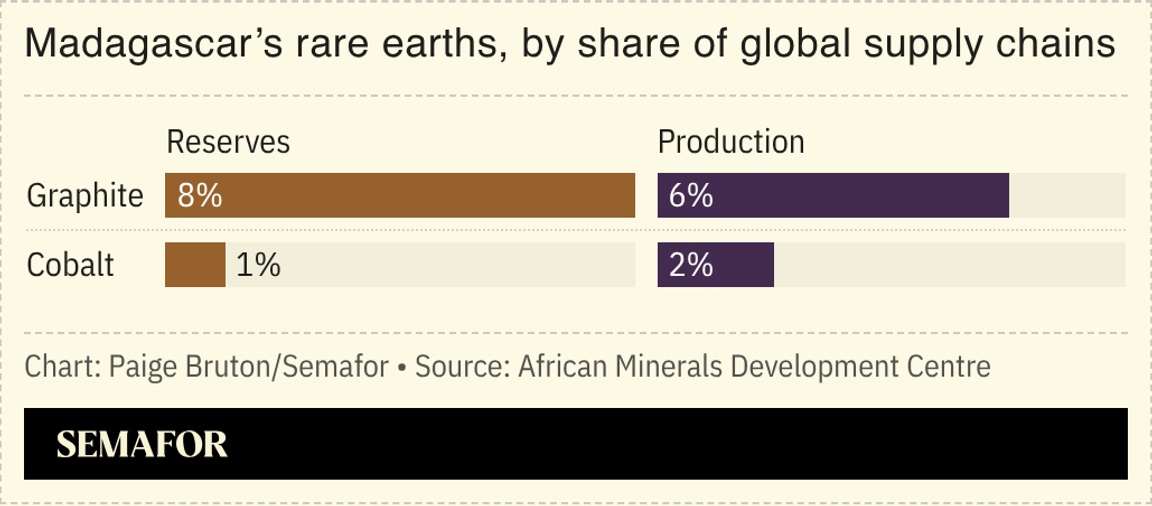 The US said it will back a rare earths project in Madagascar as part of its efforts to chip away at China’s dominance of the critical minerals sector across Africa. Washington’s Development Finance Corporation will commit up to $4.8 million to the Ampasindava project, paving the way for potential future funding. The site produces material used to make magnets that are essential for defense manufacturing, which the US is keen to secure. The Trump administration’s expansion of critical minerals investments across Africa is part of its so-called trade-not-aid push. And though experts said the US will almost certainly not catch up with China, by far the leading foreign investor in the sector, some noted Washington’s new approach to Africa’s resources is welcome after years of paternalistic foreign policy. “There is definitely a sentiment now that the Americans are back, in a big way, and in a way that means ‘let’s talk business,’” Chatham House senior researcher Christopher Vandome told Semafor. — Jenny Vaughan |
|
Semafor Exclusive US senators call for Ebola aid |
| |  | Adrian Elimian |
| |
 Gradel Muyisa Mumbere/Reuters Gradel Muyisa Mumbere/ReutersA bipartisan pair of US senators is urging the Secretary of State to unlock family planning funding and supplies for women affected by the Ebola outbreak sweeping eastern DR Congo, warning that the Trump administration’s freeze on such aid is deepening a maternal health crisis. In a letter shared first with Semafor, the Sens. Jeanne Shaheen, a Democrat, and Lisa Murkowski, a Republican, called for the repurposing of $608 million in international family planning funds from the fiscal year 2026 appropriations bill. They also pressed for a “humanitarian exemption” allowing US support for the UN Population Fund so the body can resume sexual and reproductive health programming in the affected region. President Donald Trump withdrew from the organization earlier this year. The current Bundibugyo Ebola outbreak is now the second-largest on record, the Congolese government said this week, with more than 3,500 cases reported. |
|
 - AI development in Africa poses a unique set of challenges around mammoth electricity needs that many cities — struggling to provide power for their own populations — simply cannot supply. Or more precisely, they cannot supply the grid support to channel electricity from, say, a power source to an AI data center. Awonusi Ayomide Jesudamilare explores this conundrum, asking: “How should cities weigh private digital investment against competing claims on shared resources?” The answer, she finds, is by creating a grid inside the grid: “A layer of firm, privately secured electricity built for facilities that cannot tolerate interruption, operating within a public system still struggling to expand transmission and connect new generation.”
- Afro-Mauritanian asylum seekers in the US find themselves ensnared in the Trump-era deportation system while pushing for justice back home, writes Nadia Addezio for The Polis Project. The reporting follows members of Ohio’s Afro-Mauritanian diaspora — many descendants of those killed or expelled during racial purges in the 1980s and 1990s — and how an amnesty law shields perpetrators from prosecution, leaving survivors’ decades-long search for truth about mass graves and disappeared relatives unresolved, as they fight canceled asylum hearings and deportation orders to Uganda.
- Africa’s infrastructure financing challenge is less about finding more money than creating enough investable projects that domestic capital can back. This argument, by Bright Simons in a new Brookings’ paper, pushes back on recent reports highlighting up to $4 trillion in African institutional assets, roughly half of which is portrayed as “idle savings” waiting to be deployed. Simons argues those assets are already largely committed, and that the true figure is much smaller. Instead, he says governments should focus on building stronger pipelines of bankable projects, improving project preparation, expanding credit enhancements, and deepening local capital markets to unlock long-term investment.
- Africa’s entire submarine cable network relies on a single repair vessel based in Cape Town
|
|
|


