| | In this edition, SoftBank doubles down on AI, cash-strapped investors pick their poison, and Google ͏ ͏ ͏ ͏ ͏ ͏ |
| |  | Business |  |
| |
|
 - Deep Mind reset
- Novo’s tough sell
- Masa Son’s money machine
- Musk rattles telecoms
- Private credit scrip
|
|
 Heading into last week’s Federal Reserve meeting, Wall Street’s favored betting parlor — the Fed funds futures market — put two-thirds odds that the central bank would hold rates steady. Over at Kalshi, the prediction market, the chances were as much as 10 points higher. They were both right; the Fed held steady. But Kalshi was a lot righter. When a few basis points separates investing legends from washouts, a 10-point edge is an enormous windfall for anyone who trusted its numbers over those crunched by CME, the giant futures-exchange operator. That gap matters because Kalshi is trying to shed its casino reputation, win over politicians, and position itself as a serious player in financial markets. It hired a former Standard Chartered executive to build an institutional business, has encouraged market-makers like Susquehanna to provide trading liquidity, and is building a terminal to compete for traders’ desktop real estate with Bloomberg. The case rests on three questions: Are prediction markets legal? Are they trustworthy? Are they accurate? The first is likely a question for the Supreme Court. On the second, platforms are cracking down on insider trading, though perhaps not convincingly enough to bring institutional money to the party. The third is key. Rates traders, Tesla investors and electric utilities will hook their trading terminals to whichever feed is most accurate. Investors who have relied on the same research outfits for years are “trying to forecast some political outcome around the world and sitting there with a number from Eurasia Group, and have no idea how they came up with it,” said Nicole Kagan, a Kalshi researcher, who previously built interest-rate trading models at Bridgewater, the giant hedge fund. Ian Bremmer’s shop is as good as it gets on global intelligence; can a crowd of anonymous bettors beat it? Kalshi is out today with some data to make the case. Read more about that here. Wall Street investors who are Kalshi-curious won’t settle for being directionally correct. They need perfection. The closer Kalshi gets, the better its odds of becoming a dues-paying member of high finance. |
|
 Jeenah Moon/Reuters Jeenah Moon/ReutersTelecom executives are learning the same thing auto bosses and defense contractors figured out years ago: keep a close watch on what Elon Musk does, not just what he says. On SpaceX’s earnings call this week, the company confirmed Semafor’s earlier reporting that it planned to move into the mobile business but that it didn’t need to become (or buy) a Verizon or AT&T to do so. “We definitely intend to build out terrestrial,” SpaceX president Gwynne Shotwell said, but “you don’t necessarily have to spend many billions of dollars on low band spectrum all up front before you build your system.” All the telecom talking points are true: it’s hard to build a network, Musk’s satellite technology isn’t advanced enough to work well in urban areas, and SpaceX doesn’t know how to operate in this industry. It’s also true that SpaceX’s entrance will no doubt force the big three players to spend more to get the spectrum and keep the customers they need to stay competitive. We already know Musk is coming for the telecom companies’ customers — the next thing to look for is how SpaceX starts to spend on spectrum, how it sets itself up to acquire licenses and, of course, Musk’s continued coziness with FCC chair Brendan Carr. Telcos ignore SpaceX at their peril. — Rohan Goswami |
|
 Tom Little/Reuters Tom Little/ReutersNovo Nordisk’s CFO has spent the last few days on the phone trying to reassure investors that the GLP-leader hasn’t lost a step. The market isn’t buying it. Novo’s shares have fallen 15% this year, tumbling further this week after guidance missed analysts’ targets. Meanwhile, rival Eli Lilly surged 5% on another blowout report. “It’s for the analysts to set their own expectations and build their own models,” CFO Karsten Munk Knudsen told Semafor when asked what he needed to do to sell the street on his rosier narrative. Novo was first to market with GLP-1s and briefly became Europe’s most-valuable company on its early success. Novo CEO Mike Doustdar marks his one-year anniversary this week, replacing a predecessor who was ousted for, well, fumbling that crown to Eli Lilly, which became the first pharma company ever to hit a $1 trillion market cap on the back of its Ozempic competitors. Novo has cut 15% of its workforce and launched a weight-loss pill it claims 90% market share. Investors looking for reasons to get excited at Novo’s capital-markets day next month may be disappointed; Knudsen says to expect “refinements” in strategy, not dramatic shifts. – Shelly Banjo |
|
Masa Son doubles down on AI bets |
 Manami Yamada/Reuters Manami Yamada/ReutersMasa Son is at it again. The SoftBank CEO was the defining money-spinner of the 2010s, using borrowed money and financial sleight-of-hand to turn the Japanese telecom into a venture giant. Now he’s using the same playbook to double down on the AI boom. SoftBank disclosed in its earnings report today that it had borrowed $10 billion from a group of global lenders, with its stake in OpenAI serving as collateral for the loan. But that stake itself was partially acquired using a loan from many of those same lenders, filings show; SoftBank said it borrowed $10 billion in July to fund its latest investment in the AI lab. It echoes how Son borrowed against SoftBank’s holdings in Alibaba and Yahoo to free up cash for his obsessions — but at least that collateral was made of profitable businesses. —Liz Hoffman |
|
 TT News Agency/Pontus Lundahl/via Reuters TT News Agency/Pontus Lundahl/via ReutersThe management shakeup at Google will help accelerate its development of AI, rather than hold it back, writes Semafor’s Reed Albergotti. Demis Hassabis stepping down from CEO of DeepMind and his colleague Koray Kavukcuoglu, the company’s chief AI architect taking over, comes at a moment in the AI race that demands turning R&D wins quickly into usable products. Google has a good track record of doing that with Gmail, Google’s AI mode in search, and its popular Notebook LM, not to mention having the world’s most popular mobile operating system. Hassabis was the face of Google’s AI, but his heart was in the science of it, not the business. Google shares fell 4% on Wednesday’s news, but the bleeding has stopped as it sinks in that perhaps everyone is where they’re supposed to be. |
|
Cash-strapped borrowers turn to scrip |
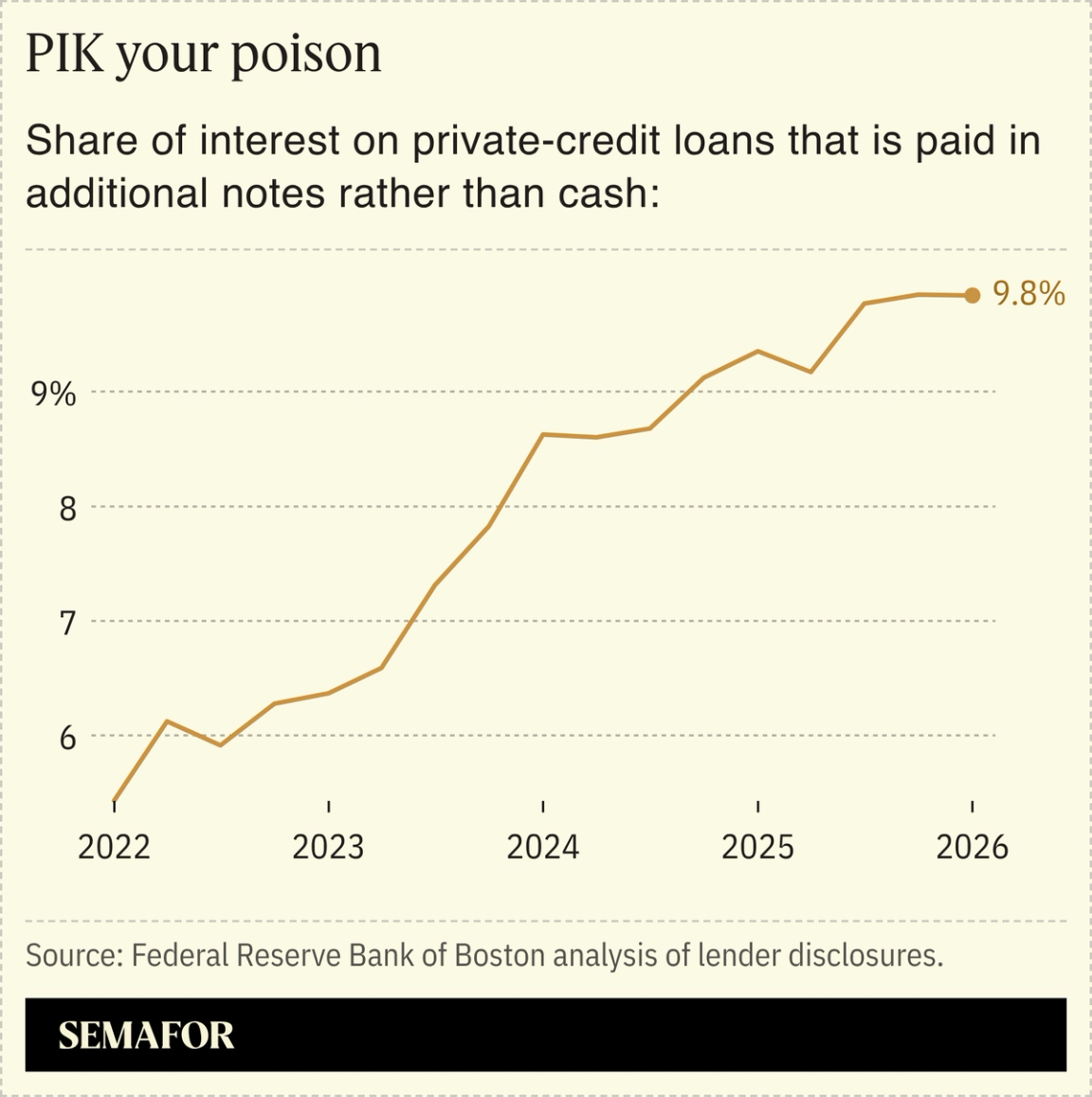 Companies that have borrowed from private-credit firms are increasingly deferring cash interest, a potential sign of weakness in a corner of the economy that’s drawn warnings of a crunch. The Boston Fed found that over the past four years “pay-in-kind” arrangements — in which interest is paid in additional debt tacked onto the borrowing pile, instead of in cash — rose from 6% to 10% of portfolios at the most common type of private-credit fund, known as a BDC. That “suggests there is growing pressure on borrower cash flows,” Fed researchers wrote. Among software companies, where fears of a credit crash are sharpest, the use of PIK doubled to 13% between the end of 2022 and March of this year. The researchers also found tighter pricing that indicates lenders are competing more aggressively to win business — never a great sign of prudent risk management. — Liz Hoffman |
|
Most business and finance news wastes your time. The Daily Upside respects it: covering what’s actually moving across markets and why, in five minutes flat every morning. Some call it the closest thing to a free MBA. Join 1M readers. |
|
➚ BUY: AI chip. Kellanova is using AI in its quest to make the perfect Pringle. The company worked with Siemens to create “digital twins” of the potato chips throughout the production line to account for variances across batches of potatoes. ➘ SELL: AI dip. Chili’s is “not all in” on AI. The firm’s tech chief told WSJ that basic tech upgrades like Wi-Fi and point-of-sale payment systems are key to the brand’s turnaround. |
|
 Companies & Deals- Loan rangers: Apollo’s private-equity book produced paltry profits in the second quarter but the firm recorded record fee revenue anyway, a stark snapshot of its pivot from a buyout shop to an insurance and lending giant.
- Equity partners: Several major US law firms have explored selling stakes in their back-office operations to private equity, per the FT. (The idea is something we explored on Compound Interest earlier this year.)
- Event horizon: SpaceX investors who thought they owned shares in SpaceX and planned to sell this week, when the IPO lockup lifts, are discovering the dangers of special-purpose vehicles.
Watchdogs- Course whisperer: Trump calls Fed chair Kevin Warsh often, WSJ reported. Fed chairs and presidents were historically in regular, and occasionally chummy, contact, but in recent decades have taken pains to keep their meetings choreographed and disclosed to avoid perceptions of political influence.
Markets- Please can we have some more? Alphabet is looking to raise up to $25 billion from its latest US investment-grade bond offering, Bloomberg reported, as big tech’s borrowing spree continues to keep pace with the AI buildout.
|
|
|


