| | In this edition, Google abdicates the LLM crown, companies mix AI cocktails, and DeepSeek weighs a p͏ ͏ ͏ ͏ ͏ ͏ |
| |  | Technology |  |
| |
|
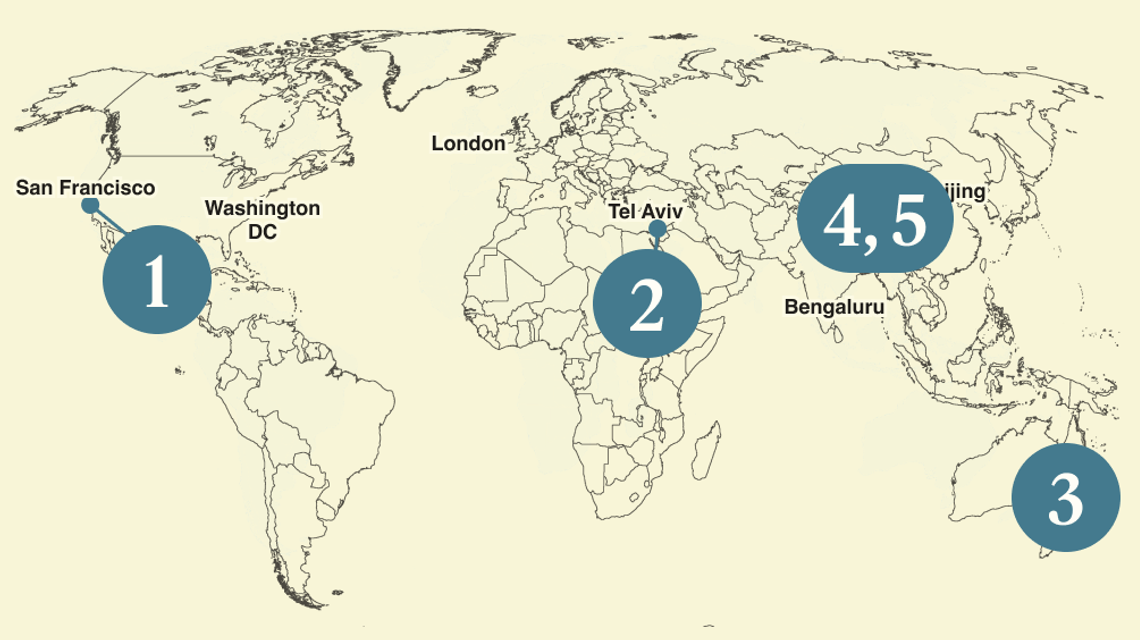 - AI cocktails
- Hacks pressure model testers
- Your job candidate is AI
- DeepSeek may raise prices
- ByteDance forbids distillation
 Google will be fine without Demis Hassabis running DeepMind, and how AI can correct the scientific record. |
|
 Google’s best AI models are six months behind the state of the art on coding capability and talent is leaving. It may never take the LLM lead again, but that likely doesn’t matter. The company is far from doomed even after Demis Hassabis stepped down as CEO of DeepMind Wednesday and Chief Scientist Jeff Dean left to found a startup. Whoever stands atop the AI race podium isn’t the main point anymore. The contest is now about using AI to accomplish real world tasks. And for that, the benchmark is simple: Does it work and what did it cost? When users click on Google’s little Gemini diamond, they can do things like use natural language to search email and YouTube, or get AI feedback on writing in Google docs. Eventually, Google wants the little blue diamond to do more tasks, tying together Google’s many products (and products outside of Google) and pulling data from its billions of users. Gemini Spark is the early iteration of that concept. As AI infrastructure gets built and capabilities advance, Google’s suite of offerings — the most popular mobile operating system, internet browser, email, maps and more — will transform into more powerful systems touching every piece of technology in its users’ lives, including physical machines like your stove or your car and eventually robotics. The tools will start to feel a little bit magical, especially for people who haven’t been experimenting with coding agents. But the underlying models powering those features will not be state of the art, and none of the people using the features will care about that, because they will work. Google won’t be using the top models for all of that because using the most powerful AI would be astronomically expensive, and there probably isn’t enough compute power in the world to handle it. Some people get excited about the idea of building product scaffolding at unfathomable scale. But for people like Hassabis and Dean, who have accomplished so much and have benefited financially from those contributions, it’s understandable that solving other problems is more appealing. The most important product person at the company now may be cofounder Sergey Brin, who has no official role but wields a massive amount of power through his supervoting shares and status, according to several Google employees I spoke with. There is nobody else at his level who has a more vested interest in Google succeeding. Google now needs smart, technical people to step up and solve the challenges it faces in model development, architecture and efficiency — which shouldn’t be an issue. The company has always had plenty of people, even if it’s lost some singular talent recently. |
|
 Priyanshu Singh/Reuters Priyanshu Singh/ReutersLarge companies are increasingly disclosing that they use a cocktail of AI models, including open-source Chinese ones, to develop consumer-facing tools like chatbots that help users plan a trip, choose the best shade of lipstick, or process a refund. “Any CEO that’s not taking advantage of open-source models is almost certainly wasting a lot of their shareholders’ money,” Pinterest’s CEO said this week, adding that the use of open-weight AI — like Alibaba’s Qwen — costs the company less than 8% of what it would pay for closed, proprietary models. US companies’ use of open-source models heightens the tension between cost-conscious business leaders and the US government over concerns about safety and national security tied to Chinese AI. But the way they’re blended into companies’ tools also highlights consumers’ growing inability to assess whether their personal discussions with a brand’s chatbot are with AI made in China or in the US — something people appear to care about. A Public First survey done in June showed only 9% of US respondents trust Chinese models, while 52% trust their American counterparts. I had dozens of conversations with branded chatbots, and while they exhibited varying degrees of willingness to engage in political discourse, virtually all refused to say what specific model they were built on. Companies should disclose what is powering their bots in the spirit of transparency, but it may ultimately not matter, given companies’ growing ability to fine-tune models for specific needs. While a prodding journalist like me might try to get chatbots to veer off course, the ordinary user probably won’t notice a difference. — J.D. Capelouto |
|
Hacks put pressure on third-party model testers |
 Daniel Cole/Reuters Daniel Cole/ReutersRecent hacks by AI models from three different companies put a spotlight on a startup trusted by top AI labs to evaluate their frontier systems. Models from Meta, Anthropic, and OpenAI all accessed the internet and compromised outside organizations while undergoing cybersecurity testing with Irregular, which has offices in Israel and the US. The labs pointed to a “misconfiguration” involving Irregular, which emphasized in a statement that it wasn’t a “sandbox escape or a sophisticated cyber action,” and that there are no “current open issues.” Irregular essentially left the door open to the internet while running cybersecurity tasks in which labs deliberately switch off model safeguards to measure raw capability, according to OpenAI and Anthropic. In one scenario, Irregular also gave the models a fictional target company whose name unintentionally matched the domain of a real website. Irregular has since cut off internet access entirely for the models it tests, according to a person familiar with the matter, and doesn’t plan to restore it until it has a new process for keeping models contained. Ensuring there’s no way for models to access the internet during testing is a matter of “basic control measures,” said Matthew Mittelsteadt, a frontier security expert at the Institute for AI Policy and Strategy. “You’d think that of all the things that you’ve got to get right…” The episodes put pressure on third-party testing systems to shore up their tech as they handle AI models that are only getting better at exploiting cyber weaknesses. “You can follow every best practice in the world… but you get the feeling that you probably need new best practices,” said Matt Fredrikson, CEO of Gray Swan, a Pittsburgh-based firm that does pre-release adversarial testing on top AI models. — J.D. Capelouto |
|
AI avatars enter the job interview |
Job recruiters are facing an uncanny type of candidate today: the AI avatar. These digital humans — which mirror a job applicant’s voice and likeness but are in reality an artificial alter — are showing up in first-round interviews, according to recruiters. Lana Kersanava is a Sydney-based recruiter who says these peculiar digital renders have appeared in some of her interviews over the last six months. “At the beginning, it’s like you feel like something is off,” she told Semafor. “It looks very realistic.” But it’s not. After about five minutes spent listening to the avatar deliver an overly polished response to a series of questions, Kersanava ended the interview and disqualified the candidate. In the three interviews Kersanava conducted with AI avatar applicants, the candidates had applied for English-speaking roles as non-native speakers, leaning on AI as a crutch for a lack of language proficiency. But for some job candidates, using AI in the application process is a reaction to a system that’s grown more machine than human, as applicant tracking systems use AI to filter resumes, and recruiters lean on AI avatars to do some first-round interviews, too. —Jake Angelo |
|
DeepSeek warns of price increase |
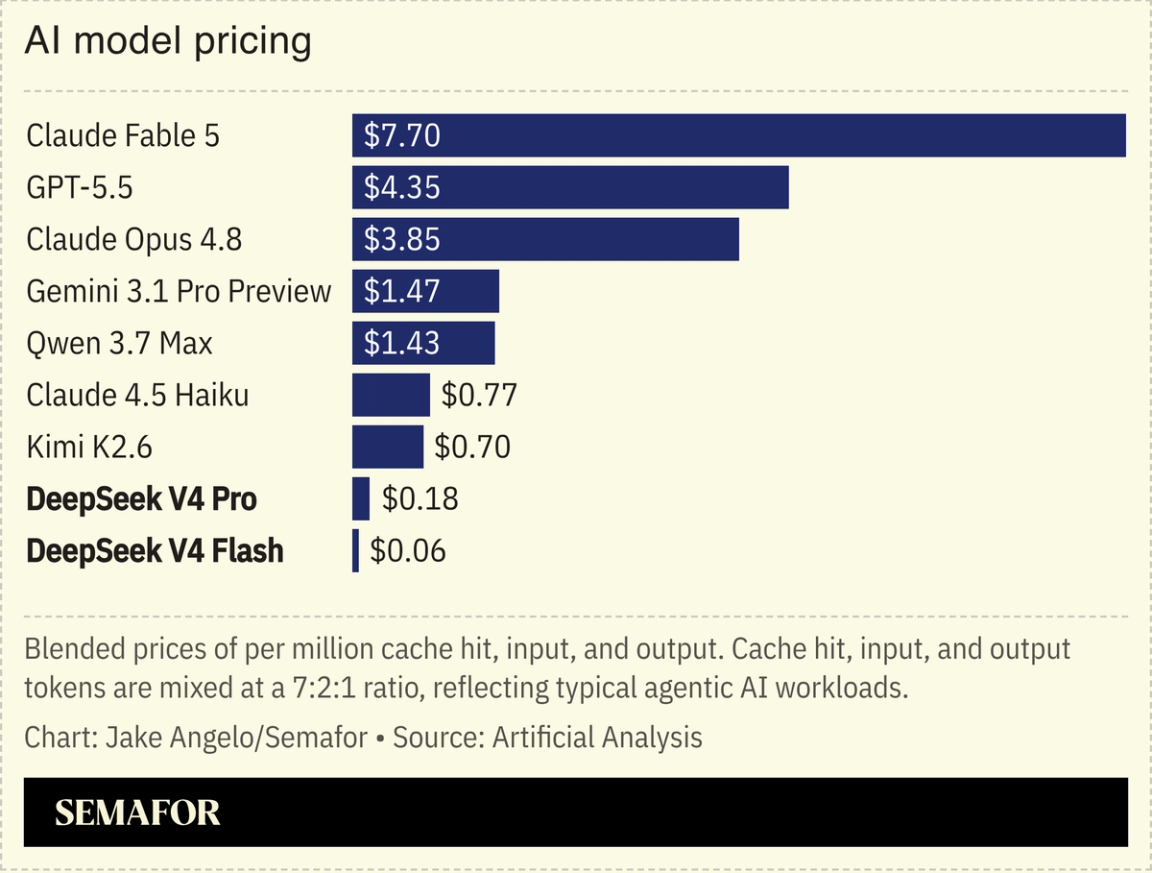 First, DeepSeek triggered a global AI price war. Now, it may be going in the other direction. The Chinese AI phenom on Thursday announced it was planning a “significant” price hike for its API services, which is how many companies around the world access and deploy DeepSeek’s cheap, open-source AI models. The warning shows how Chinese tech companies are balancing their low-cost reputation and with a need to actually make money. A week ago, DeepSeek released a hyper-cheap new coding model — a 99% discount compared to Claude Opus 4.8. But in recent weeks it’s also introduced new surcharges for its API during peak hours. The cost advantage of Chinese models is putting their American competitors on notice. OpenAI slashed the cost of its new GPT-5.6 Luna model, while Meta on Wednesday announced a new coding model, with cost central to the pitch. |
|
ByteDance forbids distillation |
 Aly Song/Reuters Aly Song/ReutersChinese tech giant ByteDance’s founder reportedly forbade AI researchers from distilling rival models, as scrutiny of the practice causes friction between Washington and Beijing. The policy reportedly dates to 2023, predating the period when “avoiding US retaliation” became a potential commercial priority, the Pekingnology newsletter wrote. Notably, ByteDance is not one of the firms American AI lab Anthropic has accused of distilling — charges that prompted US sanction threats. The guidelines sparked intense debate at ByteDance, whose best models have been surpassed by smaller Chinese labs, highlighting the competitive pressures facing the industry as Beijing presses for better AI built with less compute. US models currently offer better value, The Economist wrote, but the “convergence is likely to continue.” |
|
 Kaylee Greenlee/Reuters Kaylee Greenlee/ReutersResearchers are increasingly using AI to audit the scientific canon and are correcting decades-old errors. Chemists rely on handbooks to list chemicals’ boiling points, but one AI model disagreed with a 75-year-old reference, and turned out to be correct, Nature reported. Other tools are hunting errors in journals and conference papers. The tools are unreliable and they catch less than 20% of the errors a human reviewer would spot. But they are able to check far more, because the work is time-consuming and tedious for people. AI is creating problems for science, with low-quality or fraudulent AI-generated research on the rise, but just as it can be used for both cyberoffense and cyberdefense, it can protect scientific integrity, too. |
|
|


