|
Dear all,
Please find below your weekly update from the UK Health Security Agency (UKHSA).
If you have any questions please get in touch by emailing externalaffairs@ukhsa.gov.uk
As always, you can also follow UKHSA on X, on Instagram, on BlueSky, and on LinkedIn for all the latest updates. You can also find the latest news from UKHSA on our news page on GOV.UK.
Best wishes,
UKHSA External Affairs Team
New stories
- University vaccine communications toolkit
- Updated MenB vaccination communications toolkit
- MenB vaccination communications toolkit - leaflet translations now available
- Latest Heat-Health Alerts and useful hot weather communications resources
- NHS figures show England is on track to eliminate hepatitis C
- Book your place at the UKHSA Conference 2026 - six weeks to go!
- Addressing health inequalities in infection and antimicrobial resistant infections: a UK-wide collaborative toolkit
- Measles continues to circulate
- Updated communicable disease outbreak management guidance
- Strengthening the regulation of commercial sunbeds in England - consultation closes 14 August
- From our stakeholders: Results from the REVERSE Approach and the Road Ahead
Ongoing issues
- Sharp rise in cyclospora infections linked to Mexico travel
- UTI communications toolkit update
- New resources to support high-quality urine sample collection for suspected UTIs
- Next phase of Government childhood immunisations campaign launched
- Staying well during the 2026 festival season
- FSA urges people to avoid common food safety mistakes
- 'Be tick aware' this summer
UKHSA communications toolkits
- Information on how to access UKHSA communications toolkits
UKHSA data, analytics and surveillance
- Statistics at UKHSA
- UKHSA data dashboard
- Notification of Infectious Diseases report

Our vaccine communications toolkit has now been updated, and is available to download from the Find Public Health Resources website.
Infectious diseases can be a particular risk for new student students as they start mixing with other students from lots of different locations, and they can spread quickly.
The vaccine communications toolkit provides information to help protect students from vaccine preventable infectious diseases. It includes a range of resources on vaccines including MenACWY, MenB, HPV and MMR and the diseases they protect against.
It is essential for all university and further education settings with residential student populations. It has been produced in collaboration with the devolved administrations, NHS England and meningitis charities.
|
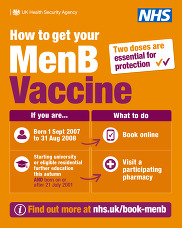
Our all-partner MenB vaccination communications toolkit has recently been updated to include a series of assets for social media (1x1s and 4x5s) explaining eligibility for the MenB vaccine to use on your own channels. We also have posters and email signatures available to download. All of these resources are available on the Campaign Resource Centre.
Ourguide for teenagers and young people being offered the Meningococcal B (MenB) vaccine has also now been translated into various community languages, and accessible formats have been added.
A reminder that the one-off vaccination programme is being offered to:
- Everyone born between 01/09/2007 and 31/08/2008
- Young people under 25 (born on or after 21/07/2001) who will be starting higher education for the first time, or who will be starting further education for the first time as a residential student, in autumn 2026
- International students under 25 entering their first year of university. They should receive their first dose in their home country where possible to give the best chance of protection ahead of the start of the autumn term
Two doses of the vaccine are needed for protection at least 28 days apart.
Those born between between 01/09/2007 and 31/08/2008 can book via the NHS National Booking Service for appointments at community pharmacies. Other eligible people can contact a participating pharmacy to book an appointment.
|
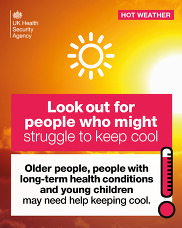
In partnership with the Met Office, UKHSA provides the Weather-Health Alerting system, which provides an early warning when adverse temperatures are likely to impact on the health and wellbeing of the population. Amber alerts are currently in place for all regions until Thursday 14 August 2026 at 9pm.
A reminder that individuals and organisations that wish to receive the heat-health alerts must register to receive the alerts where users will be able to specify which regions they wish to receive alerts for. The alert status is also publicly available on the UKHSA Data Dashboard.
We also have a series of communications resources that stakeholders might find useful for their hot weather communications:
|

New figures from NHS England show we are making significant progress towards eliminating hepatitis C as a public health threat, with over 100,000 people in England have accessed potentially life-saving treatment for hepatitis C in the last decade.
This demonstrates the impact of expanded testing and sustained access to modern curative treatments, and the commitment of health services and community partners across England. It brings England closer than ever to becoming one of the first countries in the world to eliminate this disease as a public health threat.
While the number of people living with the virus continues to decline, it remains vital that those most at risk are offered testing, can access life-saving treatments, and receive the support needed, such as harm reduction for people who inject drugs, to prevent new infections.
Partners working to reduce the harmful impact to health of hepatitis C may be interested in our hepatitis toolkit, which also provides information and resources on hepatitis B.
|
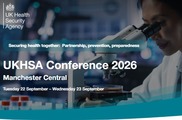
Join us for the UKHSA Conference 2026 at Manchester Central on Tuesday 22 and Wednesday 23 September. In partnership with the Faculty of Public Health (FPH), this year's conference theme is Securing health together: Partnership, prevention, preparedness.
Alongside leading voices from UKHSA, our plenary programme so far welcomes an impressive line-up of guest speakers and topics, with further announcements still to come -
- Charlotte Refsum (Tony Blair Institute for Global Change) and Saeed Alavi (Vice President for Vaccines and General Medicine, UK, GSK) on how the UK can become a global leader in health security innovation
- The BBC's Disinformation and Social Media Correspondent Marianna Spring and Cambridge University's Professor Sander van der Linden on prebunking misinformation
- Adam Kucharski (London School of Hygiene & Tropical Medicine) and Henrietta Hughes (Patient Safety Commissioner for England) on how AI could shape health security
Our featured abstracts track will also take centre stage for the first time, running alongside the main programme within the exhibition hall.
Visit the conference website for the latest information and to book your place. If you have any questions, please contact the conference team at conference@ukhsa.gov.uk.
|
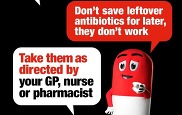
The UK’s National Action Plan (NAP) for Antimicrobial Resistance (AMR) 2024 to2029 sets out a coordinated strategy to reduce infections, optimise antimicrobial use, drive innovation, and strengthen the UK’s global leadership in tackling AMR
To support this strategy, a toolkit has been developed which brings together contributions from national, regional and local partners to support organisations in identifying and addressing health inequalities related to AMR. The toolkit collates and signposts to existing resources to enable a coordinated, UK‑wide approach while remaining adaptable to local contexts. It has been co-developed through collaboration across all 4 UK nations as part of the UK’s National Action Plan (NAP) for AMR 2024 to 2029.
|
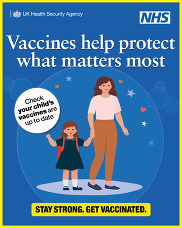
Our latest measles data shows that measles continues to circulate in many parts of the country.
Between 1 January 2026 and 3 August 2026, there have been 953 laboratory confirmed measles cases reported in England, an increase of 20 cases since the last report on 20 July 2026.
The majority (585 out of 953, 61%) of these cases were in children aged 10 years and under, and 32% (310 out of 953) were in young people and adults aged 15 years and over. A total of 51% (490 out of 953) of these cases have been in London, 16% (150 out of 953) in the West Midlands, and 10% (96 out of 953) in the North West. However, all regions have reported at least one confirmed case with symptom onset since January 2026.
Three measles-related deaths have been reported to date in 2026: one was an acute measles death in a child, another was a death in a child due to late effects of measles, and the third was a death in an adult with an underlying immunological problem.
We continue to work with partners to urge parents to check their children are up top date with their MMR or MMRV vaccines to give them the best and safest protection against measles.
Further resources
- We have a measles communications toolkit which brings together a range of resources which partners can use to raise awareness of measles, its signs and symptoms, and the MMR/MMRV vaccination offer. This is available on our Google Drive.
- We also have a measles communications toolkit which brings together a range of resources which partners can use to raise awareness of measles, its signs and symptoms, and the MMR/MMRV vaccination offer. This is available on our Google Drive.
|
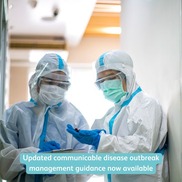
The Communicable Disease Outbreak Management Guidance has been updated.
This guidance has been developed jointly by the UK Health Security Agency (UKHSA), Association of Directors of Public Health (ADPH), Chartered Institute of Environmental Health (CIEH), Faculty of Public Health (FPH), Food Standards Agency (FSA), Local Government Association (LGA), and NHS England (NHSE). It sets out how communicable disease outbreaks in England should be managed at a local level and provides a shared framework for collaboration across public health structures and other relevant organisations."
Following the review and publication of the updated guidance in January 2025, feedback has been collated from users and partners to support further improvements to the guidance, this includes updates to reflect legislative and commissioning changes, links to additional resources, additional information around the role, governance, escalation and documentation of IMTs and a Plain English guide to IMTs for settings and voluntary, community and social enterprises.
You can continue to provide feedback on the guidance via the dedicated inbox cdomfeedback@ukhsa.gov.uk or survey available on the Guidance landing page
|
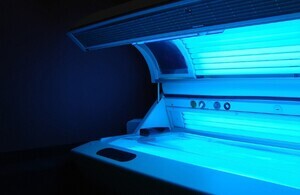
Children could be stopped from using sunbeds through mandatory ID checks, under new laws being consulted on by the Department of Health and Social Care.
Evidence shows that using sunbeds is linked to an increased risk of skin cancer and other health problems. Under 18s are already barred from using sunbeds but teens often get around these rules through using contactless systems that let anyone tap and tan without any checks by a staff member.
The new proposals would require staff to be present and check a customer’s ID before they can use a sunbed. The proposals would also mean that health warnings must be clearly displayed, and dangerous claims that sunbeds help with weight loss or prevent sunburn would be banned.
This consultation seeks views on proposals that aim to strengthen protections for sunbed users, particularly for young people and those most vulnerable to harm caused by ultraviolet (UV) exposure. The proposals will promote responsible practices among businesses providing use of sunbed services.
The consultation on strengthening the regulation of commercial sunbeds in England is open until 14 August 2026.
|
|