Paris’s e-scooter crackdown, Singapore’s creative career push and a minimalist microwave from Panasonic.
|
Thursday 20/8/26
|

|
|
London
Paris
Zürich
Milan
Bangkok
Tokyo
Toronto
|
|
|
|

Good morning from Midori House, where we are basking in the radiance of Monocle’s September issue – on which there is more below. As ever, for news and views from around the world, tune in to Monocle Radio. Here’s what’s coming up in today’s Monocle Minute:
THE OPINION: Live and learn with our September issue
TRANSPORT: Paris’s new e-scooters rules cause confusion
DAILY TREAT: Turn up the heat with Panasonic’s minimalist microwave
IN PRINT: Singapore’s creative career push
THE LIST: Stories you might have missed
|
|
There’s plenty to learn in our September Education Special
By Andrew Tuck
|

|
Don’t sit next to me at dinner. It’s not that my table manners are that bad – it’s just that one minute you will generously be telling me some interesting fact about your life, then the next I will be suggesting that you should tell this story to Monocle’s readers. Perhaps pen a few hundred words or jump on
Monocle Radio.
It’s a warning that I offer to my team at Monocle too. Earlier this year, when we were in Shanghai for our Entrepreneurs Live conference, I was able to spend time with our Asia editor, James Chambers. He happened to mention that he and his wife had decided to home-school their two children; more than that, they were “unschooling” them, letting their offspring help choose what they wanted to do and learn every day. James explained that it was going well – his children are inquisitive and, already, instinctively, excelling in languages and mathematics (James’s wife is Chinese and they are based in Bangkok, so there are lots of linguistic opportunities).
So, of course, when we started planning this issue themed around knowledge, lifelong learning and education, James found himself swiftly commissioned to write an essay about the experience and how we should all question how children are taught. His is just one of many fascinating looks at education over the following pages but I am delighted that
he has told his story – one that challenges us all to question how we should teach young people.

|
And we definitely need some new thinking because
AI is set to undermine many of the old certainties about work and life, forcing governments to scrub down their national curriculums as they think how to help young people gain skills that won’t be erased by machine learning. One of the big shifts that we are seeing is a re-embracing of the value of learning a manual trade. That’s why for this issue we also set out to find “masters and apprentices” in everything from shoemaking to boatbuilding to hear about the growing allure of working with your hands. I was struck by how, in Australia, an advertisement for a
plumbing apprenticeship received 300 applications and also by the relationships between all these teachers and students. One skilled educator can reorientate a life.
I was diligent but slightly plodding at school and only found my footing once I reached university, where I could follow my own path more and teach myself. So, while I did all the prescribed reading for my course, I also lost myself in books about art and design, took myself to the theatre and to see arthouse films and started writing for the university paper. When I began looking for work, I knew that I had to find a way into journalism and somehow landed an internship at
Time Out in London. There I met Tony Elliott, the title’s founder, who was probably the first person to see in this awkward but keen young man someone who might be worth employing – and a long career in journalism commenced. Often, that’s all anyone needs: some mentoring, a few words that help focus a young mind. That’s why we have asked
25 successful people to tell us about the one life lesson that they most cherish; the one piece of advice that provided a ticket to a different future.
Among
the answers are numerous nuggets of inspiring wisdom. Gildo Zegna, of the famous fashion house, says that he has been guided by his grandfather’s advice to “do what’s right, not what’s convenient”. Automotive CEO Klaus Zellmer urges you to “be bold enough to step into unfamiliar territory”. I also like architect Amanda Levete’s belief that you should “hold onto your passion. You can figure out the rest as you go.” Perhaps it resonates because I think that this has been my plan too.
I hope that you enjoy our September offering – and learn a few things along the way. And if you would like to send me a report card, perhaps even a gold star, you can always find me at
at@monocle.com. Here’s to staying inquisitive.
Andrew Tuck is Monocle’s editor in chief. For more opinion, analysis and insight, subscribe to Monocle today.
|
|
urbanism: FRANCE
Paris attempts to makes e-scooters even less cool
France’s relationship with the
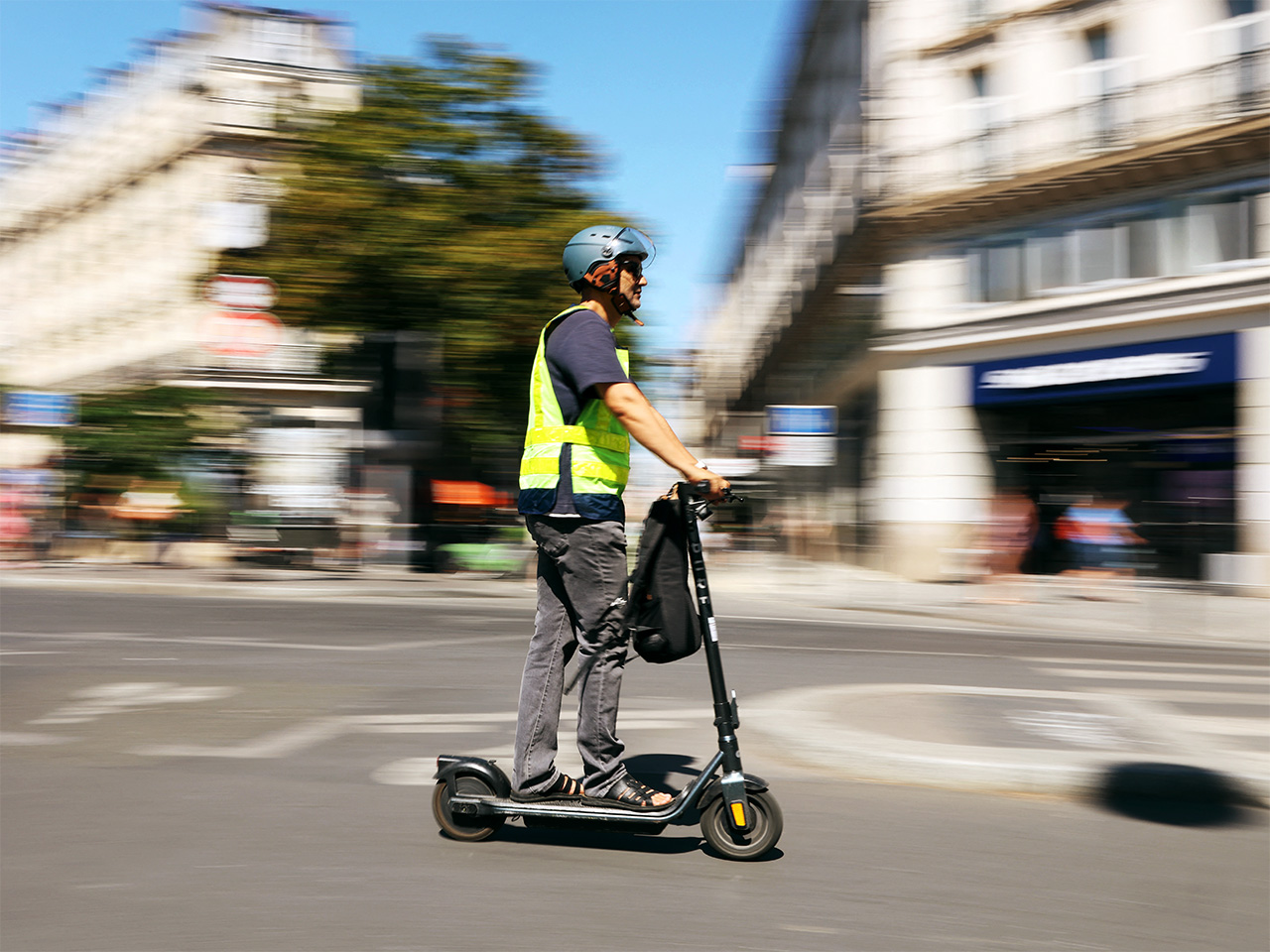
trottinette is a complicated one (writes Chloé Nakao-Pélata). Electric scooters have been both a boon and bane in the country, responsible for a rising number of road fatalities – 79 last year – but also increasingly adopted for urban mobility (some 2.5 million people own e-scooters nationwide). In an attempt to curb the former, the Paris Police Prefecture introduced a rule two weeks ago requiring riders to wear helmets and hi-vis vests or else face hefty fines (€135 and €35 respectively). Considering that at least 1,100 people were injured in accidents involving
trottinettes in the French capital last year – an increase of 33 per cent from the year before – the law makes sense.
|
|
|
Speedy changes: Paris has quickly adopted new e-scooter regulation
|
|
The problem is that, judging by the number of indignant helmetless and unvested scooter riders receiving fines from stern-faced gendarmes in Paris this week, news of the decree has not reached the streets. The order landed on a Friday in early August, when the city was deep into its annual summer disappearing act. Though the prefecture said that the timing was deliberate, allowing riders to purchase the necessary equipment ahead of the early September
rentrée,
Le Figaro has reported that not even city hall was aware that the measure would be implemented so quickly. A referendum in 2023 banished rental e-scooters from Paris but their use by private owners is still widespread. Could the introduction of mandatory
gilets jaunes finally free the city from the scourge of the
trottinette by making its riders look terribly unchic? Here’s hoping.
|
|
• • • • • DAILY TREAT • • • • •
Try out Panasonic’s minimalist microwave
Has the microwave fallen behind in an era of high-speed, intelligent kitchen appliances? Panasonic certainly thinks so: welcome the Japanese Countertop Microwave, or NN-SF57RM to give it its official name.
The Osaka-headquartered manufacturer has redesigned the clunky turntable-in-a-box’s overcomplicated interface and side-swinging door to create something a little more intuitive. And don’t worry, your food will no longer be unevenly cooked – Panasonic’s heat sensor detects steam levels to figure out when the heating process has run its course. Hot stuff.
panasonic.com
|
|
IN PRINT:
SINGAPORE
The secret sauce to Singapore’s clever population? A push for creativity and curiosity
Medicine, law and engineering have long been the holy trinity of Singaporeans’ career aspirations (writes Joseph Koh). But the city-state’s politicians hope that this won’t be the case for much longer. “The country would like students to have a broader definition of success,” says Vincent Chua, an associate professor at the National University of Singapore (NUS). Years of rote learning and high-pressure exams have laid the foundations for growth here but, as the economy evolves, education is refocusing on ways to foster entrepreneurship, risk-taking and resilience. So, while the world is worrying about engineering and Stem subjects, Singapore is establishing new design schools and encouraging the
study of the arts.
“In an industrial economy, there’s only one peak, which is the academic peak,” says Chua. “Going forward, we want to have multiple peaks: a mountain range where different people can excel in their respective areas.”

|
One peak has already been conquered. NUS, which sits at the apex of a world-leading education system, is the highest Asian institution in the 2027 QS World University Rankings. In 2022, Singapore’s students came top in mathematics, reading and science in the OECD’s prestigious Programme for International Student Assessment (Pisa) rankings. The following year, they finished first in the International Mathematics and Science Study (TIMSS) for the third time in a row. Alongside academic success has come government-level recognition of the fact that the old, hard-nosed education system undervalued the importance of creative and technical skills. “The old model has its limitations. It gets you far but it doesn’t always bring you to the top of the innovation chain,” says Chua.
So how has Singapore learned to mix things up? Click here to read the full story.
|
|
| | |