The White House press secretary is leaving. Reporters fear what’s next.
AUG 20, 2026
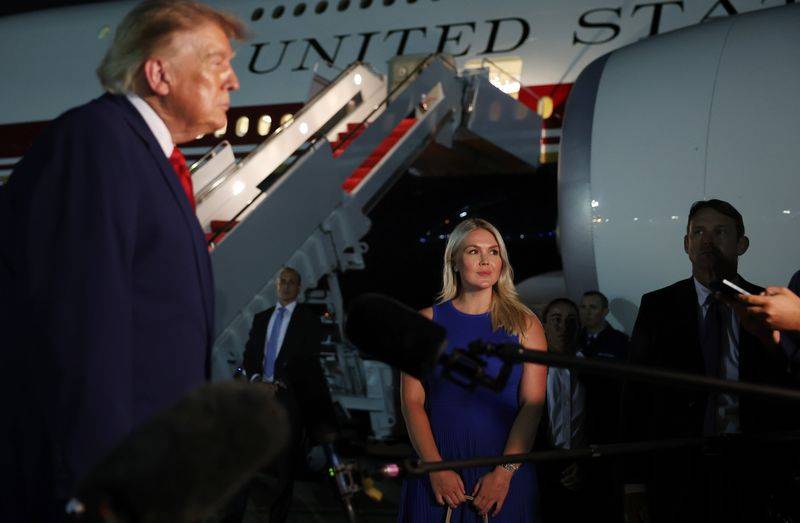
In the early hours of the morning, Air Force One hurtled across the Pacific Ocean toward Anchorage. There it would refuel before taking off again for the final destination of Joint Base Andrews. The president and his staff were returning from a whirlwind swing through Asia that featured meetings with China’s president Xi Jinping and Japanese prime minister Sanae Takaichi, as well as the presentation of one very large gold crown.
On Air Force One, somewhere above Alaska, White House communications director Steven Cheung gazed out at the Northern Lights. A brilliant streak of emerald cut across the night sky. He posted a photo on X: “BEAUTIFUL!” Nine minutes later, he followed up with another tweet.
“Didn’t you get fired from CNN for banging a source?”
Cheung was responding to a journalist who had criticized a pro-Trump commentator on X. Moments before, Cheung had called a former Trump official “a loser” with “no pull, no juice, no stroke.” A few hours later, he bashed the “failing New York Times” and accused a reporter of having “Beta cuck vibes.”
That burst of belligerence is par for the course from Donald Trump’s second-term communications team, which has evolved from the 2024 campaign to be more polemical, more trollish, and more online than ever before. “It’s the Barstoolification of the White House press shop,” one White House reporter tells me. In his second term, Trump finally has a media team that operates as a pure extension of his own id. “They see this as a campaign,” the reporter says. “It’s what the boss wants. It’s what the base wants.”
But behind the scenes, Trump’s team has maintained a professional and oftentimes helpful relationship with the press under the leadership of Karoline Leavitt, the young and ambitious press secretary who announced her imminent departure earlier this month. When she leaves, the administration will lose the official who made its peculiar relationship with the press work.
Not that Leavitt was ever a peacemaker in the conventional sense. She helped turn the White House podium into another front in Trump’s war on the media, ridiculing reporters and defending restrictions on their access. But she also became the administration’s indispensable broker with the same journalists, close enough to Trump to know what was happening and trusted enough on both sides to prevent routine hostilities from devolving into chaos. Now Cheung will become the West Wing’s most prominent communications official. It’s a prospect that some in the White House press corps are dreading.
Puerile combat has defined Cheung’s performance in the second term. He used to regularly post CNN’s ratings to mock the network, to the point that I’m told a CNN executive called him to ask that he stop. Last fall, Cheung told a New Yorker writer to “shut the fuck up.” After a White House official joked on X that liberal influencer Harry Sisson should receive a spanking, Cheung wrote that Sisson “might actually like that” because he’s a “sick freak.” When people expressed concern about the 250-foot triumphal arch Trump wants to build in Washington, Cheung suggested they had small penises. Last week, he called a former House Republican a “dildo.”
It’s not just the communications director, either. The press shop has taken up Trump’s habit of assigning crude nicknames to the reporters who cover the West Wing, multiple sources tell Vanity Fair. Garrett Haake, the NBC News correspondent, is often called “Garrett Fake”—including on the calendar when he’s booked to meet with White House officials. (One White House official says the nickname is a term of endearment and is often said directly to Haake’s face. “I can confirm this,” Haake says with a laugh when reached for comment. “I’ve been called worse in my career.”) During the 2024 campaign, two female reporters were dubbed “Alienhead” and “Pigface,” one source said. (A downside of reporting this information is that almost every journalist I spoke with asked me what their West Wing nom de guerre is.) The name-calling has spilled out into public view: White House aides called MS NOW reporter Jake Traylor “Fake Jake Traylor Trash” for months internally before posting the name on X.
The comms team in Trump 2.0 has paired this aggressive public posture with a campaign to restrict access. They stormed into office last year and seized control of the press pool, banned the Associated Press, and flooded the briefing room with pro-Trump influencers who lent the briefings a distinct whiff of Pyongyang. The White House barred reporters from “Upper Press”—the suite of offices down the hall from the Oval that houses the press secretary and other senior aides—without prior appointment. The rules restricted the ability of reporters to obtain impromptu information from high-ranking officials or to check in with the communications team during breaking news events.
And Leavitt has had her own moments of combative partisanship. Last year, she caused a stir by replying to a reporter’s request for comment with a “your mom” joke, and took up a habit of labeling reporters she doesn’t like “left-wing hacks.” She’s also a dutiful defender of Trump’s personal attacks on reporters. (Lately: He instructed CNN’s Kaitlan Collins to “smile” and likened her appearance to that of trans influencer Dylan Mulvaney. He attacked New York Times reporter Katie Rogers after she wrote about his age, calling her “ugly, inside and out.” He told Bloomberg reporter Catherine Lucey, who asked him a question on Air Force One, “Quiet, piggy.”) When asked about the mud-slinging in a press briefing, Leavitt said reporters should be grateful: “I think everyone in this room should appreciate the frankness and the openness that you get from President Trump on a near-daily basis.”
Despite Leavitt’s bouts of public belligerence, some journalists maintain that the press secretary’s sunny professionalism off-camera is what helped keep the communications shop operational. “I’m just being completely honest with you, I like Karoline,” says one top White House reporter. “I think she’s charming and funny and gossipy, and her behind-the-scenes persona is totally different from the Baghdad Bob rants at the podium.”
The operation that Leavitt oversees is an instinctive extension of Trump himself, who has spent decades attacking reporters in public while fielding their calls to gossip with them in private. “This is an administration and president that craves the adulation and approval of mainstream media,” a third White House reporter says. Earlier this year, Trump invited four reporters from The New York Times, a newspaper he is suing for $15 billion, into the Oval Office for a nearly two-hour interview. This courtesy also extends to The Wall Street Journal, which he’s suing for $10 billion.
“They want to be seen as beating up on the press,” another White House reporter says. “But behind the scenes, they’re super professional. They take reporters’ calls, they interact with reporters, even if they’re from outlets that might not write the best thing about them. They understand the need to talk with the press, to spin the press, and they understand that just shutting down reporters results in worse coverage rather than better coverage.”
“One principle is we respond to everything,” a White House official tells Vanity Fair, adding the press shop receives more than 200 inquiries each day. “The president reads everything. So her practice was that we had a response or quote in everything.”
It helps too that Leavitt boasts a distinction held by few in Trump’s orbit: She’s almost always in the room. “She was in every meeting with Trump, she was read in on every decision,” one White House reporter explains, “and that helped her work with reporters she had a relationship with.” Leavitt “actually has close access to the president,” another reporter says. “She’s not a spokesperson in name only, like [the Biden administration press officials], who didn’t know what the fuck’s going on and were sitting down the hall and just giving the canned spin without any sort of visibility in anything.”
Cheung is also “always with the president” and works with reporters he has relationships with, says a White House official. “Karoline and Cheung take meetings with the press all day,” says another reporter, adding that, before Upper Press was closed off, Cheung’s office was “always open” and there was “often a line of reporters waiting to meet him that stretched into the hallway.”
One senior official in the Biden administration says they are often told by reporters how much better the Trump administration has been to work with. “They’re incredibly proactive about making sure reporters have information,” the Biden official says. “Whereas the Biden press shop made reporters’ lives as difficult and challenging as possible.” They claimed that the Biden team could even be “punitive” when reporters came to them for comment on scoops. “The White House would lie and say, ‘No, you’re wrong. You’re crazy.’ But then they’d give [the story] to somebody else.”
Not everyone enjoys the bounty of a professional press shop in Trump’s second term, however. Some progressive journalists get knocked around regularly. S.V. Date, the HuffPost reporter who was subjected to a barrage of “your mom” cracks, has had a tough time getting statements. “This started the day they came back into office,” Date says in an interview. “They get downright abusive.” In texts shared with Vanity Fair, Cheung called Date “a little fucking bitch” in a dispute over a story.
The public pugnacity is an “entirely intentional” strategy, says one former Trump communications official. “It does two things. Number one, there is an online right community, some of the president’s biggest defenders, [who] have these megaphones, and it engages them. But two, it just gets the message out, because it’s funny, frankly. It gets attention. It’s easier to break through.”