Lumina Foundation is working to increase the share of adults in the U.S. labor force with college degrees or other credentials of value leading to economic prosperity.
Colleges and universities offer a wide range of resources designed to help students succeed, but having those supports available doesn’t necessarily mean students know where to find them. For students juggling food insecurity, housing challenges, financial strain, or other gaps in basic needs, navigating a web of campus offices can be another barrier to getting help.
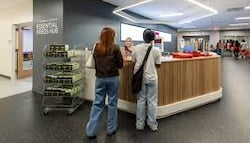
Some institutions are trying to eliminate that burden by making it dramatically easier for students to access help. Temple University is betting that one way to do this is by putting all essential needs support under one roof.
International students across the Midwest and elsewhere throughout the United States have experienced uncertainty and concern since the second Trump administration began. Specifically, the U.S. Department of Homeland Security has limited student visas, partially or completely banned travel from 39 countries, and restricted grace periods before and after studying.
Reporter Steph Conquest-Ware examines how these policies are affecting international enrollment, as well as the financial health of many colleges and universities.
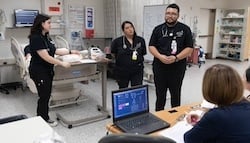
To graduate, nurse practitioner students must spend at least 500 hours working with patients in a clinical setting with a supervisor, known as a preceptor. Forty-five-year-old Yesenia Raithel Vargas needed to find preceptors licensed in psychotherapy and medication management. Bridging classroom theory and real-world experience, preceptors train nursing students, provide feedback, and evaluate their performance, playing a major role in whether or not they pass.
But there are not nearly enough of these preceptors willing to take on students—and that threatens to choke off a supply of medical professionals the country urgently needs.
Giles Sims, 34, was sick of getting passed over for jobs because he didn’t have a college degree. But with a wife and a widowed mother to help support, he needed a quick solution. So the laid-off web developer turned to one of a growing number of three-year degree programs.
The condensed programs have exploded in popularity. As of this spring, 26 U.S. states have a college that offers at least one reduced-credit, three-year bachelor’s degree. Advocates say these programs are a solution to the college affordability crisis and a godsend for non-traditional students like Sims. Critics, however, worry that they’ll narrow too much what students learn, confuse employers, limit graduate school options, and create headaches in fields that require state licenses.
What does an A in calculus actually indicate? That question has become unexpectedly urgent as more colleges confront a growing disconnect between the academic records students present during admissions and the skills some demonstrate once they arrive on campus.
Colleges now face a significant measurement challenge, prompting schools to identify more reliable ways to assess true academic preparedness when traditional credentials prove increasingly unreliable.
A conflict is intensifying between California’s public universities over the granting of degrees.
For decades, the University of California and California State University have had the exclusive right to award bachelor’s degrees, while the state’s expansive network of community colleges has been largely excluded from this process. Two bills now being debated by the Legislature would disrupt that near duopoly, mounting the greatest challenge in years to lines of authority in higher education that have gone largely unchanged since 1960.