| |
| |
| |
Hi,
This morning, energy regulator Ofgem announced the latest Energy Price Cap, which will rise by 3.6% in October, even after the Government's VAT cut.
The Price Cap dictates what households on firms' standard default tariffs will pay for energy between October and December 2026. But you can beat the hikes by doing a whole-of-market comparison and switching away from the Price Cap.
So, we wanted to give you Martin’s reaction to the announcement, including the key actions to take...
 "(BAD) NEWS: The Ofgem Energy Price Cap for England, Scotland and Wales for the three months starting 1 October is to RISE 3.6%, even when you include the Government's six-month cut to electricity VAT that starts the same day. "(BAD) NEWS: The Ofgem Energy Price Cap for England, Scotland and Wales for the three months starting 1 October is to RISE 3.6%, even when you include the Government's six-month cut to electricity VAT that starts the same day.
"When the July Cap rose by 12.6% the mitigating fact was that it was only for the low-use summer quarter. Now it will rise 3.6% ON TOP of that, so rates will be nearly 17% higher than they were in April over the high-use winter period. Prices are the highest they've been since winter 2023.
"Here are the new 1 October Price Cap Direct Debit average UK rates (they do vary by region) including VAT when it's charged...
- Elec unit rate: 26.32p/kWh (was 26.11p) – UP 0.8%.
- Elec standing charge: 54.83p/day (was 57.19p) – DOWN 4.1%.
- Gas unit rate: 7.97p/kWh (was 7.33p) – UP 8.7%.
- Gas standing charge: 29.68p/day (was 29.04p) – UP 2.2%.
"It would've been even worse without the electricity VAT cut, as otherwise on 'typical use' it would've been a rise of roughly 6.2%.
"It also means those who with electricity-only use rather than gas too will see a much lower rise, and some on very low electricity-only usage may see a slight fall, as the electricity Standing Charge has been cut (mainly due to the scrapping of VAT).
"Ofgem says someone on what it calculates to be 'typical use' would see their equivalent annual cost rise by £60. Yet that's a bit misleading as the Cap only lasts three months and changes again on 1 January 2027 and sadly it's currently predicted to rise substantially again then, though that's a bit of crystal-ball gazing.
"IMPORTANT: The Price Cap only applies to Standard Tariffs… it dictates the maximum unit rate and Standing Charges firms can levy on their Standard Variable Tariffs (which around 60% of homes are on).
"Standard tariffs are the default you're on if you've never switched or your fix deal ended and you did nothing. If you're fixed, or on most special tariffs, you are not on the Price Cap so its change doesn't usually impact what you pay.
"Q. Why is this happening? The vast majority of the rise is the spike in wholesale rates caused by the Middle East conflict. The October Cap is set on an average of wholesale prices from 19 May to 18 August, and they were high throughout the entire period. Worse, they've kept climbing since, which is why the prediction for January is for it to get even worse.
"Q. Wasn't scrapping VAT meant to stop this? It was designed to shift some costs off bills and into general taxation, and it does – but it's a drop in the ocean compared to the rise in wholesale rates.
"Plus, it's only VAT on electricity that's gone, which cuts electricity costs by 4.8%, all else being equal, yet all else isn't equal, hence the overall rise. The VAT scrapping is worth about 2.5% off the Cap, without it, prices would've risen more.
"Q. What happens to those on fixes? The electricity VAT cut for six months from 1 October applies to all tariffs, so those on fixes will see what they pay for electricity drop too. Otherwise fixes are unaffected by the Price Cap move (until the fix ends, when you're moved by default onto a price-capped standard tariff unless you choose to fix again).
"Q. Is it time to fix if I'm on the Price Cap? The cheapest fixes are currently 7% less than the current Cap, so roughly 10% less than October's. With the Cap predicted to rise again in January, they look a decent bet. Your cheapest depends on usage and location, so use my whole-of-market by default comparison site which also has a 'Pick Me A Tariff Tool' if you're not good at deciding.
"Though it's worth noting fixes were quite a bit cheaper about six weeks ago. If, and it's a big if, things in the Middle East settle down you may be able to fix at far lower prices in future (equally things could get even worse).
"So if you're someone who has been on the standard tariff for ages then the safest thing is just to get a cheap fix now (not just any fix, ensure it's as cheap as possible, don't just stick with your own firm). Though if you're a regular fixer who'll monitor the market, there's a chance waiting may turn out to be better.
"There are other options than fixing too. For lower users, British Gas has a Cap Tracker that matches the Cap rates but knocks £60 off Standing Charges for a year (plus £20 dual-fuel cashback via MSE). And there are EV tariffs and time-of-use tariffs that are worth a look."
|
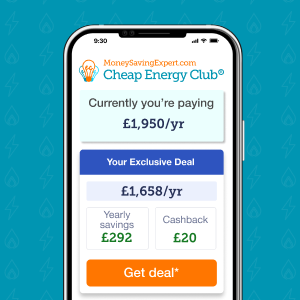
Your cheapest tariff depends on your region and usage level, so use our Cheap Energy Club comparison to find your winner. Though remember, comparison sites (including Energy Club) will currently show savings compared to the current Price Cap (or your current tariff if you're on a fix), as firms' October Price Cap rates haven't been published yet. But come October, the savings will be more substantial.
PS: The market is volatile so prices can change, and new tariffs can come in, but the links above are via our comparison, which is always updated.
Thanks,
The Cheap Energy Club team
You're getting this email because we think you're on a Price-Capped tariff (or on a fix ending soon). Not right? Update your details in Cheap Energy Club.
Not sure if you’re currently on the Price Cap?
If you're not on a fix or special deal, you are likely to be on the Price Cap. These are firms' standard default tariffs, often called 'Standard Variable' or 'Flexible' tariffs. Still not sure? Use our new Energy Price Cap checker tool.
|
| |
|
|
|
| |
|
|
| |
| Use Energy Club in the MSE app |
| |
| You can now easily check and compare energy tariffs in the MSE app. |
| |
|
|
| |
|
| |
|
|
|
|
This email has been sent to dupa@niepodam.pl. If you have received this email in error, please notify us immediately at energyclub@moneysavingexpert.com.
Important. What you need to know about how MoneySavingExpert.com works.
We think it's important you understand the strengths and limitations of this email and the site. The info we provide does not constitute financial advice, always do your own research on top to ensure it's right for your specific circumstances - and remember we focus on rates not service.
We don't investigate the solvency of companies mentioned, but there is a risk any company can struggle.
A core part of Cheap Energy Club is we keep you up to date with everything we think you need to know - whether it be a tariff that'll save you money, or a Price Cap or regulatory change. We do this via email and/or push notification (if you have our app). We may also in future restart our 'savings alert' service.
See more info about how Cheap Energy Club uses and looks after your personal information in our Terms & Conditions and
Privacy Policy.
This email is sent to you as part of the Cheap Energy Club service. If you no longer want to receive these emails, you'll need to delete your account.
Martin Lewis is a registered trade mark belonging to Martin S Lewis.
|
|
|
|
|
Email reference ID: dfdb6270ebb38645d734ea01f6a8b5ecb4a8c8e1
|
|
|
|
|