What matters in U.S. and global markets today

Start the day with Reuters on the stories moving U.S. and global markets. Subscribe for $1/week.


Morning Bid U.S.

Morning Bid U.S.

A Reuters Open Interest newsletter

What matters in U.S. and global markets today


By Mike Dolan, Editor-at-Large, Finance & Markets

Whatever doubts people may have about AI demand, Nvidia's results certainly don't show it. The $5 trillion chip juggernaut comfortably ticked all the boxes yet again with its quarterly update yesterday. Meanwhile, U.S. PCE inflation came in slightly hotter than anticipated ahead of the start of the Federal Reserve's Jackson Hole Symposium. 

I'll get into that and more below.

But first, check out my column on why Fed Chair Kevin Warsh may need to be careful what he wishes for as he seeks to resurrect monetarism. 

And listen to the latest episode of the Morning Bid daily podcast. We discuss Nvidia's blockbuster results and what investors should be looking out for in Wyoming.

Subscribe to hear Reuters journalists discuss the biggest news in markets and finance seven days a week.


Data refreshes every time you open this email. For more U.S. market news, click here. Please send any feedback to morningbid@thomsonreuters.com.


Today's Market Minute

  • Nvidia on Wednesday forecast a 70% jump in revenue next fiscal year, underscoring unabated demand for AI computing, while warning that shortages of memory components would continue to curb how ‌quickly it can expand.
  • Friday marks six months since the U.S. and Israeli bombing of Iran triggered a conflict that has disrupted global energy supplies and sent ripples through global financial markets. Check out Reuters analysis of the war's widespread market impact.
  • Meta Platforms will pay up to $18 billion over the next decade and strictly limit how teenagers use Facebook and Instagram under an agreement with nearly all U.S. states to resolve claims it designed those social media platforms to addict children.
  • Asia's imports of crude oil in August are still well short of levels prior to the start of the Iran conflict, raising further questions as to just how much crude is actually leaving the Middle East, explains ROI Asia Commodities Columnist Clyde Russell.
  • The world's energy traders are sending a consistent message about 2027: They do not expect global energy markets to become calmer anytime soon. ROI Energy Transition Columnist Gavin Maguire breaks down the current environment in seven charts.
 

Nvidia vaults over high bar

Nvidia's stock rose almost 5% overnight after the chip giant beat estimates and reported that its data center revenue more than doubled over the past year, with 70% sales growth projected in 2027.

Reports that Nvidia is planning to buy recently-hacked AI platform Hugging Face for $13 billion did little to douse its stock.

Beyond Nvidia, upbeat results from business software firm Salesforce and cybersecurity company CrowdStrike saw both their share prices leap more than 10% before today's bell.

These moves rippled across the AI chip and infrastructure world, with South Korea’s chip-heavy KOSPI rising 1.5% on Thursday. However, Japan's Nikkei dipped slightly, weighed down by Nvidia supplier Advantest, reversing early gains.

In other tech news, Meta Platforms agreed to pay up to $18 billion over the next decade and strictly limit how teenagers use Facebook and Instagram to resolve claims that it had designed these social media platforms to addict children.

The other big news of the day was the release of slightly-hotter-than-forecast U.S. PCE inflation for last month, with annual headline and core rates of the Fed’s favoured price gauge running at 3.7% and 3.3%, respectively. One component pushing up prices was, perhaps unsurprisingly, memory chips, which represent a larger share of the PCE index than the consumer price basket.

This inflation report offered little to cheer Fed officials as they get set to start their annual Jackson Hole conference, where Chair Kevin Warsh gives a keynote speech tomorrow.

Elsewhere, oil prices kept slipping lower, with news of more diplomatic talks between Gulf states. Iran and Oman are working to finalize details of an agreement to control the Strait of Hormuz, according to a senior Iranian source.

Finally, in Europe on Wednesday, European Central Bank officials indicated the ECB was preparing another rate rise next month, with  little appetite for further hikes after that. European bond markets are bracing for that rate move and the start of what could be a tense government budget season in France and elsewhere.

With that, onto today's column.


Monetarist resurrection, or timely rethink of inflation targeting?

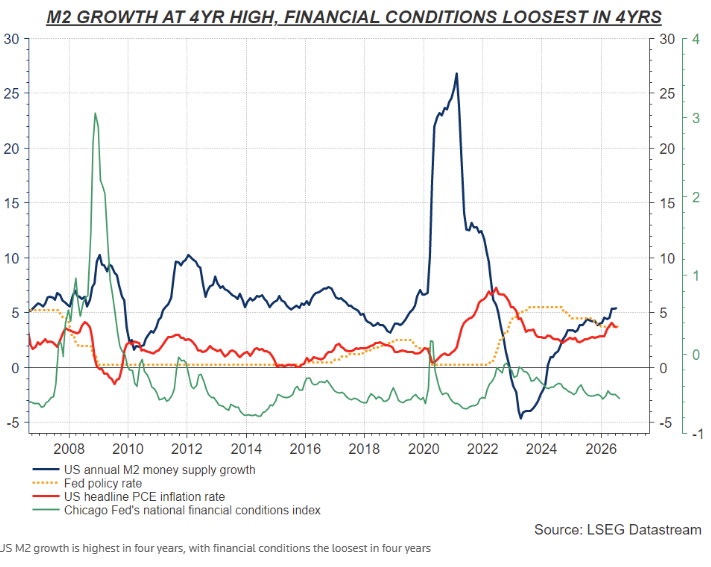
Be careful what you wish for. In reviving the Federal Reserve's long-dormant money-supply debate, Chair Kevin Warsh has created a headache for himself — and for the U.S. president who appointed him. Many of those most likely to cheer his monetarist turn are also most likely to want interest rates higher, not lower.

Some of the biggest critics of using inflation targeting alone to guide the Fed toward its mandate of stable prices think the wider financial picture and the current AI investment frenzy are reasons to consider whether policy is tight enough.


Graphics are produced by Reuters.