| | In today’s edition: The US and Iran trade fire for the first time in a month, Saudi firms scrap IPOs͏ ͏ ͏ ͏ ͏ ͏ |
| |  Larak Larak |  Washington DC Washington DC | Riyadh |
 | Gulf |  |
| |
|
 - US and Iran trade fire
- Ending Iran’s Dubai trade
- More Saudi IPOs pulled
- War divides Gulf stocks
- Two very stable coins
 50,000 pack Dubai’s Palestine festival. |
|
Strikes resume six months into Iran war |
 Iran footage purporting to show missiles launched at US military targets in Jordan. WANA News Agency via Reuters. Iran footage purporting to show missiles launched at US military targets in Jordan. WANA News Agency via Reuters.Six months into the Iran war, hopes for a return to routine were once again frustrated after the US and Iran traded fire for the first time in about a month. Students across the Gulf are back in school, and executives were optimistic that the return of US diplomats, more normal air travel, and Washington’s focus on “maximum pressure” through sanctions would help revive activity. The region has grown accustomed to embargoes: The Islamic Republic has survived numerous sanctions for 47 years, while Gulf economies have thrived despite the turmoil around them. As long as the war was economic, there were reasons to be upbeat. The “kinetic” side of the pressure campaign is more damaging. The US said it struck Iranian rocket launchers preparing to mine the Strait of Hormuz early Monday, and Tehran responded by targeting the Gulf and Jordan. Iran also said a supertanker was hit by two mines in Hormuz. Oil rose to near $91 a barrel. On the political front, there are no signs of a shift in Iran’s policy toward its neighbors. The still-unseen supreme leader urged Gulf states to unite with Tehran against their “real enemy,” Israel and the US. Gulf pundits reacted with incredulity. A prominent anchor on Saudi-owned Al Arabiya TV reminded an Iranian professor of the definition of an enemy. — Mohammed Sergie |
|
Iran’s UAE network under pressure |
 Mohamed Abd El Ghany/Reuters Mohamed Abd El Ghany/ReutersThe Central Bank of the UAE launched an investigation into the local branches of Egypt’s Banque Misr after the US Treasury said it would bar the lender’s UAE operations from dollar transactions over its dealings with Iran. The probe follows the US announcement last week of a fresh sanctions campaign against Iran. The Treasury Department said Banque Misr’s UAE branches had processed about $1.8 billion in transactions “that are potentially part of Iranian shadow banking networks.” The proposed action highlights the UAE’s place as a center for trade with Iran. Yet even after the US warned of an “economic D-Day,” branches of Iranian banks in the UAE have continued to operate, and many of Iran’s biggest trading partners have shrugged off the threat. |
|
Saudi firms drop IPO plans |
| |  | Matthew Martin |
| |
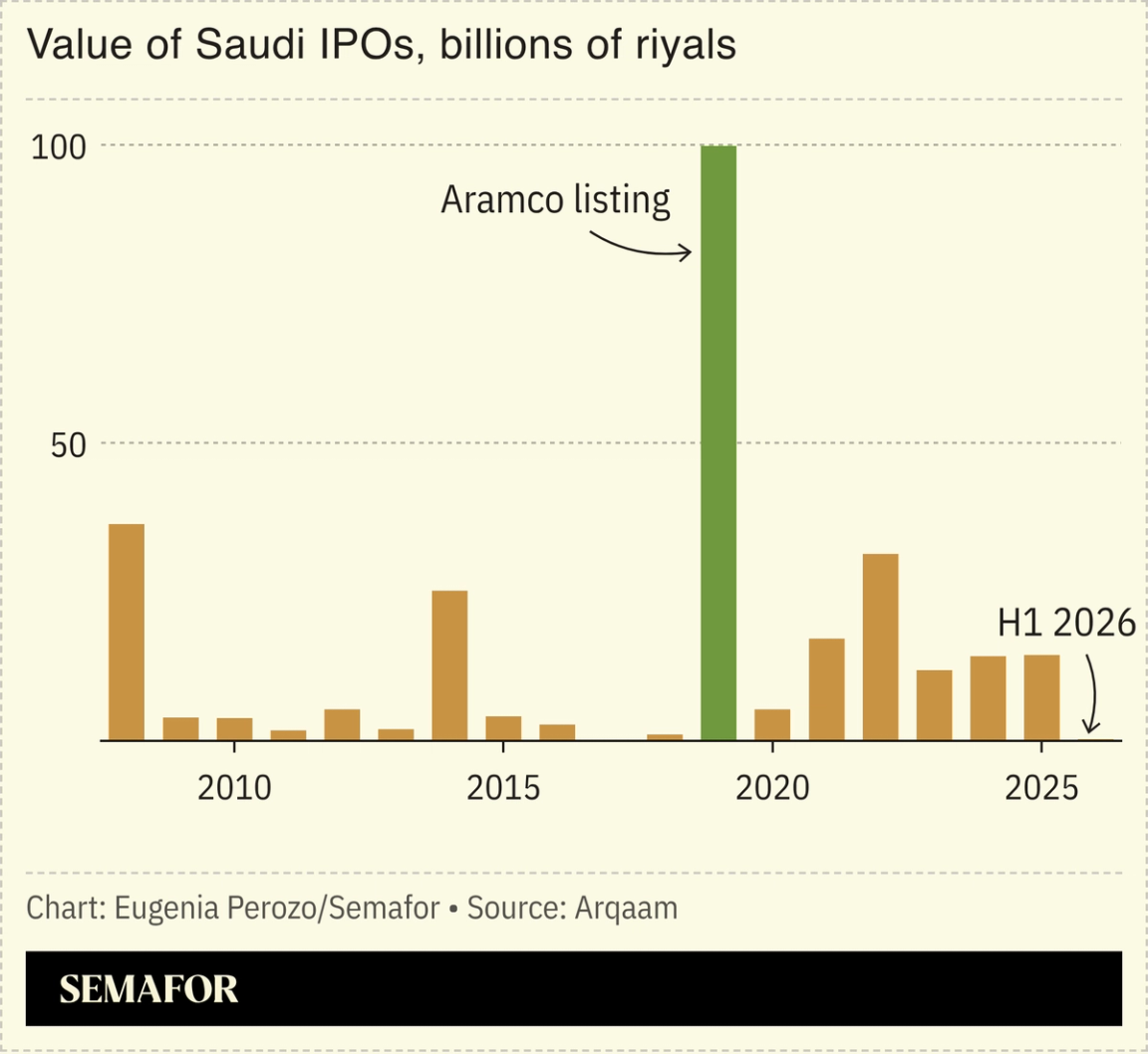 Three Saudi companies shelved plans to go public over the next month as the Iran war clouds investor sentiment, according to people familiar with the matter. The decision by bottled drinks company Berain Water, lubricants and automobile servicing business Petrolube, and Facilities Management Company to postpone their listings suggests investors remain wary of putting new money into the kingdom’s stock exchange, and will likely deter other firms planning IPOs in the short term. That will be a blow to owners of companies considering going public, including the kingdom’s sovereign wealth fund. The Capital Market Authority is keen to ensure that the first IPOs under its new chairman, Mazen Al Sudairi, are a success, according to one of the people. The regulator has been investigating the poor performance of recent listings, including the advice given by investment banks, as it tries to revive the IPO market, Semafor previously reported. |
|
Iran war splits Gulf markets |
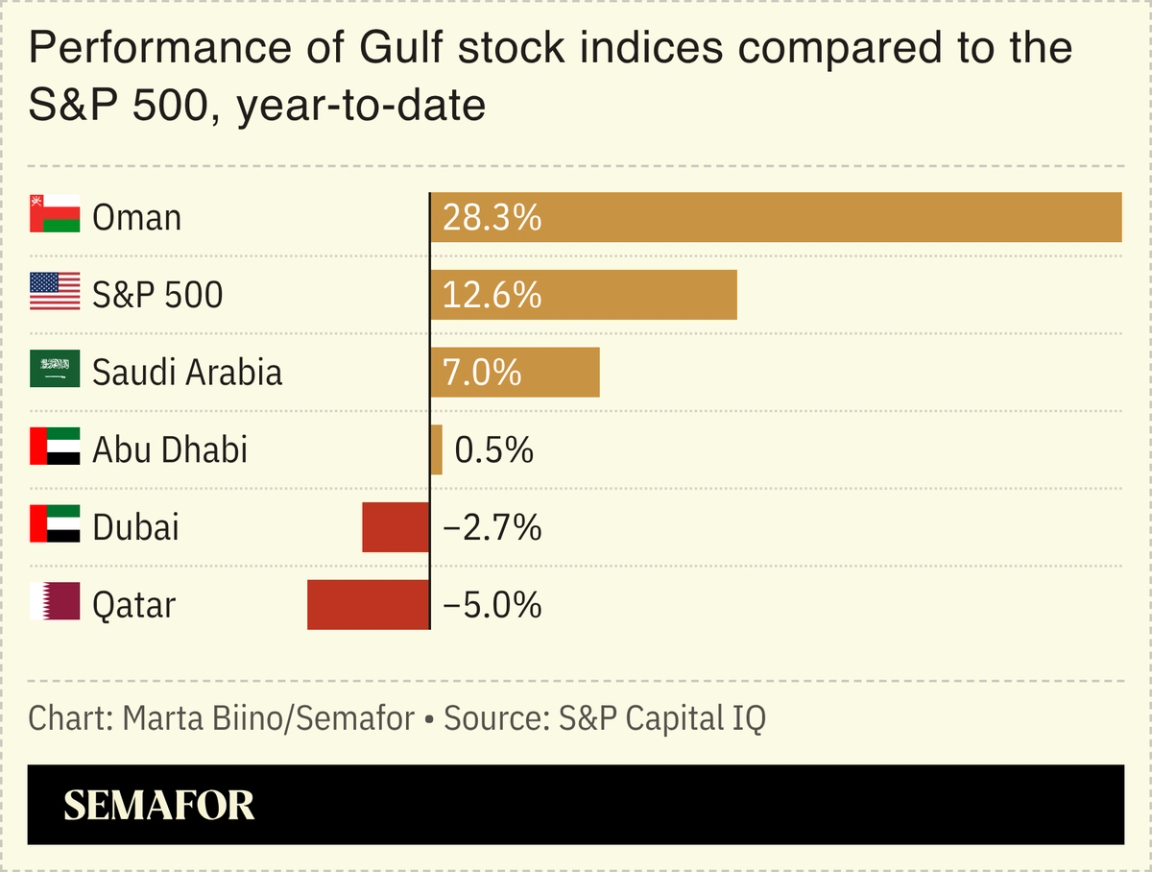 The Iran war is widening the divide between Gulf stock markets. Dubai and Qatar have fallen as they remain more exposed to the closure of the Strait of Hormuz, while Saudi Arabia and Oman have performed positively. Qatar’s problems predate the war due to the post-2022 men’s soccer World Cup slowdown: Listed companies’ profits declined 11% in the first half, and the country’s banking sector has barely grown while bank earnings in Saudi Arabia and the UAE rose by double digits, according to AGBI. Oman’s success similarly began before the conflict, after Muscat introduced a series of economic reforms over the past five years, and the country has also benefited from its position as an oil exporter sitting outside the strait. |
|
Sheikh Tahnoon backs two stablecoins |
 Abdulla Al Bedwawi/Handout via Reuters Abdulla Al Bedwawi/Handout via ReutersSheikh Tahnoon bin Zayed reportedly has interests in two stablecoin initiatives, one in the US and one at home in the UAE. The deputy ruler of Abu Dhabi and UAE national security adviser is a major shareholder in the holding company of a new US bank linked to World Liberty Financial, the digital-assets platform co-founded by members of the Trump family, The Wall Street Journal said. He and co-investors own a 49% stake in a holding company of a bank that recently received preliminary regulatory approval to issue USD1, the dollar-backed stablecoin World Liberty launched last year. The other stablecoin is gaining traction at home, where International Holding Co., the conglomerate Sheikh Tahnoon chairs, has completed at least one transaction in DDSC, the dirham-backed stablecoin developed with First Abu Dhabi Bank, the UAE’s largest lender, which he also chairs. That $30 million transfer was one of the largest single stablecoin transactions in the Middle East, according to its backers. — Kelsey Warner |
|
 DefenseEnergy- Qatar has reportedly extended force majeure on LNG supplies to Asian and European customers, including buyers in Bangladesh, Italy, and Pakistan. QatarEnergy has mostly stopped shipping through Hormuz after Iran attacked two LNG carriers in July. — Bloomberg
Finance- Asset manager PGIM is expanding its secondaries platform, Montana Capital Partners, in the Middle East, with a senior hire in Abu Dhabi. The firm pushed into private credit earlier this year and aims to invest $1 billion in private-credit secondaries over the next two years.
Gigaprojects- New Murabba, the PIF-owned developer behind Riyadh’s $50 billion downtown district, has replaced its chief executive. Briton Michael Dyke, in the job since January 2024, hands over to Sabah Barakat, a PIF executive who is also acting group CEO of Roshn. Construction on the 400-meter Mukaab skyscraper was suspended in January, and completion of the wider district has slipped to 2040 from 2030. — FT
|
|
 Emirates News Agency Emirates News AgencyMore than 50,000 people packed Expo City Dubai on Saturday for “Emirates Loves Palestine,” a celebration of Palestinian culture with traditional food, music, and dabke dancing, plus a set from pop star Mohammed Assaf. At the same time, a parallel “Palestine Loves the UAE” event was running in Gaza, with a live link between the two. Anwar Gargash, a diplomatic adviser to the UAE’s president, called it a “renewed commitment” to Palestinians. The UAE has been Gaza’s biggest wartime donor, channeling around $3 billion in relief since 2023. Last week, it sent a further 903 tons of aid. |
|
|


