| | In this edition: Nigeria’s security woes dominate election campaign, Zambia opposition leader faces ͏ ͏ ͏ ͏ ͏ ͏ |
| |  | Africa |  |
| |
|
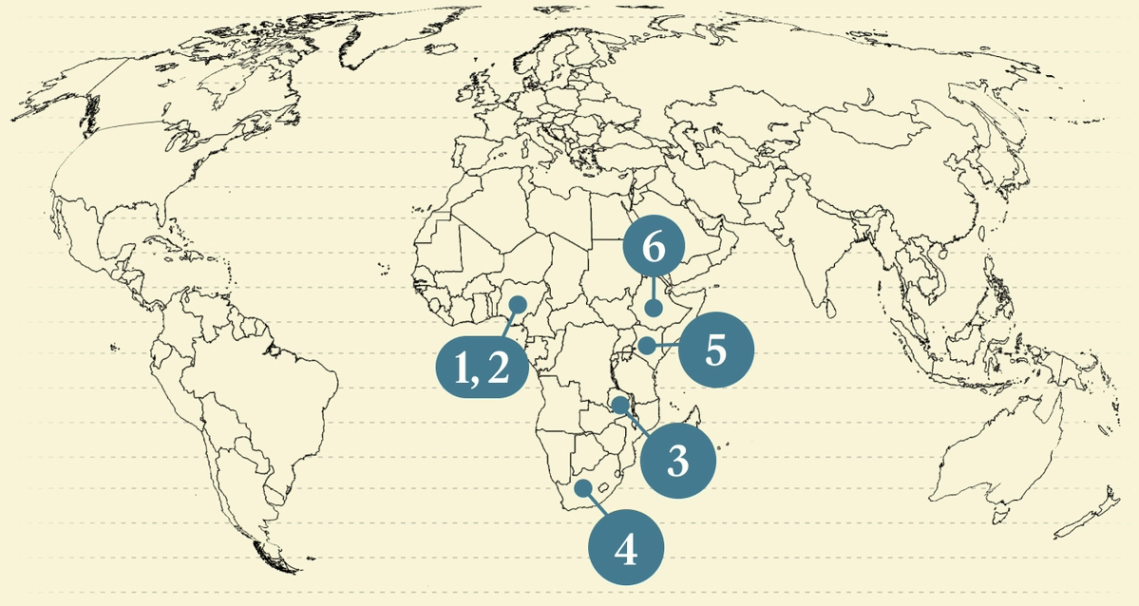 - Insecurity surges in Nigeria
- Nigeria’s investor boost
- Zambia’s Mundubile charged
- Valterra eyes China trade
- Iran war drives diesel imports
- Garcia starts Africa trip
 The week ahead and a look back at an Ethio-jazz pioneer’s astonishing career. |
|
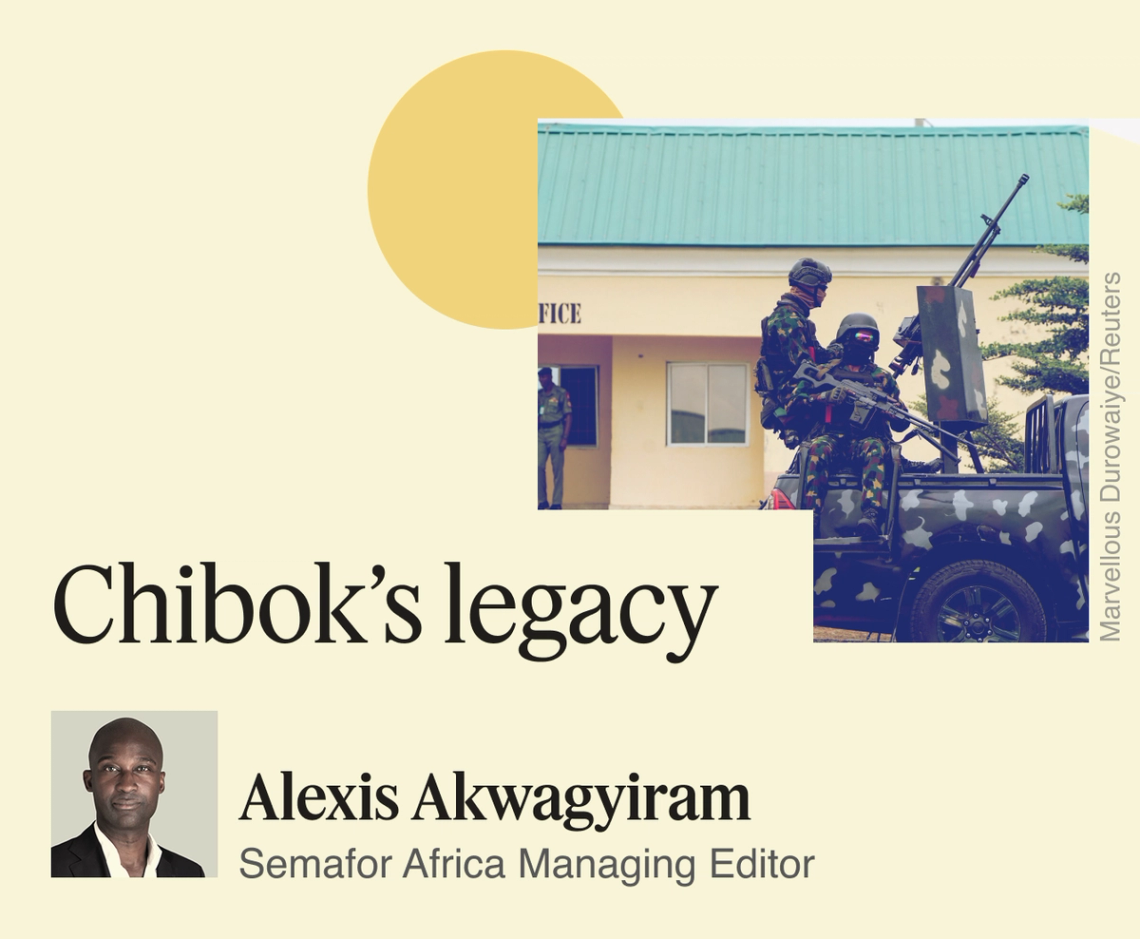 Insecurity was a major issue during Nigeria’s 2015 election, my first as a Reuters correspondent there. It still is today, ahead of presidential polls in January — on a far larger scale, with implications for the country’s economy greater than ever before. That 2015 election is significant because it was held a year after nearly 300 girls were abducted from a school in the northeast Nigerian town of Chibok by jihadist group Boko Haram. That mass abduction, which garnered global headlines, was the template for a kidnap-for-ransom strategy that has been honed by criminal gangs who mostly operate in northern Nigeria but in recent years have spawned copycat abductions in other parts of the country. Mass kidnappings have now become an industry, as our Lagos-based correspondent Alexander Onukwue reports. That election also marked a key step in incumbent President Bola Tinubu’s path to power: He fused his southwestern supporter base with that of northern politician Muhammadu Buhari to create a new party, the All Progressives Congress. Buhari benefited from outrage over the Chibok girls’ abduction to become the first opposition candidate to unseat a president, and Tinubu succeeded Buhari in power. But the problem that helped thrust Tinubu’s APC into power is now a multi-headed hydra that goes far beyond the northeastern jihadist insurgency. When combined with the rising cost of living tied to his economic policy overhaul, it poses the greatest threat to his bid for a second presidential term. His main rivals are banking on persuading the electorate that they can better protect people, while also making life more affordable. Even if, as in the 2023 election, Tinubu’s rivals split the opposition vote, mounting anger around insecurity could mean he only limps through to reelection. And, with time, the macroeconomic benefits of his policies could be eroded if investors come to believe widespread insecurity makes it unsafe to operate in the country. |
|
Violence surges in Nigeria ahead of vote |
| |  | Alexander Onukwue |
| |
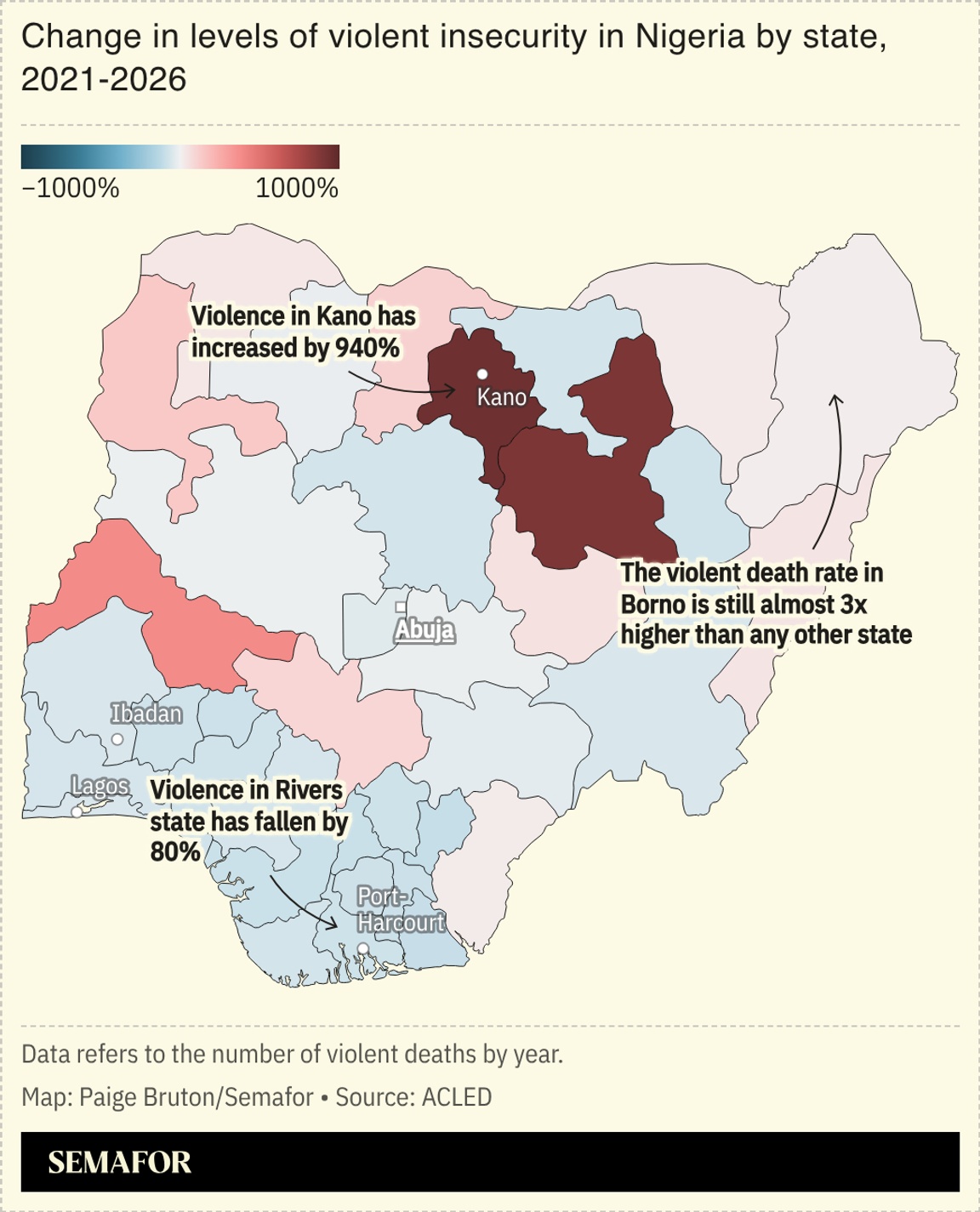 The targeting of civilians by insurgents and bandits in Nigeria has surged compared to last year, as new research sheds light on the depth of the security challenges rocking the nation ahead of January presidential elections. Conflict monitoring organization ACLED found a 30% rise in the targeting of civilians by insurgents and bandit groups in Nigeria, while the three months through June were the country’s most violent quarter since it began collecting data in 1997. Banditry is increasingly lucrative: Ransom payments for abductions last month tripled to $5.8 million, according to the SBM, a Lagos-based consultancy. The rise was on the back of a 66% year-on-year increase in the number of kidnap victims, the firm said. President Bola Tinubu, who began a three-week vacation in Europe on Sunday, has ordered an army and police rescue operation of the 600 people kidnapped from mosques in Niger state this month. Those attacks were the latest to hit the headlines. But while his team has trumpeted economic progress ahead of January’s presidential election, it has been quieter about Nigeria’s security situation. |
|
Nigeria receives investment boost |
 Reginald Bassey/Wikimedia Commons/CC BY-SA 4.0 Reginald Bassey/Wikimedia Commons/CC BY-SA 4.0Nigeria will be restored to an index that measures equities in frontier markets, three years after it was delisted over concerns about the ability to repatriate earnings. FTSE Russell, a subsidiary of the London Stock Exchange Group, will upgrade its designation of Nigeria next month to “frontier market” from “unclassified” — a move that is likely to attract new portfolio investment. A foreign exchange crisis between 2022 and 2023 in Nigeria constrained the ability of several international companies to take their money out, fueling an exodus of entire businesses and capital. Nigeria’s finance minister said government “improvements” to foreign exchange liquidity prompted the return to the FTSE Russell index. Credit ratings agency Moody’s also gave Nigeria an upgrade last week, revising its outlook to “positive” from “stable” on the back of strong foreign exchange reserves. — Alexander Onukwue |
|
Zambia charges opposition leader |
 Zambian opposition leader Brian Mundubile. Moses Mwape/File Photo/Reuters. Zambian opposition leader Brian Mundubile. Moses Mwape/File Photo/Reuters.Zambia’s main opposition leader was charged with treason and flown under armed guard to a maximum-security prison in a case that threatens to taint Lusaka’s image as a relatively stable Southern African democracy. Brian Mundubile, who finished second in the Aug. 13 election with 38% of the vote, was detained alongside his running mate Makebi Zulu and businessman Harry Findlay. They are among 18 people accused of plotting to overthrow the government in the days leading up to President Hakainde Hichilema’s re-election. The arrests followed a raid on Mundubile’s Lusaka home during the vote, where police said they recovered weapons. Mundubile disputes the account, saying his aides were unarmed. He later sought refuge at a UN building before surrendering to authorities last week. |
|
Valterra eyes China hydrogen demand |
 Nqobile Dludla/Reuters Nqobile Dludla/ReutersValterra Platinum, the world’s largest platinum group metals miner, is betting that China’s push into hydrogen-powered freight trucks will deliver a fresh wave of demand for the metals, an executive said. PGMs are vital to hydrogen technology, acting as catalysts in fuel cells to power electric vehicles. The company forecast it could add 6 million ounces a year of platinum and sister metals in demand. The projection, based on capturing a fifth of the global heavy-duty truck market for fuel cell vehicles, is nearly equivalent to a full year of global mine supply of the metal used primarily in catalytic converters to reduce emissions from internal combustion engines. For South Africa, which supplies more than 80% of the world’s platinum, the hydrogen bet ties its export earnings and job creation to Beijing’s industrial policy. Under China’s 15th five-year plan, energy security and the rollout of hydrogen infrastructure are central priorities. Beijing is deploying fuel-cell fleets near low-cost production hubs in the Yangtze River Delta, and pilot “tank-swapping” stations for heavy trucks are being tested to cut distribution costs. — Tiisetso Motsoeneng |
|
Africa turns to Asia for diesel |
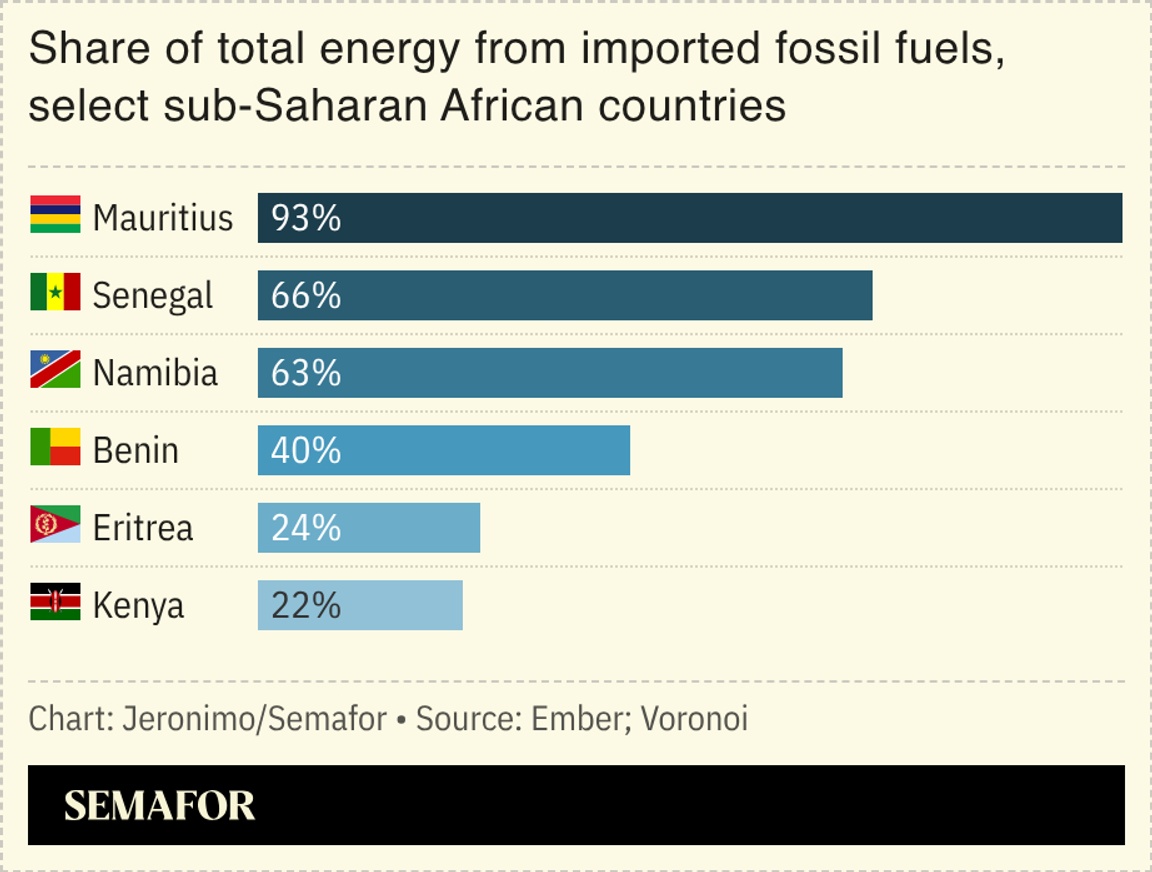 Asian diesel exports to Africa have soared to a multi-year high as the war in the Middle East roils global energy markets. Before the start of hostilities, Africa relied on the Gulf for a large share of the fuel it consumes, importing roughly $90 billion’s worth a year. Nations across the continent have vowed to increase their energy independence — Africa’s richest man recently unveiled plans to build a $16 billion refinery in Kenya modeled on a giant one in Nigeria — drawing interest from Middle Eastern investors, Oil&Gas reported. However, analysts warn that the plans will likely take years to come to fruition, forcing countries to seek immediate alternatives elsewhere. This item originally appeared in Seamfor’s twice-daily Flagship briefing. Subscribe here. → |
|
|
Garcia makes second Africa trip |
 Frank Garcia. US Bureau of African Affairs/X. Frank Garcia. US Bureau of African Affairs/X.US Assistant Secretary of State for African Affairs Frank Garcia is on his second official trip to the continent since taking the job in June. It is the latest bid to underscore the Trump administration’s commercial diplomacy push with African policymakers. Garcia will visit Zambia, Ethiopia, and Kenya from Aug. 30 to Sept. 10, just weeks after his inaugural tour of Nigeria, Côte d’Ivoire, and Mali. Garcia is expected to attend President Hakainde Hichilema’s Sept. 1 inauguration in Lusaka before heading to Ethiopia and wrapping up in Nairobi, likely at the US-East Africa trade forum. The trip offers an early test of whether Washington can turn its “trade over aid” rhetoric into real deals. Zambia is particularly sensitive amid tensions over US health assistance and mining, while Kenya is pursuing deeper US trade and investment. The bigger challenge will be the capacity to deliver results with a US diplomatic apparatus weakened by staffing cuts and vacancies. — Yinka Adegoke |
|
 - Aug. 31-Sept. 3: GITEX Nigeria, tech and startup show takes place in Lagos and Abuja.
- Sept. 1: Senegalese general and former minister of the armed forces Birame Diop takes up the presidency of the Ecowas commission.
- Sept. 1: Zambian President Hakainde Hichilema is sworn in for a second term.
- Sept. 2: Ghana releases its latest inflation data.
- Sept. 2-3: Dar es Salaam hosts the 10th Africa Agri Expo, one of the continent’s largest agricultural summits.
- Sept. 3: South Africa, Kenya, Uganda, Zambia, Ghana, and Mozambique release their latest manufacturing data.
- Sept. 3-4: Nairobi hosts Odoo Experience Africa 2026, a business and tech event drawing more than 10,000 attendees from across the continent.
|
|
|


