| | President Donald Trump issues fresh threats against Iran, central bankers worry about AI risks, and ͏ ͏ ͏ ͏ ͏ ͏ |
| |  | Flagship |  |
| |
|
The World Today | 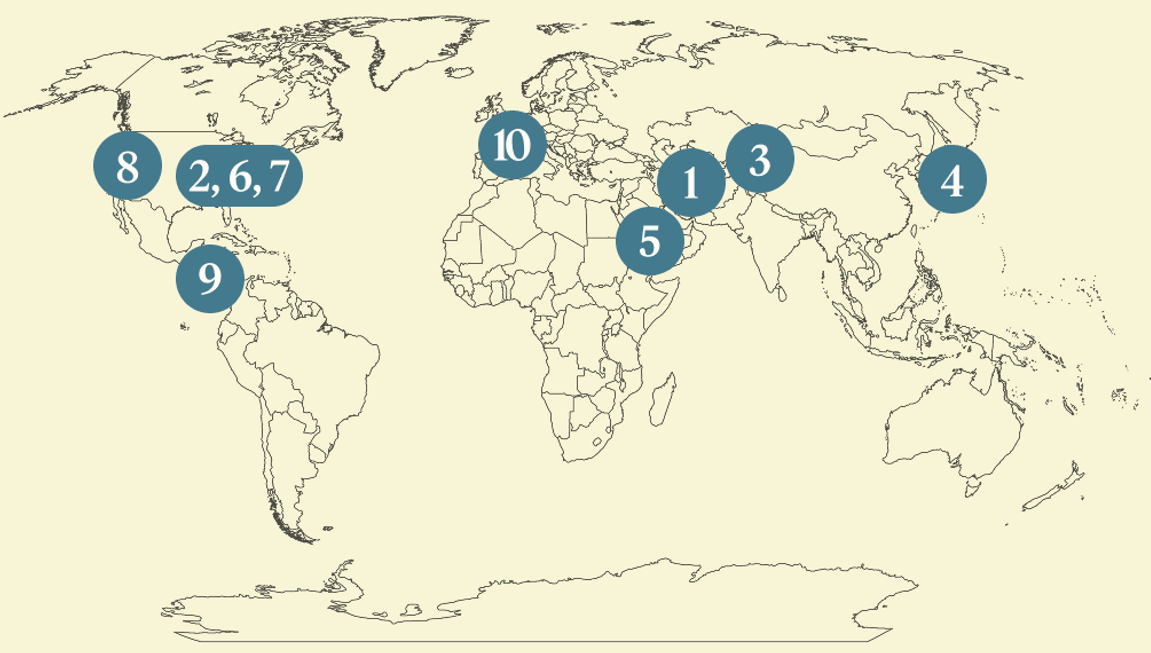 - Trump’s new Iran threat
- Bessent faces G20 test
- China is star of the SCO
- Japan ups defense spend
- Saudi pulls IPO plans
- Trump touts data centers
- BoE chief warns on AI
- Meta’s physical AI push
- Violence in Costa Rica
- Scrapping the leap second
 A book about AI with ‘the kind of writing that AI will never replace.’ |
|
Trump threatens more Iran strikes |
 Majid Asgaripour/WANA via Reuters Majid Asgaripour/WANA via ReutersPresident Donald Trump on Monday threatened to “hit Iran hard” after the US and Iran traded strikes, though analysts were skeptical of the White House’s willingness to escalate the costly conflict. Trump posted AI-generated videos of the US bombing Iranian targets, but actually bombing them requires munitions the Pentagon is running short of: Military leaders warned the US defense secretary this week that “prolonging large-scale operations against Iran is unsustainable,” The Washington Post reported, and will weaken US capabilities elsewhere. “The war has almost irreparably damaged Trump’s foreign-policy toolkit,” Foreign Policy’s editor-in-chief argued. While Trump still has “powerful economic tools to wield as cudgels against allies and adversaries… countries and companies will learn that he has peaked.” |
|
Bessent faces G20 ‘credibility test’ |
 Sam Wolfe/Reuters Sam Wolfe/ReutersUS Treasury Secretary Scott Bessent’s attempt to sell Washington’s economic agenda at this week’s G20 finance meeting will have to contend with global anxieties over US debt and the Iran war’s economic fallout. Bessent’s controversial interventions of recent weeks — propping up the Japanese yen and doubling Treasury’s bond purchases — have raised questions about his credibility, Bloomberg wrote, possibly undermining his efforts to sway global colleagues on issues including AI oversight and economically isolating Tehran. Bessent will also have to cajole European officials who were outraged at Washington’s decision to invite Russia’s financial chief to the gathering: Germany’s finance minister, who recently blamed the US’ war with Iran for global bond market turmoil, said the move “sends a signal I find troubling.” |
|
Xi pledges stronger Russia ties |
 Kristina Solovyova/Sputnik/Pool via Reuters Kristina Solovyova/Sputnik/Pool via ReutersChinese leader Xi Jinping pledged stronger ties with Russia after meeting President Vladimir Putin on Monday, as Beijing flexed its diplomatic might at the Shanghai Cooperation Organization summit in Kyrgyzstan. With 10 member states in attendance, the gathering offers Xi the chance to demonstrate that Beijing has “friends and options around the world at precisely the moment Washington is alienating many of its allies,” a China adviser in the Biden administration told The New York Times. It’s also a chance for Xi to put a floor under China’s tense relationship with India, which “finds itself a reluctant and defensive participant — unable to move too close to China or identify fully with the anti-Western agenda promoted by Beijing and Moscow,” a Foreign Policy columnist argued. |
|
Japan plots record $55 billion defense spend |
 Kim Kyung-Hoon/Reuters Kim Kyung-Hoon/ReutersJapan will seek to build more drones and missiles as part of a record defense spend of more than $55 billion next year, amid growing concerns over China’s military assertiveness. Under a plan that Beijing has decried as “new militarism,” Japan is targeting more uncrewed weapons systems — including a new 3D-printed drone fleet — to compensate for its aging population. Tokyo also sees threats from North Korea and Russia: Vladimir Putin visited the formerly Japanese Kuril Islands earlier this month for the first time, reigniting a 150-year-old feud. Still, the record top-line figure is a modest increase over this year’s budget, lagging South Korea and Taiwan, and may prove too incremental to satisfy US demands. |
|
Saudi firms drop IPO plans |
 Faisal Al Nasser/Reuters Faisal Al Nasser/ReutersThree Saudi companies scrapped plans to go public over the next month as the Iran war clouds investor sentiment, Semafor’s Matthew Martin reported. The firms’ decision suggests foreign investors remain wary of putting new money into Saudi’s stock exchange, and will likely deter other firms planning IPOs in the short term. That will be a blow to the kingdom’s sovereign wealth fund, which had been considering a fresh wave of stock offerings in companies it controls, pinning its hopes on a stock market revival. Saudi’s stock market regulator has been probing the poor performance of recent listings, Semafor previously reported, and is keen to ensure that the first IPOs under its new chairman are a success. |
|
Trump pans data center criticism |
 Saul Loeb/Pool via Reuters Saul Loeb/Pool via ReutersUS President Donald Trump said communities opposed to data centers will end up “backwards and poor,” in remarks that are unlikely to soften mounting public criticism of Big Tech. “Let data reign,” Trump said Monday, as bipartisan backlash to the AI buildout reaches fever pitch ahead of the US midterm elections. Tech leaders have responded by “throwing their financial resources behind the Trump administration,” a Bloomberg columnist argued, but “history shows the limits of counting on friendly politicians.” Congressional Democrats are weighing how to use their subpoena power if they prevail in November, and “that iconic photograph of Jeff Bezos, Mark Zuckerberg, Sundar Pichai, and [Elon] Musk at Trump’s inauguration… guarantees Democrats will call them to testify in 2027,” Semafor’s Ben Smith wrote. |
|
Finance leaders warn of AI threats |
 Henry Nicholls/Reuters Henry Nicholls/ReutersThe head of the world’s financial stability watchdog warned that greater cyber threats from frontier AI are heightening the risk of market disruptions. Financial institutions and service providers should prepare for “severe scenarios involving simultaneous disruption across multiple firms or shared technology dependencies,” Andrew Bailey wrote in a letter Monday to G20 finance ministers and central bankers, joining a chorus of prominent voices warning about the threats highly advanced AI poses to critical infrastructure. Bailey said firms should be prepared to restore critical systems from “bare metal” if necessary. Meanwhile, central bankers in Jackson Hole, who were presented with dystopian scenarios where AI agents outmaneuver them, fretted more about “near-term and real-world implications of AI,” Reuters reported. |
|
Meta tests robots for data centers |
 Christinne Muschi/Reuters Christinne Muschi/ReutersMeta is testing robots for its data centers that are capable of handling routine maintenance like fitting cables or resetting servers, as physical AI becomes more powerful. The robots could replace 80% of some people’s workloads, a worker told WIRED: “We thought those of us performing the physical tasks were safe.” Meta will be slowed down by US controls on Chinese robots — it will use US, Canadian, and Swiss models, but China is the undisputed robotics world leader. Its machines shattered speed and jumping records at the World Humanoid Robot Games last week, although experts cast doubt the humanoids are ready for industrial work. Still, labor shortages across Latin America, Asia, and Europe are creating huge markets for Chinese robots. |
|
Crime soars in Costa Rica |
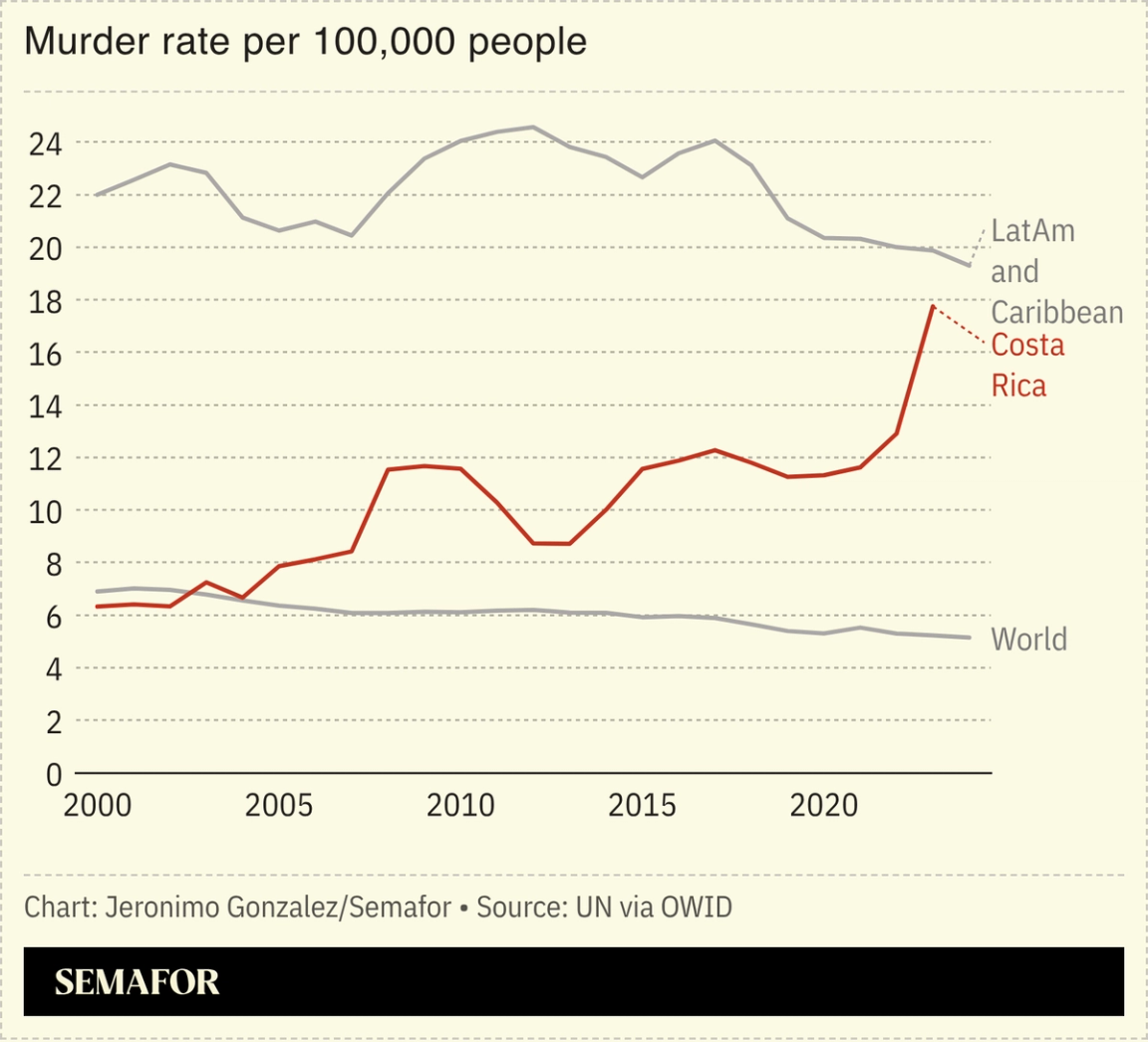 Costa Rica, once a beacon of stability in Latin America, faces a wave of violence that threatens to upend the country’s political system. Surging cocaine production in Colombia, a short boat ride away, has sent crime rates soaring in Costa Rica — much as in other parts of the region — as cartels vie for control of valuable shipping routes on both its Pacific and Atlantic coasts. The government, inspired by El Salvador’s draconian though effective crackdown on crime, has vowed to step up its fight, but some argue transnational cartels retain the upper hand. “It’s a bit of an uneven battle, because drug traffickers have vastly greater financial resources,” a Costa Rican business owner told The Wall Street Journal. |
|
|


