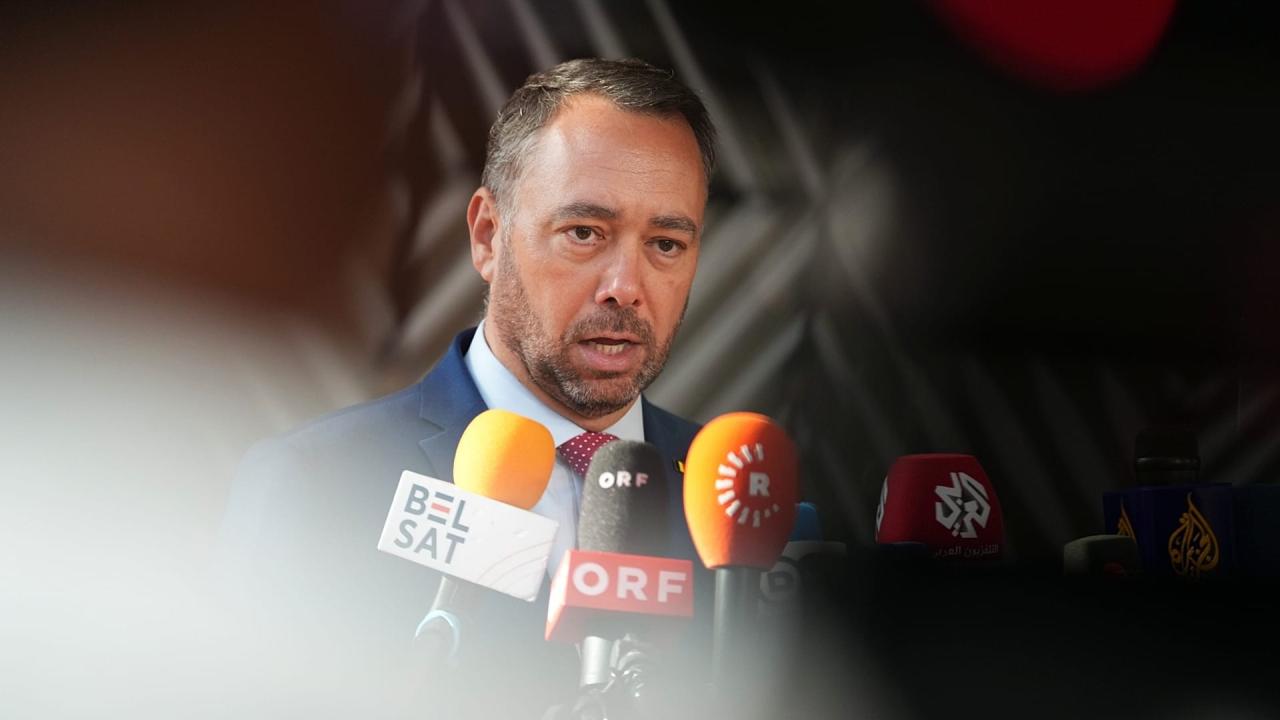
Good morning, I’m Mared Gwyn. This morning, a warning from the Lithuanian Foreign Minister on the escalating threat from Moscow. But we start with the deepening crisis facing the Spanish government.
Panic in Moncloa: There is a sense of growing chaos at the heart of the government in Madrid this morning after a leaked police report suggested the Ceuta border crisis, which saw over 80,000 migrants cross into the Spanish enclave, was planned and steered by Moroccan authorities and designed to violate the Spanish border under the guise of a migratory wave.
Prime Minister Pedro Sánchez has repeatedly exonerated Morocco of responsibility and placed the blame on smuggler networks, alleging also that Russia and Israel have been spreading disinformation about the incident.
Conflicting narratives: The Director-General of the Spanish National Police has since assured the Spanish Interior Minister Fernando Grande Marlaska – who had asked the police to probe the reports – that there is no evidence “whatsoever” to indicate that the Moroccan authorities were responsible for orchestrating the incident.
Sánchez is expected to appear in parliament later today to double down on his insistence that there is no compelling evidence that would incriminate Morocco. It follows protests across Spanish cities last night on the day of Ceuta’s anniversary.
That’s despite leaked papers claiming to show photos of plainclothes and uniformed Moroccan security officers, as well as a police note dated July 29 (a day before the mass crossing) warning of an “extreme risk” of a “coordinated” arrival of migrants from Morocco into Ceuta, leaking to the press.
Political frenzy: The allegations have triggered a political frenzy, with the interior ministry — one of the government’s most politically sensitive departments — now under intense pressure over questions about its control and oversight of parts of the police, as our chief EU editor Maria Tadeo explains in this must-read piece.
Juan Fernando López Aguilar, a former socialist justice minister and a member of the European parliament, told Europe Today earlier this week that the Ceuta incident “couldn't have happened without some overlooking by the Moroccan authorities”, in a sign of the fracturing unity within Sánchez’s close circle.
Sánchez against the ropes: The question of how much the Spanish government knew in the hours prior is central to its political survival as Sánchez faces his most serious crisis to date ahead of an election in 2027. Opposition leader Alberto Núñez Feijóo told reporters that the government “knew it — and covered it up.”
Brussels is also keeping an eye on the saga. “We do not comment on leaks,” a spokesperson for the European Commission said. “We understand there is an investigation ongoing by the Spanish authorities. This is a matter for the national authorities.”
Conservative and far-right MEPs also gathered in front of the European Parliament in Brussels on Wednesday in protest at Sánchez’s handling of the crisis. Vincenzo Genovese has this dispatch.
NATO under threat: In other news, Lithuania’s Foreign Minister Kęstutis Budrys has exclusively told Euronews that Russia is considering “options” to “escalate towards the direction of NATO”.
Speaking to our correspondent Shona Murray in Wicklow, Ireland, Budrys said that both Lithuania and the NATO Alliance were alert and ready for the threat: “We are prepared, we know what you are cooking there, and believe it, it will be then considered within the NATO alliance as activities against all of us.”
His statements come following CIA chief John Ratcliffe’s recent dash to Moscow, reportedly to dissuade the Kremlin from escalating its confrontation with the Baltic nation, and after Germany attributed an attempted drone attack on Leipzig airport to Moscow.
‘Catastrophe’ averted: Describing the incident in Leipzig as close to “catastrophe”, Budrys suggested Lithuania would respond firmly if a similar attempted attack were to succeed on Lithuanian territory.
“If there is the attribution, there is intention, there is damage then it falls under UN Charter definition of the conditions for self-defence: of course we would go for it,” he said.
New momentum for visa ban: Reports have emerged suggesting that one of the two suspects in the Leipzig incident is a Belarus national already known to authorities for criminal offences committed in the Baltic states, and who is believed to have entered the Schengen area on a tourist visa provided by the Italian authorities.
It has revived an ongoing debate on further tightening the entry rules for Russian tourists, but also to fully ban former Russian combatants from entering the Schengen area, as my colleague Luca Bertuzzi reports. The EU’s foreign policy chief Kaja Kallas said there was “broad support” for both measures during an informal meeting of foreign affairs ministers in Wicklow, Ireland on Wednesday.
‘Schizophrenia’: A proposal to fully ban former Russian combatants from the Schengen area – championed by Baltic states – was previously watered down due to questions over how the ban would administratively be enforced and the legal risks it would present for consular services, with France and Italy leading the concerns.
Lithuania’s Budrys told Shona: “We should stop this schizophrenia and just (...) solve it.” |