| | In today’s edition: China and Saudi Arabia move closer on tech, Emirates unveils new premium economy͏ ͏ ͏ ͏ ͏ ͏ |
| |  | Gulf |  |
| |
|
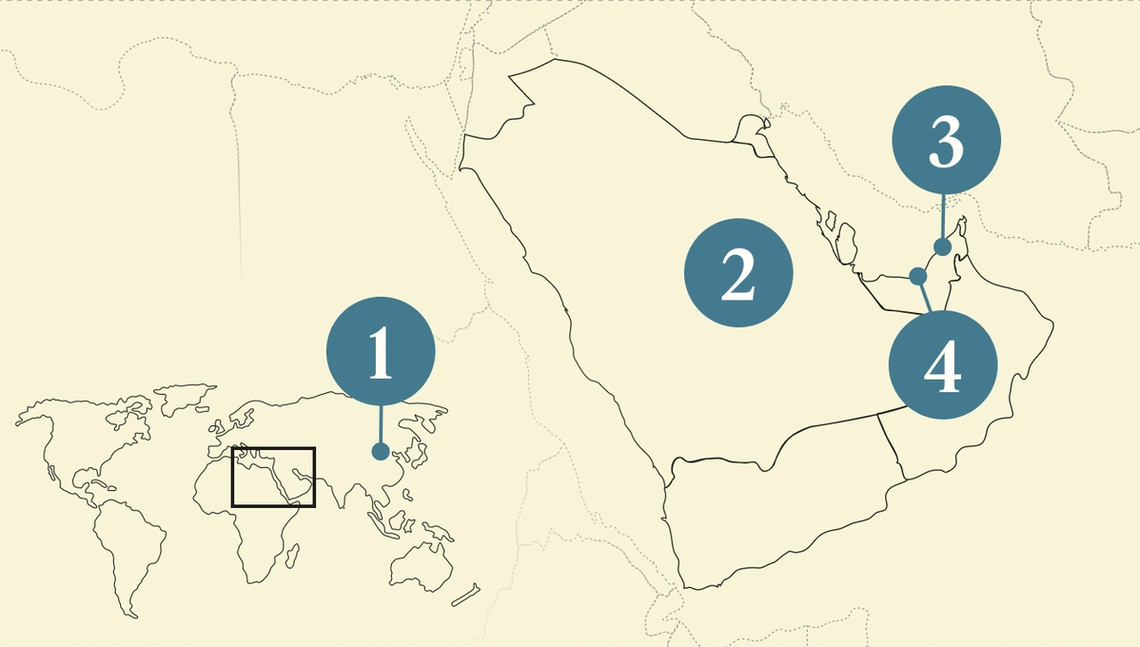 - Saudi Arabia’s China play
- Gulf airlines moving cargo…
- … and passengers, in style
- The $300,000 falcon
 The Week Ahead: Events season warms up, OPEC meets again, and Comic Con hits Abu Dhabi. |
|
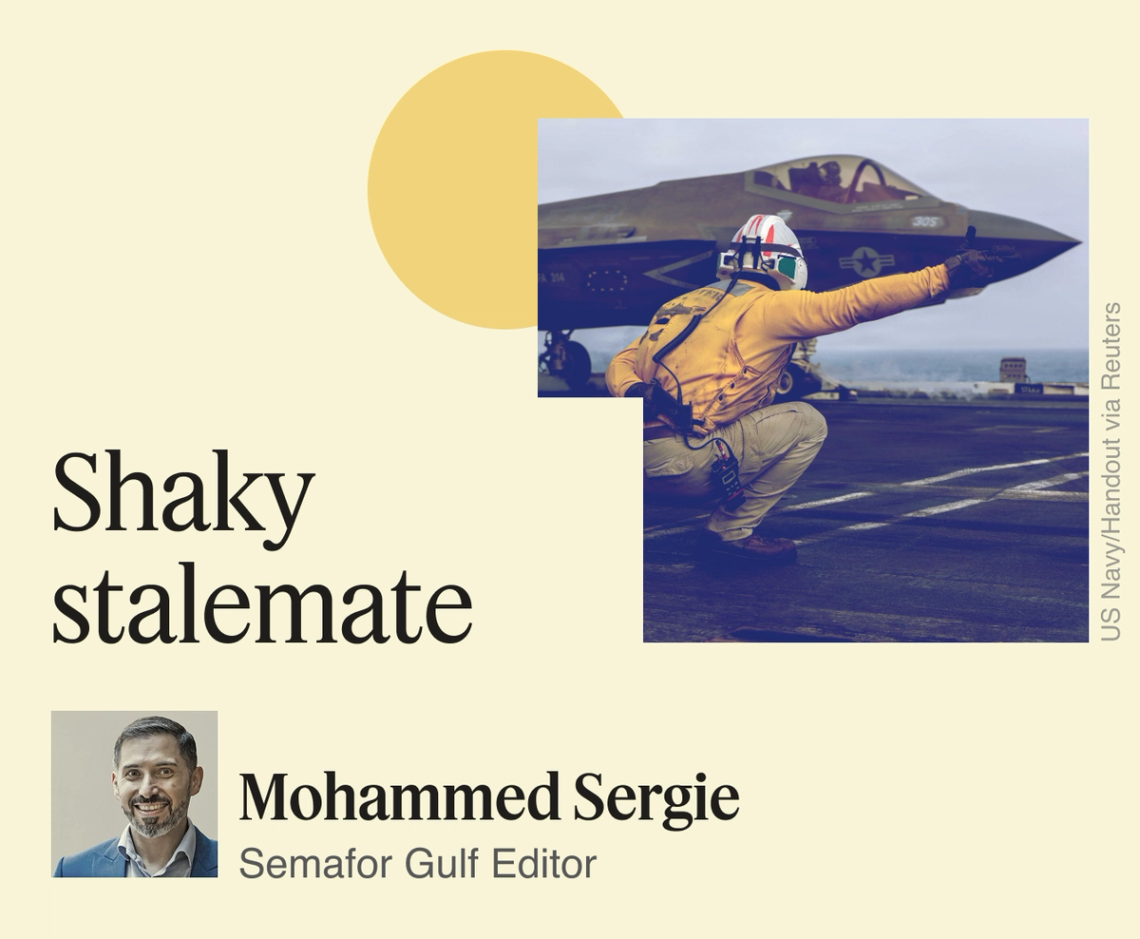 Six months into the US-Iran war, there is little agreement on almost anything, including what to call it. US Vice President JD Vance declined Thursday to call the conflict a war — a term many in the Gulf also prefer to avoid — arguing that there is “no active shooting right now.” Semantics aside, a conflict involving more than 50,000 US troops, tens of thousands of sorties, ballistic missiles, and drones, and thousands of deaths isn’t business as usual. The pain, so far, has been unevenly distributed. Companies in the Gulf want to get back to growth and have largely adapted to disrupted supply chains, while air defenses are providing enough security for schools to reopen and large events to be held. Some countries and industries are faring better than others, depending on their ability to move oil and gas and cater to the domestic market rather than tourists. The scenario is flipped in Iran. Analysts may debate whether Tehran is “winning” the strategic contest, but ordinary Iranians are taking the hit. Inflation and food prices are soaring, fuel shortages have emerged, and the country has been unable to export crude for weeks. The regime, meanwhile, has the guns — and has repeatedly demonstrated its willingness to use them against dissenters. The global economy has been relatively insulated, but its buffers are weakening. Brent is moving toward $100 a barrel, US diesel has hit a record, and Abu Dhabi’s Murban crude commands a premium of more than $30 a barrel for delivery to East Asia, suggesting tighter supply as China ramps up purchases. Gulf officials have warned that the region can’t stay in this limbo indefinitely, and the skirmishes of the past week are proof of that assessment. Whatever the US vice president wants to call it, we remain closer to war than to peace. |
|
Chinese tech wave lands in the kingdom |
 Semafor illustration/Go Nakamura/Yilei Sun/Reuters Semafor illustration/Go Nakamura/Yilei Sun/ReutersFielding a question from Chinese state media on Sunday, a senior government official from Saudi Arabia touted a “great wave” of innovation emerging from China, and pledged the two countries would deepen their ties. The press conference in Riyadh kicked off LEAP, a major technology event. In the days since, a flood of deals have been announced to bring Chinese robotaxis, laptops, AI models, and data centers to the kingdom — while casting the competition for tech dominance between China and the US in the Gulf and around the world into stark relief. The Gulf “is a crucial node that shows the world that Chinese tech can go around the world and out-compete American tech,” James Kynge, senior research fellow for China and the world at Chatham House, told Semafor. The Saudi tech industry is still dominated by US companies: AWS, for one, is building $5.3 billion worth of data centers in the kingdom. And as part of a deal to secure export licenses for advanced chips from the US government, Public Investment Fund’s AI firm HUMAIN will not allow Chinese frontier AI models to be trained on its compute capacity. Still, a whole generation of Chinese tech entrepreneurs is driven by international expansion, and they are increasingly arriving in the region, lured by capital and access to new markets: “Ride the wave,” as one Beijing-based academic put it. — Kelsey Warner |
|
Gulf carriers bulk up on cargo |
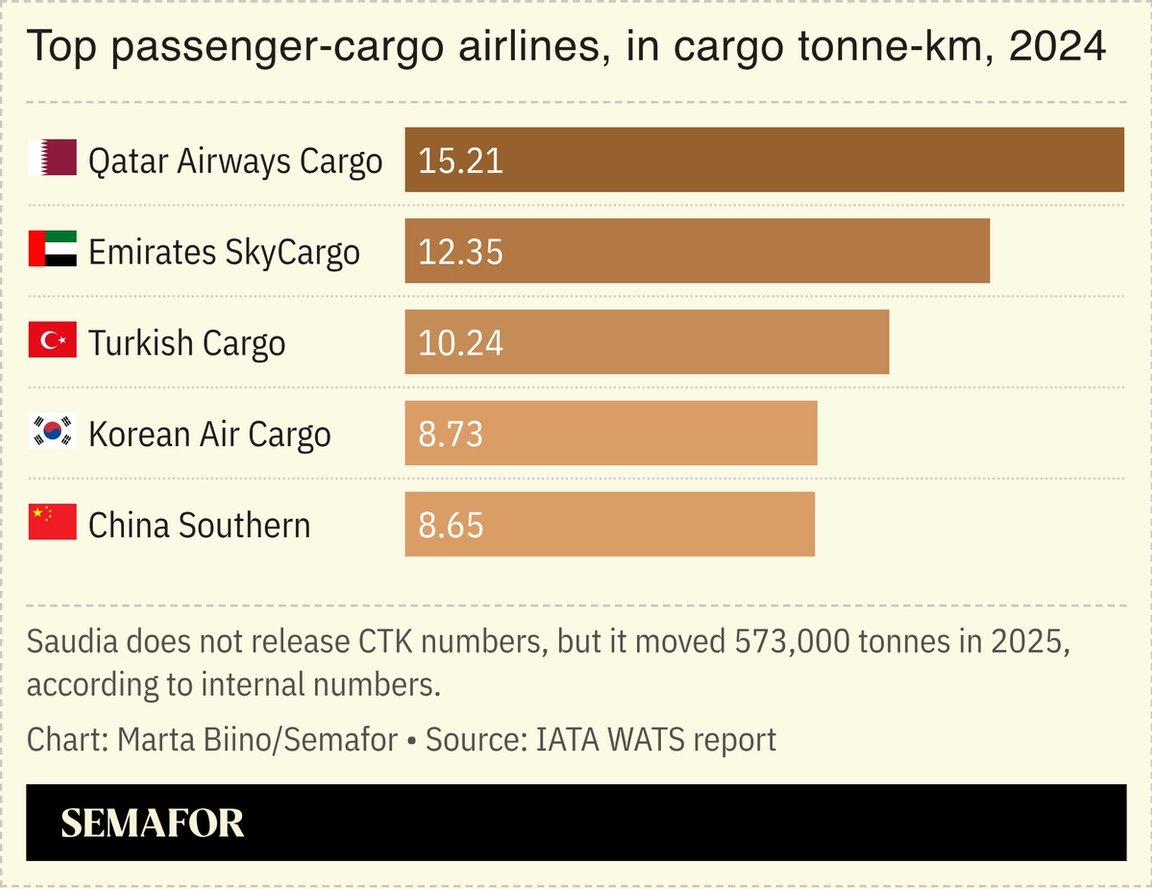 Saudia Cargo will double its fleet, adding four Boeing 777-200F jets over more than two years, as Saudi Arabia pushes to become a logistics hub linking three continents. The aircraft will carry heavy and temperature-sensitive goods nonstop on long-haul routes, an executive told Asharq Al-Awsat. Other Gulf carriers have been adding freight capacity throughout the war. Emirates SkyCargo in July flew the first commercial Boeing 777-300 passenger-to-freighter conversion, carrying more than 100 tons from Hong Kong to Dubai, with Israel Aerospace Industries contracted for at least three more conversions. Qatar Airways and Etihad Airways are expanding through dedicated freighters and belly capacity. That capacity is arriving before the freight has fully returned, however. Middle East carriers’ cargo traffic rose 1.7% year-on-year in July compared to a 4.0% increase in capacity, IATA said, while volumes on crucial routes from Europe and Asia to the Middle East fell for a fifth straight month. |
|
Emirates raises the premium stakes |
 Courtesy of Emirates Courtesy of EmiratesThe battle for super-luxury supremacy in the skies is moving further back in the cabin. Emirates, the largest long-haul carrier, is introducing the world’s first electrically powered premium economy seat, with a large privacy screen separating passengers from their neighbors. The seats, which rival many first-class options on domestic routes in Europe and the US, will debut on newly delivered Airbus A350s. It’s the latest upgrade aimed at getting customers to pay more for a better experience, and could help differentiate Emirates among connecting passengers wary of transiting through a region prone to conflict. Emirates, Etihad, and Qatar Airways already offer some of the world’s best-rated premium cabins. Private jet operators are also competing for some of those dollars, but the Gulf’s commercial carriers are betting travelers will still prefer “zero-gravity” beds and wagyu sliders with Dom Pérignon delivered to their suites. |
|
$300k falcons fly off the shelves |
 Courtesy of Emirates News Agency Courtesy of Emirates News AgencyThe Gulf is on a multi-million dollar falcon shopping spree, with two prized birds trading for eye-watering prices in Abu Dhabi this week. Bred on the same American farm, an ultra-white gyrfalcon chick went for 1.1 million dirhams ($300,000) while a pure-white gyr fetched 1.5 million dirhams. In Riyadh, the breeders’ auction closed last month with a 1.3 million riyal ($346,000) Canadian-bred chick. Bedouins once flew the region’s birds of prey to put meat on the table. Today they come from specialist farms, get their own seats on commercial flights, and can win back their price on a racing circuit worth tens of millions of riyals. Spending picks up ahead of the hunting season that opens in October. Its prize quarry, the houbara bustard that Gulf nationals pay $100,000 to hunt in Pakistan’s deserts, is valued for its supposed aphrodisiac qualities. — Manal Albarakati |
|
| |