
|


 |
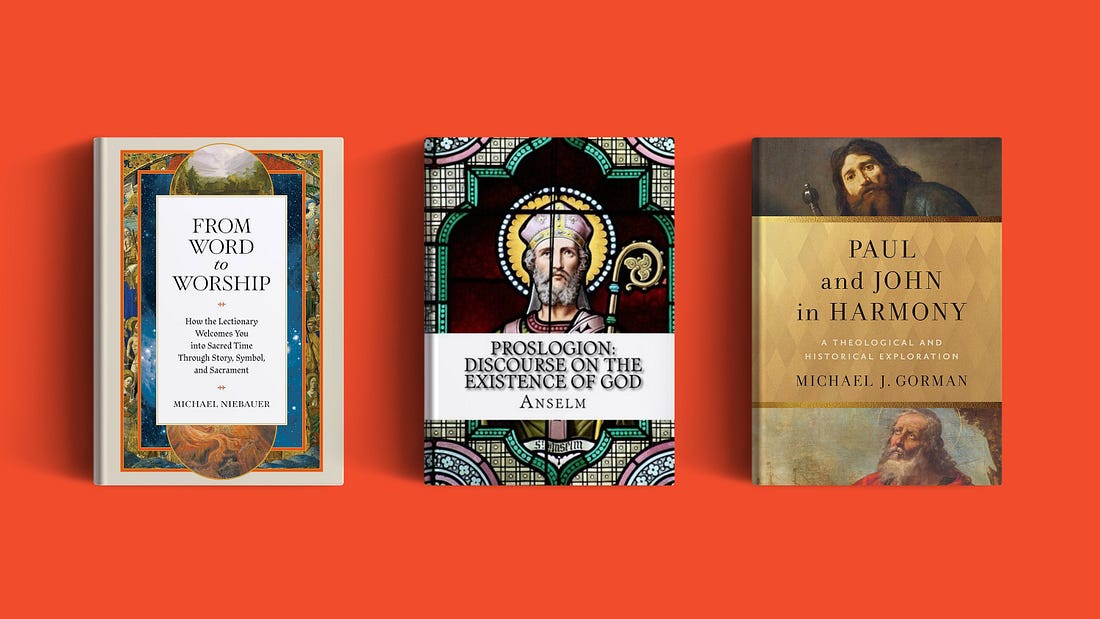
Have you ever noticed similarities in the phrases used by the apostle Paul and those used in the Gospel of John? One of today’s books highlights their commonalities and what they might mean. Another book makes the case for lectionaries in corporate worship—even for low-church evangelicals like me. Finally, rounding out the newsletter, we have Anselm’s classic Proslogion. Theologian Andrew Wilson offers insightful context and commentary on all three titles.
Happy Reading,
Taylor Berglund
Senior Features Editor, Christianity Today
A portion of this newsletter appeared as a column at Christianity Today. Join CT for full access to all our journalism.
This email may contain affiliate links that help support CT at no additional cost to you.

 |
Three Books on Theology
Michael Niebauer, From Word to Worship: How the Lectionary Welcomes You into Sacred Time Through Story, Symbol, and Sacrament (Baker Books, 2026)
Lectionaries are underrated. Used well, they can be an excellent way of ensuring that the church hears, understands, and responds to the whole counsel of God—the Psalms, the Gospels, and the rest of the Old and New Testaments—rather than just the portions from which the pastor wants to preach. But they are not often used: “Many mainline churches have abandoned orthodox understandings of the authority of Scripture and have developed an aversion to preaching from lections of the Bible now deemed to be offensive. Baptist, Pentecostal, and evangelical churches have largely refrained from using lectionaries altogether.” And even when they are used, they are not always used well. Ministers, let alone their congregants, are not always clear on how to connect the different pieces of Scripture together and how their collective witness speaks to 21st-century people.
Michael Niebauer wants to help with both problems. In response to the first, he makes strong arguments for using lectionaries in corporate worship—arguments low-church evangelicals (like me) may find provocative. Niebauer says the lectionary helps us understand time, the person and work of Christ, and Christian liturgy in a way that more closely resembles the early Christians. It connects Israelite history, New Testament practice, and modern life in a myriad of ways. It resists the tyranny of the historical-critical method of biblical interpretation, in favor of apostolic, patristic, and Reformation approaches. It is surprisingly seeker sensitive. And finally, it requires interpreters of the Word—whether preachers or hearers—to think deeply about biblical symbolism.
Frequently, From Word to Worship assumes knowledge of the lectionary to an extent that is indecipherable to those who do not use it; chapters begin with headings like “Maundy Thursday, Easter 3A, 4A, 5A, 3C, Proper 12B, 13B” rather than the biblical passages under discussion, which might have been more accessible. That said, commending the lectionary to the uninitiated is not Niebauer’s primary aim.
His main goal is “to help unlock the potential of the lectionary to disciple Christians to approach Scripture along the same vector as the early church.” In this he succeeds. His chief way of doing so is by exploring the significance of symbols which recur throughout the Bible and serve as “binding agents” which tie disparate sections together: trees, fire, wind, water, stones, bread, snakes, light, blood, gardens, and numerous others. It is a simple idea, and it works. Eleven chapters explore several symbols each, joining together Old and New Testaments with the church calendar and the shape of the Christian life. Thoughtful appendices fill in the blanks. The result is a book that is, at the very least, a helpful resource for those who already preach the lectionary and, at best, a good case for starting.