Your 10-minute creative leadership practice from IDEO U
Sounds correct → Sounds like you
For a long time, perfection was the goal. Even when nobody reached it, that’s where we were aiming. But correctness has never been easier to buy, which makes it worth less and less. Now people want evidence you did the thinking yourself. That you're making the tough calls, not reciting something safe. So let the seams show. Keep the evidence of you. It’s easier to connect with a person than a robot.
“When you read it back, there's a kind of shininess to it. It sounds compelling. But it's often hollow. It's generic. It doesn't feel like yours. Because it isn't, if you asked [AI] to write it for you."
Ed White
IDEO
The Tension
Stay current + Stay yourself
“I think we're in a moment where everyone expects you to use AI. At the same time, there's still a stigma around it because it can feel like cheating and your voice can get lost. But if you don't use it, you risk coming across as out of touch with technology."
— IDEO U community member, in the live chat during our podcast recording with Ed White
There's no fixed answer for how much to hand off to AI and how much to do yourself. The inconvenient answer is it depends. But experimenting with the tools enough to form your own opinion is a good place to start.
What tension are you holding right now? Hit reply. Your reflections help shape future conversations inside this community.
Try This Now
Talk it out
Ed White, one of the instructors in Creative Storytelling with AI, tells people never to skip writing their own lousy first draft. This is where your voice reveals itself. But the version of an idea you'd say out loud to someone is almost always closer to your voice than the version you'd type.
Before your next email, deck, or pitch, try this: explain the idea out loud, either to a real person and record it or dictate it on your own. Start with that transcript and edit from there.
If it’s still not quite right, pick a few wildly different audiences (a 4th grader, your board member) and explain the idea as if you were talking to each. Pick the parts that sound most like you and best fit your audience.
Ed White digs into the tensions around creative storytelling and AI on the Creative Confidence Podcast: Listen to the full conversation →
Toolbox
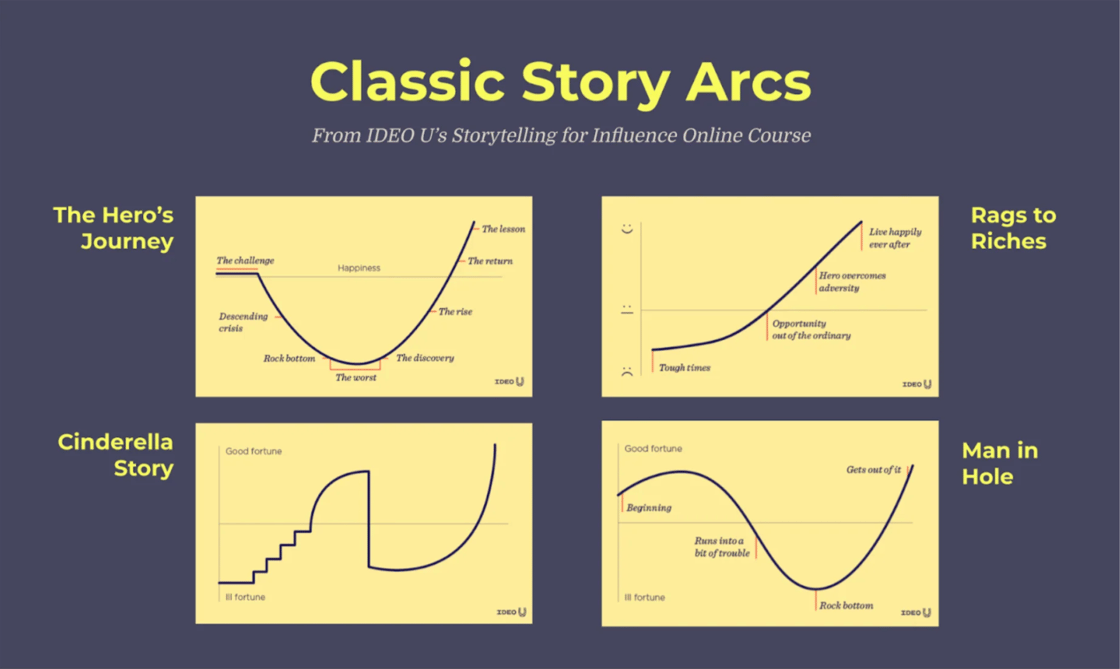
Storytelling Arcs
Every story has a shape, whether you choose it intentionally or not. It’s easy to reach for the same one, but the arc of your story matters as much as what’s in it.
The Hero's Journey — if you want your audience to adopt a new idea.
Rags to Riches — to communicate hope, optimism, and perseverance.
Cinderella Story — to show that negative circumstances can improve, despite obstacles along the way.
Man in Hole — if you navigated through unexpected trouble.
Next time you’re presenting an idea, think about your desired outcome and choose a story arc intentionally.
The Work of Art, by Adam Moss — "Highly recommend this book. It's superb." Shared by an IDEO U community member in a live podcast recording.
Zoe Scaman — A strategist who writes about somatic intelligence: "She's massively inspired me." Shared by Ed White, Creative Storytelling with AI instructor.
Why Do Teens Talk to AI? Ask Them. — "It's just me and a chatbot, so I don't feel like there's any judgment there." Shared by Savannah Kunovsky, IDEO managing director, emerging technology
What We Tell AI — An art project collecting anonymous confessions about people’s relationships with AI. Shared by Jenina Yutuc, IDEO Design Research Lead
Playing to Win for your personal life — Strategist Roger Martin says if you’re “too busy,” your personal strategy sucks. Shared by Rachel Youngblade, IDEO U Marketing Lead
From IDEO U
Why Some Friction Is Good for Your Storytelling: Ed White —Article | Podcast
Building a Personal AI for the Messiness of Life: Sida Li —Article | Podcast
Designing GenAI for the Emotional Side of Money: Johannes Seemann —Article | Podcast
Storytelling Techniques for Entrepreneurs (Replay): Tom Kelley —Article | Podcast