
|
 |
👋 Hi, this is Gergely with a subscriber-only issue of the Pragmatic Engineer Newsletter. In every issue, I cover challenges at Big Tech and startups through the lens of engineering managers and senior engineers. If you’ve been forwarded this email, you can subscribe here.
What is happening with code reviews?
AI generates more code than devs can track in 2026, so will the code review process have to adapt – or is it doomed? A look into this decades-old practice and the approaches that could replace it
|

| |||||||||||||||


One question haunting the minds of CTOs and heads of engineering whom I’ve been talking with, is how to deal with large quantities of code review which have only been growing now that AI agents generate most code at many tech companies.
Since the end of 2025, it has seemed that the era of devs writing code by hand is over at startups and in Big Tech. AI agents work faster and generate more pull requests (PRs) than devs ever did, and the size of those pull requests is also increasing.
Today’s article summarizes some approaches to code review at various workplaces in this new paradigm, covering:
Humans review the AI code reviews. The most popular approach: AI code review tools go through code changes, and devs review the review itself.
Triage by “blast radius” & decide an approach. Low-risk changes don’t need human review, and high-risk ones do. Adopted by OpenAI, Anthropic, and others.
Review the plan/tests/database schema, but not implementation. Focus on reviewing the “before” and “after” states of an implementation, rather than the implementation itself.
Produce less code. Set up AI agents to produce smaller PRs that are easier to review and reason about.
Review everything by hand. Not everyone has adopted AI code review tools – even those that have sometimes still expect devs to read through all the new code, before allowing it to go to prod.
No human code review? There’s more talk about dropping human code reviews than there is evidence of this actually happening, so far. The most I could find was AI startups doing it and building additional layers for safer production rollouts.
Why do we review code, anyway? Before figuring out whether or not code review should stay, it’s worth going back to the fundamental technical, team, and organizational reasons for code reviews.
Unsurprisingly, it’s clear there’s no one-size-fits-all solution to the question of how to handle a deluge of AI-generated code review. Please leave a comment below about how your team or company deals with this new, pressing issue!
A snapshot of what’s going on in code review at this stage of AI development is provided by the graphic from GitHub, below. The background context it provides is pretty stark. It shows the stats for the number of PRs and commits over the course of three years on the popular platform:
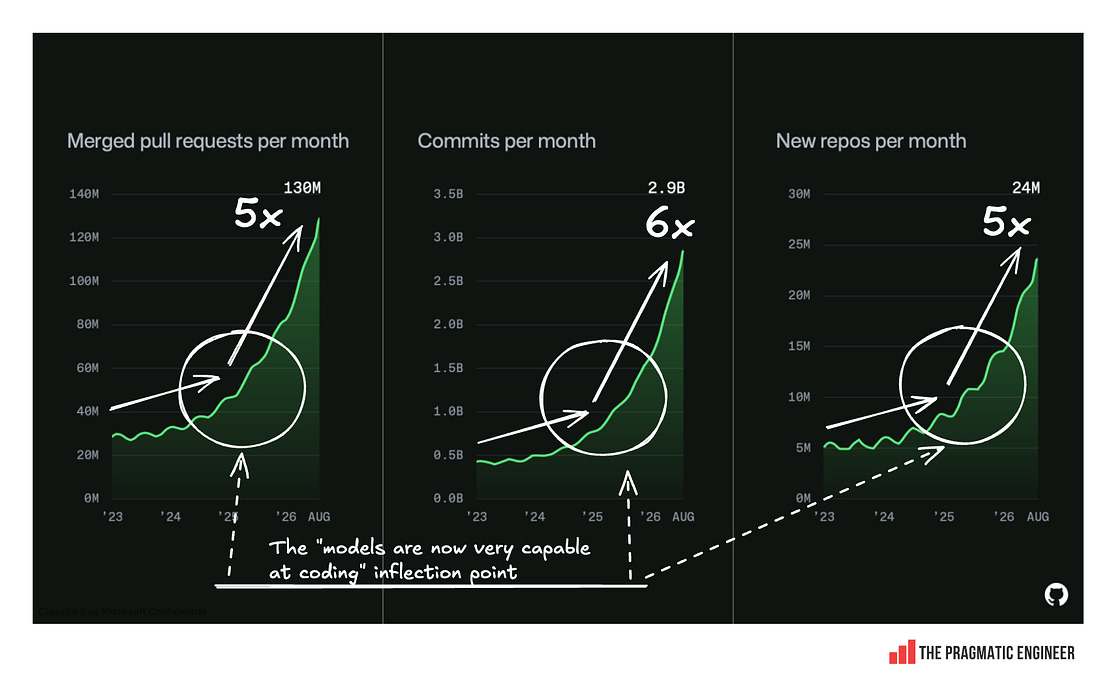 |
Over that time, the number of PRs opened has increased fivefold, which is a lot! And growth sped up from the end of 2025, when PRs and commits nearly doubled just in that period alone! So, how are teams dealing with this avalanche of extra work? To find out more, I asked around.
1. Humans review the AI code reviews
The most common approach is to add an AI code review step to every pull request in a variety of ways:
Use one or more vendors to review PRs. There are dozens of vendors offering this functionality – ones like CodeRabbit, Gitar, Greptile, GitHub Copilot Code Review, Qodo, Claude Code Review, Ellipsis and more. Many teams choose one or more, and the bots then review PRs, leaving comments for devs. For example, the Bun project by Anthropic has CodeRabbit, GitHub Code Review, and Claude Code Review all generating comments on PRs.
Multi-agent code review. Build a custom solution which triggers several models/agents to review the code and suggest fixes.
Agents update PRs with fixes. Vendors and home-grown solutions can instruct agents to update PRs with fixes and then re-trigger reviews – if you trust agents to make sensible fixes, that is!
Typical processes:
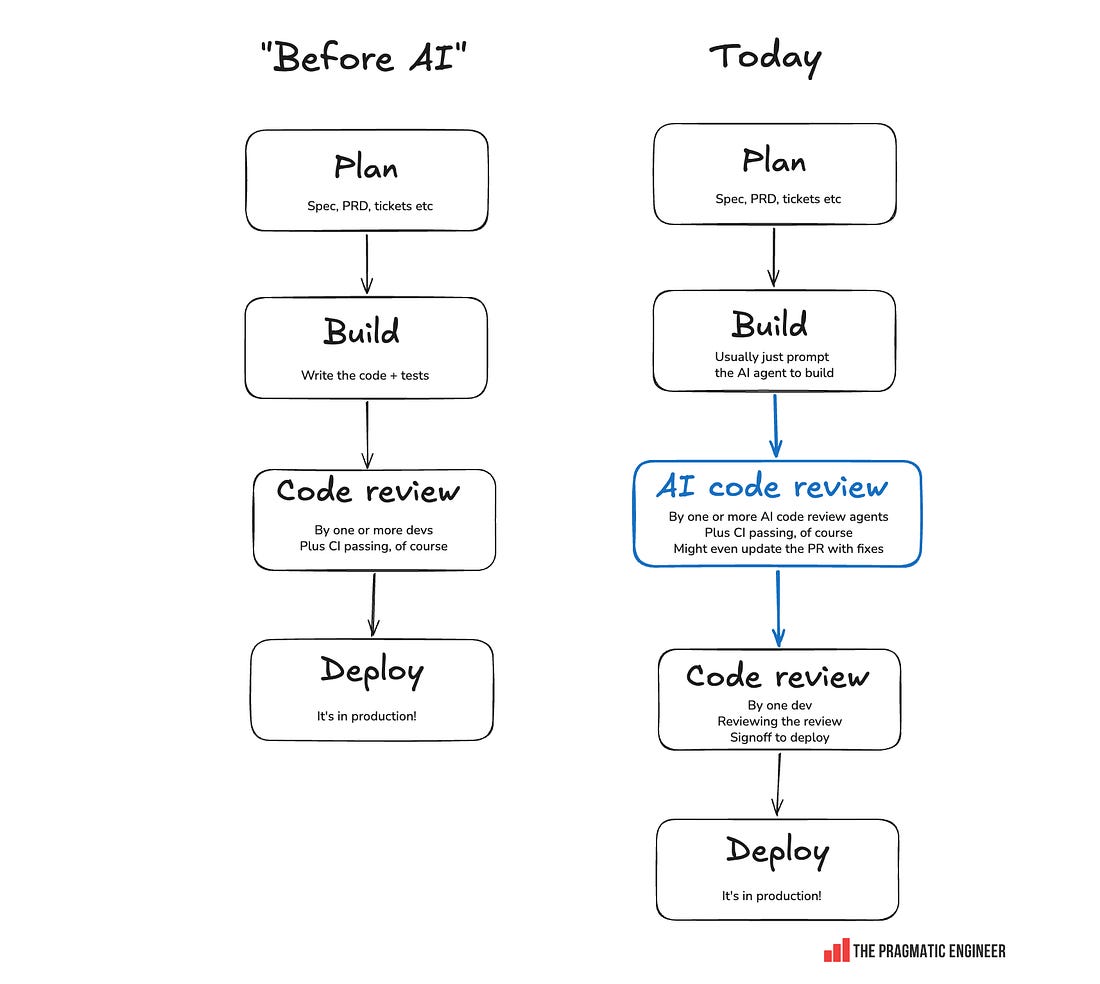 |
In the above cases, engineers typically review the review itself, and not usually the code. Here’s Etienne Dilocker, cofounder and CTO at AI database software, Weaviate, explaining why he likes their approach:
“It’s very hard for agents to get the balance [of the code review] right. If you ignore human code review entirely and leave it to agents, every PR will either suffer from scope creep or ship critical issues. But, of course, you can’t review everything by hand. So my current favorite setup is: