
| Forwarded this email? Subscribe for more |



 |
| By Simon Sebag Montefiore | PREVIEW |
Is there a more consequential region in the world than the Middle East? Its wars, rivalries, and upheavals have shaped the world for millennia, and show no signs of abating. And few people are better equipped to explain them than historian Simon Sebag Montefiore.
In 2011, Dr. Montefiore released his bestseller, “Jerusalem,” an epic, 3,000-year history of a city whose influence extends far beyond its walls. And in his forthcoming book, “The Cauldron,” he turns to the modern Middle East, tracing its history from 1900 to today.
Today’s essay, which he has written specifically for us, takes on the question at the core of the region’s turbulent history. In a landscape defined by competing powers vying for dominance, who will win? For anyone seeking to understand the forces reshaping the Middle East—and the world—this is essential reading.
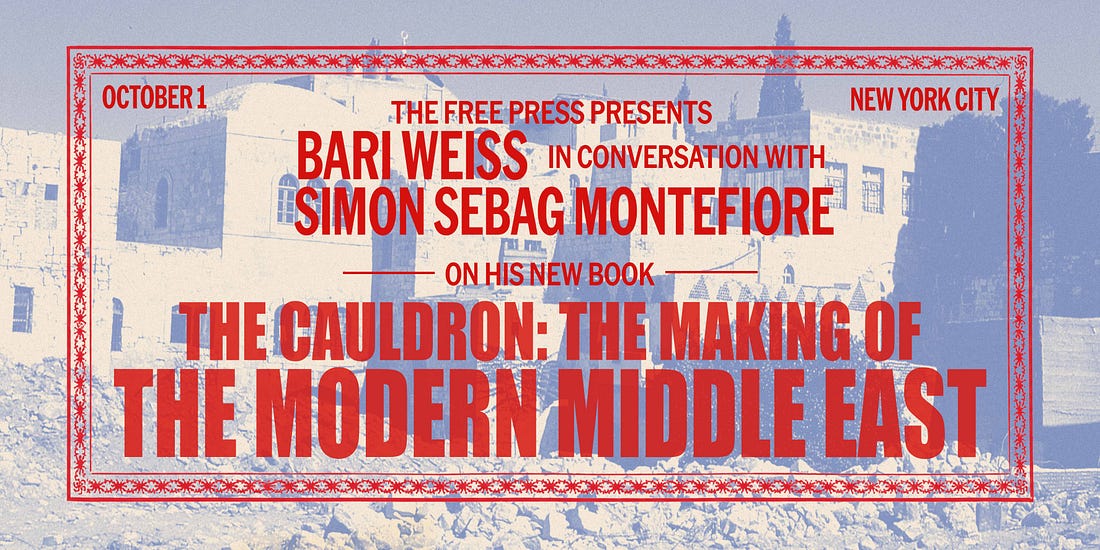
And that’s not all. On October 1, Free Press founder and CBS News editor-in-chief Bari Weiss returns to the stage for her first live event in nearly a year, sitting down with Montefiore for the opening night of his U.S. book tour. The two will meet in uptown Manhattan for a wide-ranging conversation about the history that made the modern Middle East, and the forces shaping it now. A limited number of tickets include a signed copy of “The Cauldron.” Get your tickets here. (Paying subscribers get early access to tickets until Thursday at 12 p.m. ET.) You won’t want to miss this. —The Editors
 |
 |

Every day, it becomes clearer that the tournament of power known as The October 7 Wars—the spasm of conflict between Israel and America versus Iran and its proxies unleashed by Hamas’s slaughter spree three years ago—marks a new era in the turbulent history of the Middle East. While America’s armed blockade may be starting to make gains against Iran (which, in turn, is being quietly supported by the other megapowers, China and Russia), the powers of the region are realigning themselves in profound and once unimaginable ways, trying out new alignments and conjunctions.
A month ago, on August 7, Saudi Arabia, Turkey, and Pakistan signed the Mecca Joint Defense Agreement, a self-declared “Islamic NATO” in which “any armed attack against any one of the three states shall be regarded as an attack against them all.” Israel, meanwhile, has signed a huge defense contract with Greece and intensified its cooperation with India. Iran has continued to hit Arab states—some advised on their defenses by Ukraine, others by Israel, all by America—while its ally Russia furnishes it with new missile technology. And across the region, large and small powers are promoting neo-imperial interests—particularly in a new arena of competition for rising Middle East powers, East Africa. According to U.S. African plenipotentiary Massad Boulos (whose son Michael is married to President Donald Trump’s daughter Tiffany), a total of 12 Middle Eastern powers are participating in the Sudan war, the site of the worst humanitarian catastrophe of the last three years.
Which leaves a natural question: Out of all this, who will emerge to rule the Middle East?...
Continue reading 'Simon Sebag Montefiore: Who Will Rule the Middle East?' | |||||||||||||||||||||||||||
Or | |||||||||||||||||||||||||||
|
