Risk and Protective Factors
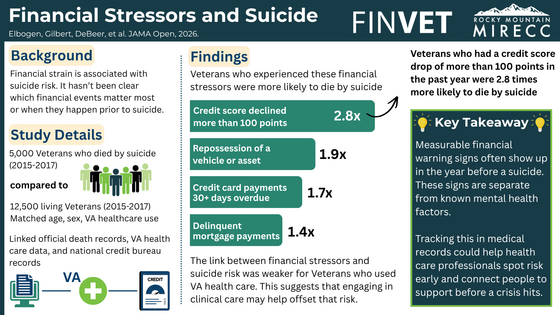 Our researchers and other colleagues found that suicide was associated with financial stressors in the prior twelve months (detailed results here). Examples of financial stressors include delinquent mortgage payments and late credit card payments. Visit FINVET to find money resources that can boost financial literacy and help navigate Veterans’ financial journey.
During transition from military to civilian life, most Veterans reported low initial financial well-being, but consistently high vocational and social well-being (published findings).
Researchers looked at newly identified suicidal ideation and suicide attempts among service members following traumatic brain injury (view findings). Findings highlight suicidal ideation and suicide attempt risk by sex, with females at higher risk than males.
We collaborated with other VA researchers to look at suicide risk for Veterans experiencing criminal legal involvement and/or homelessness (article available here). Findings show a high prevalence of suicide-related outcomes for Veterans in both groups, pointing to a potential need for augmented risk assessment.
Clinical Interventions
 We contributed to research on the national implementation of the Safety Planning Intervention for VHA patients at risk for suicide. Of those who were supposed to complete a safety plan, about 98% did so within the required time frame (read findings).
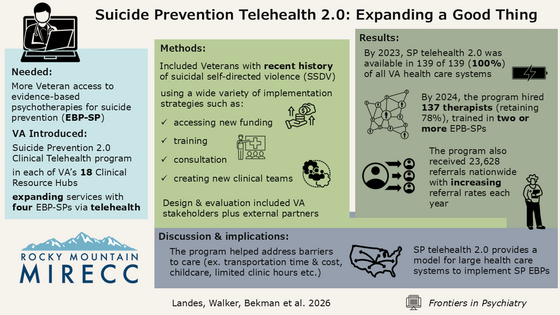
We also collaborated on an examination of Suicide Prevention 2.0 (SP 2.0), expanding suicide prevention treatments via telehealth. By April 2023, SP 2.0 was available in all 139 VA health care systems. By September 2024, there were 23,628 referrals (article here).
Veterans and service members often face potentially morally injurious events that violate one’s morals and are related to increased suicide risk. A Rocky Mountain MIRECC team developed two interventions for moral injury. In preliminary research, both Acceptance and Commitment Therapy for Moral Injury (ACT-MI) and Present Centered Injury for Moral Injury (PCT-MI) were acceptable to Veterans. Veterans described ACT-MI as providing alternatives to suicidal behavior (published findings). A large national study is now underway to fully evaluate how well these interventions work.
|