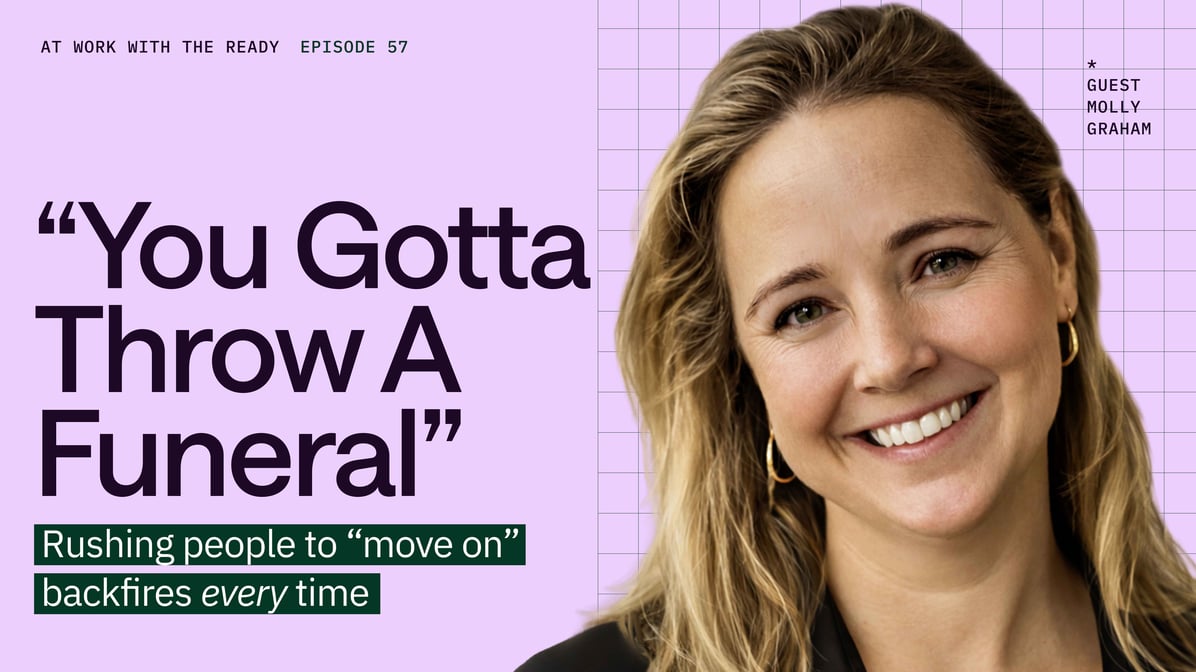
There's a moment in our latest podcast episode (a sharp conversation between Rodney Evans and guest Molly Graham, who picked up the WorkLife podcast mantle from Adam Grant this year) that's bounced around my brain for two days:
"When you do big change events, you have to design grief into the process. How are you going to help people hold it? You need to make space for it before getting all fluffy bunny with people. They need time to process the change, whatever form it takes. Too often, we want to rush and push people into the future."
It is so deeply human to want to expedite the big change-to-fluffy bunny pipeline. I've been on Team Fluffy Bunny before, pumping up colleagues who seemed skeptical of [insert massive shift here] and were approaching it with trepidation or sadness. I've also been on the receiving end of FBE (a.k.a. Fluffy Bunny Energy) before my own anger or disbelief could settle in my body. The rush to move on—whether you're the rusher or the rush-ee—can result in feelings of resentment and distrust if you're not careful. And by "not careful," I mean if you try to divorce human experience from organizational change.
Fear sweats. Worry dreams. Fretful bargaining over a decision that's already been locked in.
Trying to navigate our operational environments with zero room for emotional processing, or with weak gestures toward processing time while the thinly-veiled desire from the LT is for everyone to "get back to normal," is patronizing at best and corrosive at worst. Because as Rodney and Molly discuss, an organization built around avoiding feelings doesn't have fewer feelings to grapple with. It just has an underground pit of unprocessed grief that gets bigger and deeper over time.
But morale!
The short-term gains of good vibes, a clean all-hands, and the patina of productivity quickly give way to long-term consequences like low trust, incoherence, burnout, and inertia. Without formal structures to hold and learn from feelings, people often build informal ones—like the water cooler vent session or the midday job search. Those cost more energy than saying the hard thing out loud ever would.
Therein lies the rub with Fluffy Bunny Energy: a well-intentioned approach rooted in a desire to preserve morale can instead cause harm, because the smoothness being pushed on the surface feels detached from the human experience churning below it.
We shed. We change. We shed again.
The snakeskin-like shedding of hopes, dreams, and old identities that happens at work, both for individuals and for companies, isn't bad. It's an organic response to change. But without explicitly designing that into the process, and without clear incentives that let people grieve what they're being asked to either give up or become, you don't get the trust that lives on the other side of it.
Rodney and Molly have different insights on how to lead teams through change, but here's what's non-negotiable: You can't ask folks to absorb change in an emotionless void. It's not only a disservice to humans (that includes you), but it also weakens the space, role, or team you're asking people to step into and energize.
So the next time your instinct is to lead with FBE, pause. Slow down. And try asking your team "What do you need right now to make sense of what's happening?" The answer might actually be a lightweight version of FBE. But it might also be the unvarnished truth about why a big decision was made. Or the afternoon off. Or something else entirely that feels like participation instead of a push.
The Ready, 6312 S Fiddlers Green Circle, Suite 300E, Greenwood Village, CO 80111, United States

.jpg?width=1196&upscale=true&name=the-ready-sky-session-sign-up%20-%202%20(1).jpg)
