By Ivana Saric
Digital Editor, Council on Foreign Relations |
President Donald Trump will welcome Chinese President Xi Jinping for his first state visit in more than a decade tonight, kicking off a three-day summit.
The visit comes as a bilateral trade truce struck last year is set to expire in November; The United States faces midterm elections that could decide the control of Congress; The U.S.-China artificial intelligence (AI) race is top-of-mind among industry leaders and government officials in both countries; And Xi is preparing for the Chinese Communist Party’s 2027 congress, where he hopes to secure a fourth term.
“The current ‘détente but not quite a détente’ suits Beijing just fine,” Rush Doshi, director of CFR’s China Strategy Initiative, wrote in a new expert take. He said Beijing will largely want to maintain the status quo, extending “what it sees as Trump’s de-escalatory approach” through his term. And though the United States has taken some steps to counter China, Trump “favors stability” in the bilateral relationship, Doshi said.
Though Xi’s visit “isn’t likely to produce many deliverables,” Doshi identified ten defining issues.
Trade is a critical question: whether Washington and Beijing will extend the current truce, as well as the possibility of further U.S. sanctions on China. In the same vein, Chinese auto investments in the United States have stalled and past purchase commitments are not yet confirmed, while new ones could filter through a “still-nebulous” U.S.-China Board of Trade, Doshi said. Then come a host of questions around the bilateral AI dialogue, including which government agencies will be invited to the table and whether either Washington or Beijing will agree to regulate the technology.
“The lowest-hanging fruit is not a negotiated slowdown but coordinated parallel regulation, with each side adopting similar safeguards on its own,” Doshi wrote. But, “there’s a long way to go on both sides.” U.S. chip export controls and concerns about AI training are also important considerations, Doshi added, though it is unclear whether those will be part of the discussion during the summit. Finally, several geopolitical concerns could also influence the visit. These include U.S. policy toward Taiwan, the Iran war, and further cooperation to crack down on fentanyl. Read Doshi’s full analysis of the issues at CFR.org. The Daily Brief will bring you the latest from this important state visit, along with more CFR analysis, tomorrow. |
|
|
|
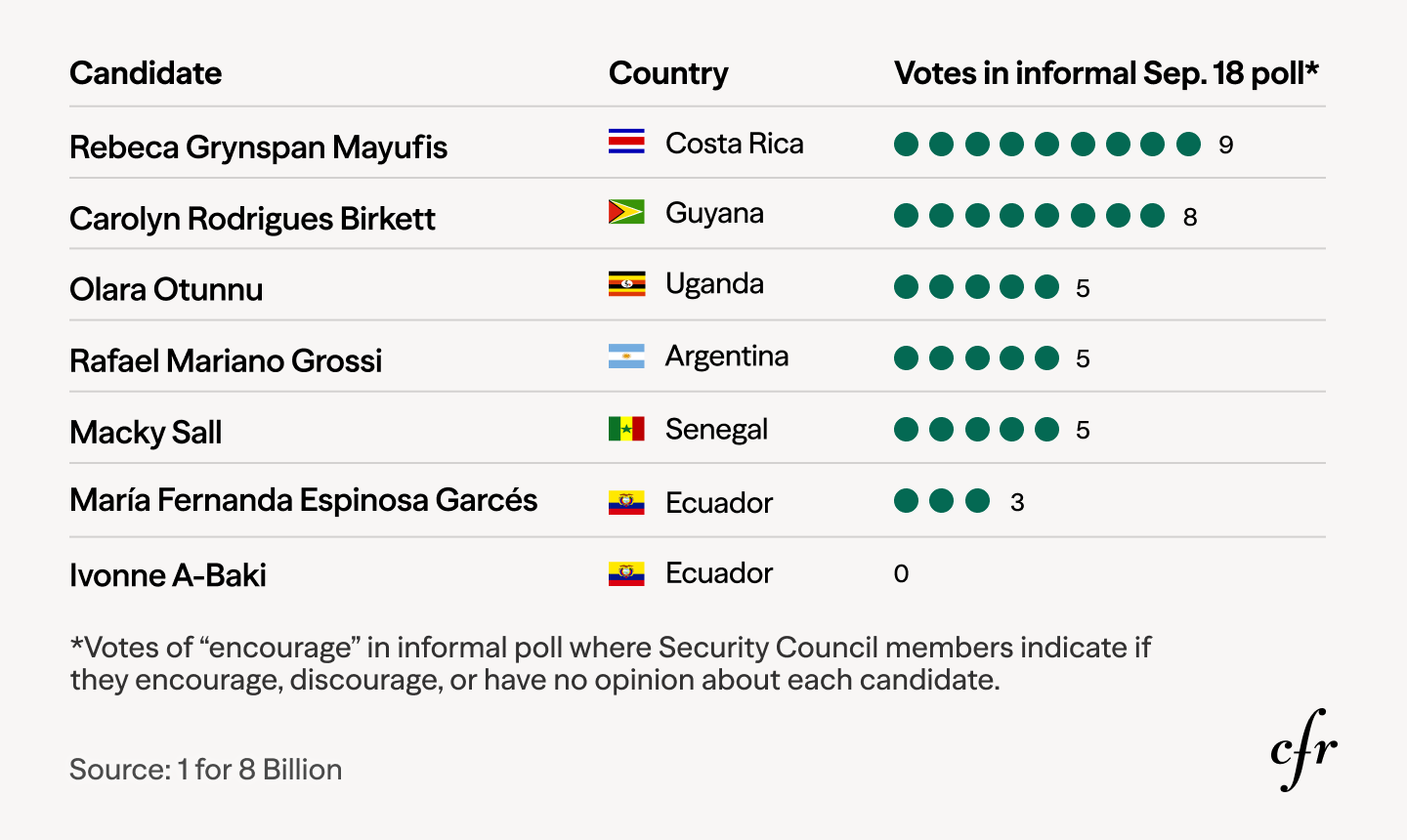
Seven candidates are currently vying to succeed UN Secretary-General António Guterres, whose term ends in December. With four women in the running, the election could see the body elect its first woman leader. As CFR’s Linda Robinson told the Daily Brief, having a woman serve in the United Nation’ most prominent position “would help raise the profile of the UN efforts on behalf of women and children as the body embarks on an intensive restructuring to become more efficient and effective.”
|
To learn more about the role of the UN secretary-general and the selection process, check out CFR’s article on the topic. |
|
|
|
World leaders and thinkers are speaking at CFR during the UN General Assembly week. Senior Editor Diana Roy is there in person to bring their insights in the Daily Brief. -
Philippines Secretary of Foreign Affairs Ma. Theresa Lazaro Discusses Foreign Policy Priorities: The U.S.-Philippines military relationship is “ironclad,” said Lazaro, adding that there has been “a good number of collaborations” between the two countries’ defense establishments, particularly on maritime cooperation. On China, Lazaro said trade relations are “robust,” though “on the security side, obviously [maritime] encounters continue.” Regionally, she noted that the Association of Southeast Asian Nations (ASEAN) is “endeavoring to finish a code of conduct” for the South China Sea, though there are still “milestone issues” that need to be discussed, such as definitions of self-restraint. Energy security is also a regional priority, including efforts to establish an ASEAN Power Grid and diversify suppliers, Lazaro said.
Watch the full conversation with Secretary of Foreign Affairs Ma. Theresa Lazaro.
-
South Africa Foreign Minister Ronald Lamola Analyzes U.S. Relations, Calls for Greater African Representation: South Africa considers the United States an important strategic partner, with U.S. companies playing a significant role in the country’s economy and bringing “new, modern technology” into the market, said Lamola. However, he added that disagreements over mining and the Trump administration’s resettlement program, which primarily applies to Afrikaners, have created tensions. He said the country has “worked very hard” to preserve its “unity in diversity,” and rejected allegations of genocide against Afrikaners as “fake news.” When it comes to multilateral institutions, Lamola described BRICS as “an important voice” for the Global South and called for greater African representation on the world stage. He added that perhaps the UN Security Council was “irrelevant” because “the African continent is not there.”
Keep an eye out for the full conversation with Foreign Minister Ronald Lamola on CFR’s events page. |
|
|
|
Every day, the Daily Brief brings you a curated list of the top stories from around the world. |
- ICC Convicts Former Central African Republic Militia Commander. The International Criminal Court convicted Mahamat Said Abdel Kani of carrying out crimes against humanity, including torture, at a detention center.
-
Tigrayan Leaders Declare War on Ethiopian Government. Authorities in the country’s Tigray region said they had mobilized forces and seized locations, including an airport, earlier today. It marks a return to conflict for the region, which endured a two-year civil war from 2020 to 2022.
|
-
Venezuela’s Opposition Leader Blocked From Return. María Corina Machado was “denied entry” into Venezuela three times in the past twenty-four hours, her advisor said today. Machado left Venezuela with U.S. assistance prior to the intervention that ousted former President Nicolás Maduro and is now considered a fugitive by Caracas. Meanwhile, interim President Delcy Rodríguez met with Trump in New York, less than seven miles from the prison where Maduro is held.
-
Argentina’s Milei Renews Falklands Islands Claim at UNGA. President Javier Milei reupped his country’s sovereignty claims over the disputed Falklands, a British overseas territory, and criticized the United Nations for its ineffective response to the tensions, in a speech today.
|
-
India Election Panel Faces Scrutiny After Report. According to an investigation by the Indian Express, the panel pushed through voter roll measures that could exclude tens of millions of voters, despite concerns from two of three commissioners about the legality of the moves.
|
-
Italian Lawmakers Approve Return to Nuclear Energy. The country’s senate passed a bill today that would pave the way for the construction of new atomic energy plants. The government has twelve months to draft decrees covering implementation issues like safety standards and reactor licensing.
- Zelenskyy Encourages World Leaders to Target Russian Revenues. Addressing the UN General Assembly, Ukrainian President Volodymyr Zelenskyy warned that countries trading with Russia “give this war more time.”
|
-
Tehran Accuses Washington of ‘Terrorism.’ Iranian President Masoud Pezeshkian told the UN General Assembly today that Iranians had been “victims of terrorism” by the United States. It came a day after Trump said he was weighing whether to “annihilate” Iran. Both leaders also said they were open to diplomacy.
-
Axios: Trump’s Board of Peace Pitches Gaza Plan. The $2.45 billion plan offers an outline for the enclave’s postwar reconstruction and governance. It encompasses sixty-six projects covering infrastructure development, economic acceleration, peace and security, and more, but requires Israeli and Hamas cooperation to implement.
|
|
|
|
Host: Ivana Saric
Editor: Xian Chiang Waren
Email Operations: Eric Rojas
Editorial Director, News: Phil McCausland
Editor-at-Large: Robert McMahon
Chief Digital Content Officer: Millie Tran |
|
|
|
58 East 68th Street, New York, NY 10065 |
1777 F Street, NW, Washington, DC 20006 |
|
|
|
|