Betting on the weather isn’t new, but some climate scientists have been left feeling queasy about people placing bets on the well-documented breakdown of a stable climate, caused by the burning of fossil fuels.
Such bets, they argue, trivialise and gamify raw human suffering, distancing people rather than rallying them to act on the climate crisis. Particular alarm has been raised about the consequences of betting on wildfires, after large wagers were placed on the Los Angeles fires last year (Kalshi and Polymarket stress they have banned such betting, due to unintended incentives for would-be arsonists).
“I find it depressing because it’s distracting us from what we should be focusing on,” said Kaitlyn Trudeau, a scientist at the non-profit Climate Central. Trudeau’s own grandfather lost his home in the LA fires, and she was aghast to find that people had been betting on the disaster.
“I’m not against prediction markets in general but we need to be clear about the downsides,” she said. “They aren’t going to reduce the risks of climate change or solve climate change.”
When I covered the story this month, though, it was striking to me how these prediction markets, which are essentially a gauge of public opinion, see their role as forecasting events in the natural world. A Kalshi spokesperson told me the company sees itself as part of “well-calibrated forecasting data” – essentially using the wisdom of the market to help predict how hot it will get, how bad floods will become and other such environmental outcomes.
A growing array of data, and the use of artificial intelligence in harnessing it, is indeed helping scientists work out thorny questions over how the climate crisis is set to unfold. Perhaps prediction markets will be able to add to this in some way.
But recent evidence suggests that anyone predicting exactly what will happen to our planet – other than it generally getting hotter, more chaotic and more dangerous – over this century will have a tough task.
The United Nations recently conceded that a foundational international target to restrain the global temperature rise to 1.5C beyond pre-industrial times – a promise made just a decade ago – is now already effectively trashed.
Global heating is too rapid, and too unrestrained, to meet the 1.5C goal, which will cast billions of people into the throes of extreme weather, food insecurity and heightened risk of the sort of cataclysm we recently saw in Nepal.
Conversely, the advance of clean energy means that the very worst previous scenario, a pathway known as RCP8.5 and lined with rampant coal burning, is now unlikely. The absolute worst, but also the most optimistic, scenarios have been swept from the table, all in just a handful of years.
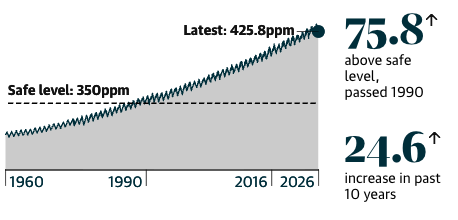
The world itself will have further surprises in store for us as we blunderingly fiddle with its chemistry. “Feedback loops” from natural systems such as thawing permafrost, supersized wildfires and overheating wetlands mean that planet-heating emissions coming from such sources could accelerate overall global heating by as much as 30%, a recent study found.
This will add as much as 0.4C to the overall global temperature – a large chunk on top of what is already set to be a disastrous rise in heat. But even in this stark new study, researchers caution that there are uncertainties.
While for now we still retain some control over our own destiny, the situation could still gallop away from humanity – the planet, once provoked, could unleash far hotter temperatures than this. Perhaps – hopefully – it will be less sensitive. But do you really want to bet on that?
Read more:
• Temperature check: alarm as prediction markets lean into weather and climate bets
• The threatening thaw: climate professor on heatwave risks to tipping point of permafrost
• Climate crisis probably weakened glacier that caused devastating Nepal-Tibet floods, first study finds





 Large bets, which are now banned, were placed on Kalshi and Polymarket during the Los Angeles fires in 2025. Photograph: Agustin Paullier/AFP/Getty Images