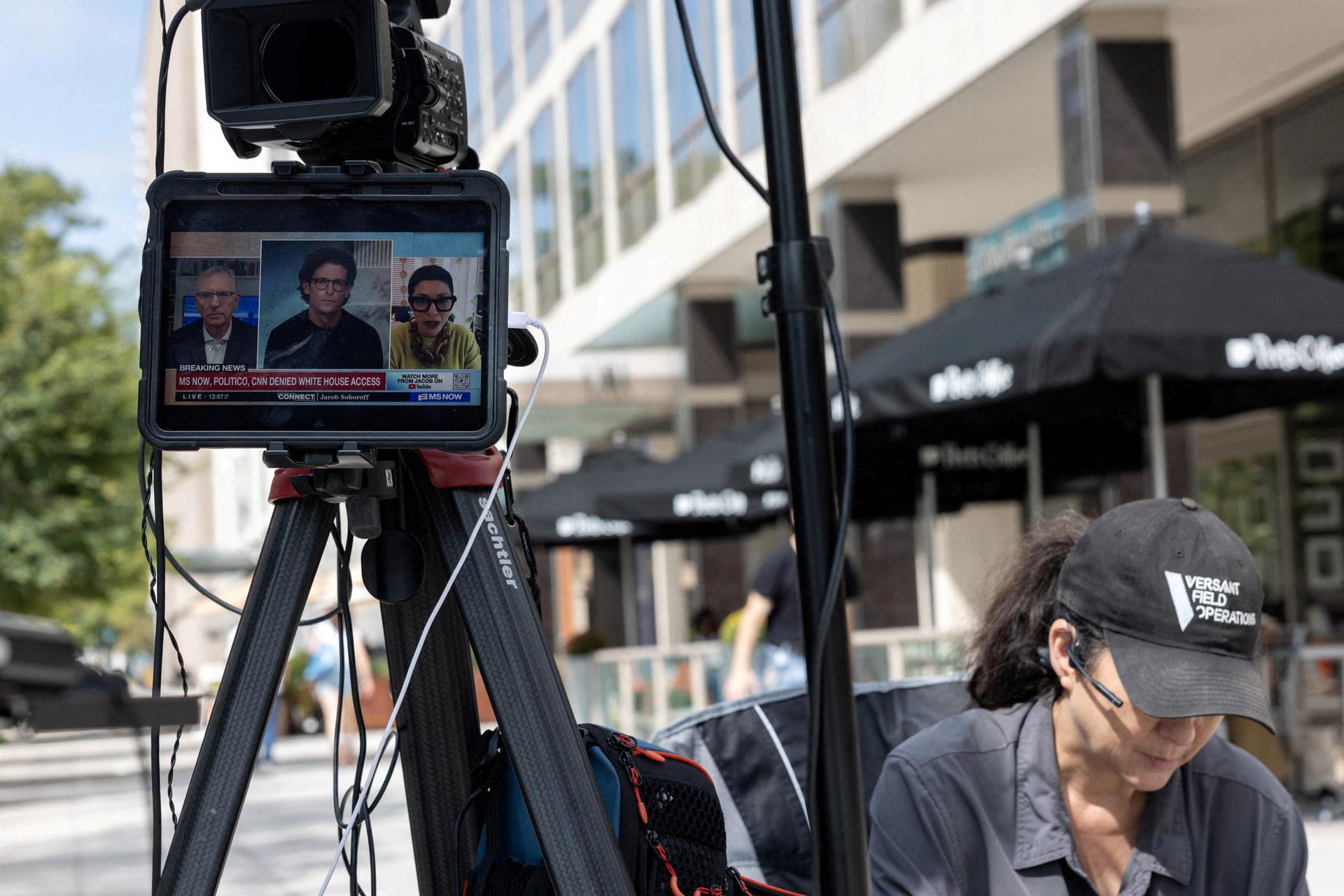
- US District Judge Tim Kelly told the Trump administration that the president’s banning of three media outlets was likely unconstitutional. He ordered the White House to return reporters’ press passes and blocked officials from enforcing the ban for 14 days. He also rejected the government’s assertion that national-security concerns motivated the ban.
- An Iowa judge dismissed Trump’s 2024 lawsuit against the Des Moines Register and pollster J. Ann Selzer, saying a poll that showed Trump trailing before the 2024 elections was legally protected speech.
-
Florida’s state-run public pension fund and a conservative think tank sued the New York Times, seeking materials to determine whether the company’s board is letting the paper promote biased editorial coverage against Israel.
|
-
The world’s two biggest power brokers are meeting in Washington while the rest of the A-listers are snarling traffic in New York City at the United Nations General Assembly. Experts ponder the implications of the Donald Trump-Xi Jinping meeting for the UN and its continuing relevance.
-
Soybeans, sorghum and US farm goods likely will come up as US farmers want China to buy more agricultural products and to ease tariffs on their exports. Rare earths also could feature on the agenda given the US’ continuing reliance on the important minerals which will extend well into the next decade.
- Benjamin Netanyahu will use his appearance at the second-biggest show in town to berate Zohran Mamdani for calling the Israeli prime minister a war criminal.
-
In other General Assembly news, Ghana’s foreign minister said support for slavery reparations is growing among Western nations. Delcy Rodríguez said Venezuela will hold elections but did not say when. The US withheld a visa for Sudan’s army chief, making his attendance contingent on agreeing to a 90-day ceasefire.
|
|
|
|
-
Artificial-intelligence buildout is on track to require a larger share of US output than the rollout of electricity, railroads, interstate highways or the internet, a researcher said. The increasingly complicated financial structure to handle this comes with systemic risks, Stijn Van Nieuwerburgh wrote in a paper prepared for a Brookings Institution conference.
- History suggests that US stocks are poised for weakness as the Fed starts raising interest rates. Investors who want to properly gauge the fallout will focus on how much aggression the central bank applies as well as the economy’s response, my colleague Ann Saphir writes.
-
On that topic, learn how Fed officials want to pursue this path without damaging the job market.
-
Bond traders. They’re not only dreamy, they’re incredibly prudent. Find out how they navigate tumultuous markets. And if you don’t know what the Treasury basis trade is or why it’s falling out of favor lately, this is your chance to find out.
-
More on that note: SoftBank Group raised more than $11 billion in the largest high-yield corporate bond sale on record. Why? To fund its bets on AI, of course. Columnist Mike Dolan says Wednesday’s market rout shows why it’s not time to return to the bond market. And from reporters Marc Jones and Naomi Rovnick: A 5% benchmark on the US 10-year Treasury yield was seen as the point at which global financial markets would hit turbulence. Investors will have to rethink that idea.
|
|
|
|
I’m an elite athlete, get me out of here
|
|
|
|
|