|
Hello Network Members!
We look forward to seeing everyone at our upcoming meeting on October 6 from 10:00 AM - 12:00 PM. We'll have a discussion about trauma in active duty military members, veterans, and military-connected families; a presentation on the new Fairfax County Youth Survey data (preview below); and more!
If you don't already have the meeting on your calendar, please sign up below to receive the invitation and link:
In the meantime, please check out the announcements and information below.
Sincerely,
Your TICN Coordinator
This training is designed for behavioral health clinicians (and supervisors who still carry an applicable caseload**) who are treating clients under age 18 who are at risk of suicide and who are part of the LGBTQ+ community. Lesbian, Gay, Bisexual, Transgender, and Queer/Questioning (LGBTQ+) youth experience higher rates of suicidal thoughts and behaviors than their heterosexual and cisgender peers. This training will provide an overview of the factors that drive these disparities and teach strategies to enhance the delivery of evidence-based care for queer youth at risk for suicide. Recommendations are informed by the perspectives of youth with lived experience in combination with evidence-based approaches from the field of suicide prevention. Training content will be delivered through one virtual training session that includes didactic material, question and answer time with the trainer, and the opportunity to attend three post-training consultation calls.
**If space allows, there may be an opportunity for clinical supervisors who do not have their own caseloads to audit this training. If you do not carry a caseload of your own, but supervise clinicians who meet this training's eligibility criteria, please DO NOT complete an application and instead email us at FCEBP@gmu.edu with an audit inquiry.
Training Format & Dates:
-
Delivery: Virtual via Zoom
-
Date & Time: October 23rd, 2026, 9am – 12pm EST
-
CEUs Available: up to 0.3 CEUs when converted under SACSCOC standards (GMU awards CEUs using SACSCOC conversion standards wherein one CEU is equal to TEN instruction hours; this 3 hour training becomes 0.3 CEUs when converted)
Eligibility Requirements: To apply, you must:
-
Be licensed or license-eligible (i.e., undergoing formal clinical supervision for licensure from a licensed clinical supervisor) to provide therapy services.
Possess a masters degree or higher in a mental health related field by the date of training.
Currently be providing therapy services to youth/adolescent clients (~7 - 18 years of age)
Have at least 1 resident of Fairfax County/City (under age 18) on their caseload, OR: be employed by an organization located in Fairfax County/City
Be available to attend for the full duration of training without interruption.
Commit to keep your camera turned on and remain visible and engaged for the full duration of training and acknowledge that failure to do so will result in CEUs being reduced.
Complete pre- and post-training assessments for each day of training, and complete one 6-month follow up after the training has concluded.
Note: it is not required that applicants have a member of the LGBTQ+ community on their current caseload, however eligible applicants who do will receive priority admission.
Application Details:
-
Deadline: Friday, September 25, 2026, 5pm EST.
-
Estimated Completion Time: ~10 minutes
-
Confirmation: You’ll receive an automated email upon successful submission (check your spam folder if needed).
-
Decision Notification: Decisions will be communicated to all applicants by September 28, 2026.
Apply Now:
https://gmuchss.az1.qualtrics.com/jfe/form/SV_djvqAuSL8eEnlIy
Questions?
Please email FCEBP@gmu.edu with any questions.
Each fall, Fairfax County Public Schools (FCPS), the Fairfax-Falls Church Community Services Board (CSB), the Virginia Department for Aging and Rehabilitative Services (DARS), and The Arc of Northern Virginia sponsor:
Moving on to Life in the Community: A Resource Fair
-
Who should attend: Students with developmental or intellectual disabilities and their families
-
Purpose: Learn about adult services and supports available after transitioning from FCPS
-
Representatives will provide information about:
- Adult service providers
- Employment and training programs
- Medicaid and Social Security
- Residential options
- Supported employment
- Day support programs
- Recreation and leisure activities
- Travel training
- Advocacy and funding
- And more
Date: Thursday, November 19, 2026
Time: 6:30–8:30 p.m.
Location: Fairfax High School cafeteria
Entry: Door 1
Register here
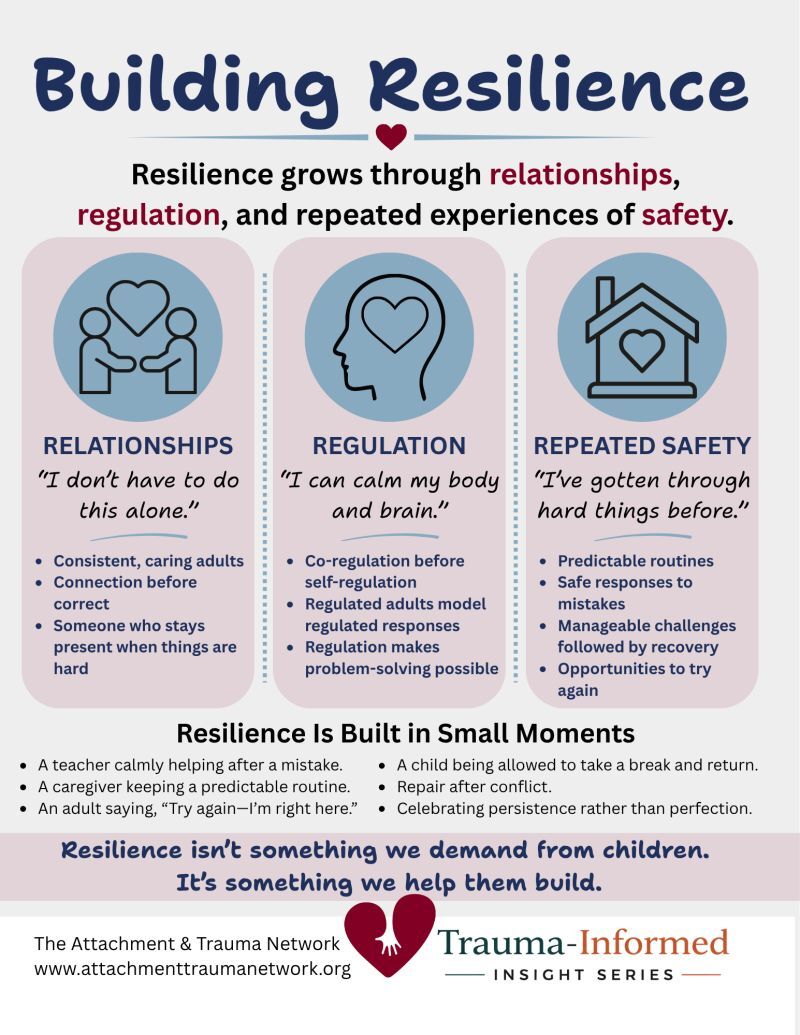 This is an educational infographic titled ‘Building Resilience’ and subtitled ‘Resilience grows through relationships, regulation, and repeated experiences of safety.’ The graphic has three columns with icons and text.
Left column, ‘Relationships – “I don’t have to do this alone.”’ Icon of two people holding a heart. Bullet points: consistent, caring adults; connection before correction; someone who stays present when things are hard.
Middle column, ‘Regulation – “I can calm my body and brain.”’ Icon of a head with a heart in the brain area. Bullet points: co‑regulation before self‑regulation; regulated adults model regulated responses; regulation makes problem‑solving possible.
Right column, ‘Repeated Safety – “I’ve gotten through hard things before.”’ Icon of a house with a heart inside. Bullet points: predictable routines; safe responses to mistakes; manageable challenges followed by recovery; opportunities to try again.
Section heading: ‘Resilience Is Built in Small Moments.’ Examples listed: a teacher calmly helping after a mistake; a caregiver keeping a predictable routine; an adult saying, ‘Try again—I’m right here’; a child allowed to take a break and return; repair after conflict; celebrating persistence rather than perfection.
Bottom banner text: ‘Resilience isn’t something we demand from children. It’s something we help them build.’ Logo and website for The Attachment & Trauma Network and note that this is part of the Trauma-Informed Insight Series.
Check out these five takeaways from the latest Youth Survey:
1. Mental health among Fairfax County Youth continued to improve
Overall, the mental health indicators among 8th, 10th, and 12th grade students, including levels of stress, persistent feelings of sadness or hopelessness, suicidal ideation and suicidal attempts continued to improve significantly since 2021. The 2025 rate of persistent feelings of sadness and hopelessness was at 18% and was a 20 percentage-point drop from the rate in 2021. Meanwhile, over one in four 6th grade students (26%) reported this feeling, a seven percentage-point decrease from the rate in 2021.
2. Rates of substance use among Fairfax County youth were lower than national rates
The majority of students (90% of 8th, 10th, and 12th grade students and 96% of 6th grade students) reported no use of any substance in the past month. Most rates of substance use among Fairfax County students were less than the national rates for past month including the use of alcohol, cannabis, cigarettes, hookah and vaping.
3. Many students reported engaging in physical activities
About half of 8th, 10th, and 12th grade students (45%) and 6th grade students (51%) reported being physically active for at least one hour per day for five or more days in the week prior to the survey. The 2025 rates were the highest since 2018. Additionally, over 40% of 8th, 10th, and 12th grade students and 60% of 6th grade students reported doing something active with family or friends three or more times for the same period.
4. Some students spent over three hours per day using social media or playing video games
One fourth of 6th grade students (25%) and over a third of 8th, 10th, and 12th grade students (37%) reported using social media for three or more hours on an average school day. Meanwhile, one fifth of 6th grade students (20%) and 14% of 8th, 10th, and 12th grade students reported playing video or computer games for three or more hours on an average school day.
5. The majority of Fairfax County Youth students reported having support at home, school and in the community
Most 8th, 10th, and 12th grade students reported having adults in their community they can talk to (85%), a trusted adult at school (80%), and parents, caregivers, or other adults in the family whom they can ask for help (89%).
|