 |
|
Audit Buzz Newsletter
September 2026
|
In this issue, we share an article about Fighting Fraud in the Digital Age; promote the Fraud, Waste, and Abuse hotline; and offer a training opportunity.
Prior editions of Audit Buzz are archived here on Office of Auditor General (OAG) website.
We appreciate the continued cooperation and courtesy shown to our staff by Fairfax County Public Schools (FCPS) management and employees during all audit engagements.
Knowledge Hive
Fighting Fraud in the Digital Age
Experts and investigators recently gathered at the Association of Certified Fraud Examiners, DC Chapter, Fraud Summit in Washington, D.C., to share ideas on how to spot and stop fraud schemes. As technology advances, scammers are finding better new ways to misappropriate money and information. At the same time, agencies and local governments are using better strategies to protect the public funds.
1. Artificial Intelligence: A Powerful Tool with Risks
Artificial Intelligence (AI) can help investigators predict future risks, with the following considerations:
-
Do Not Rely Solely on AI: AI can be used as a starting point for investigations, and humans must make the final decisions. Relying completely on AI to conduct interviews or solve cases can lead to serious errors.
-
Bad Data In, Bad Data Out: AI is only as smart as the information it is given. Before using AI tools, organizations need clear rules, strong privacy and governance protections, and good data.
2. Trust Must Come with Verification, Independent Review, Segregation of Duties and Accountability
Trusting someone is not a substitute for proper checks and balances.
-
The Trusted Insider Risk: When an employee is liked and trusted by everyone, people often stop checking their work. This gives bad actors a chance to commit fraud without getting caught.
-
Always Verify: Organizations must use independent reviews, rotate job duties, and apply oversight rules to everyone. No matter how high up or trusted they are.
3. Deepfakes and Fake Websites Are Expanding
Scammers are using modern technology to make fake content look completely real.
-
Seeing Is Not Always Believing: Fraudsters can use AI to mimic voices on phone calls or create fake video streams to trick people into sending money.
-
Watch for Online Red Flags: Scammers build fake websites and fake LinkedIn profiles to build trust before stealing money. Double-checking information through official sources and using safe words with family or coworkers can help prevent these traps.
4. Fraud Prevention: From Reactive to Proactive
OAG presented this topic at this Fraud Summit, focusing on our four-part holistic strategy to manage fraud, waste, and abuse: Risk Assessment, Internal Audit, Outreach and Education, and Hotline Management.
Highlighted data from the ACFE shows that organizations could lose 5% of their revenue to fraud annually, with tips from employees being the leading detection method. Grounded in this insight, OAG conducts risk-prioritized audits, covering operational areas like procurement, payroll, and student activity funds, to address potential systemic gaps before wrongdoing occurs.
A central pillar of OAG's proactive framework is training and community engagement. Through root-cause analysis, training sessions, and publications like the Audit Buzz newsletter, OAG educates staff on key themes like financial integrity, internal controls, and accountability. Complementing education is the 24/7 Fraud, Waste, and Abuse Hotline, which gives employees a confidential mechanism to report irregularities. The presentation concludes by emphasizing that trust, continuous education, and open communication are the most critical factors in protecting public education funds.
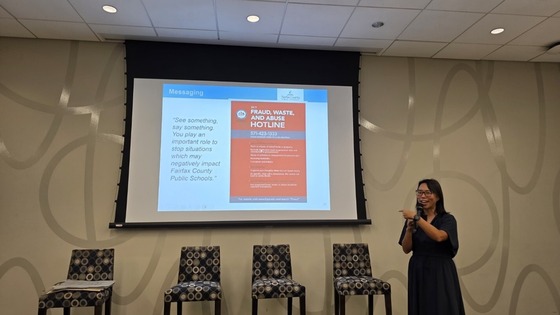 Esther Ko promoting the Fraud, Waste and Abuse Hotline
Did You Know?
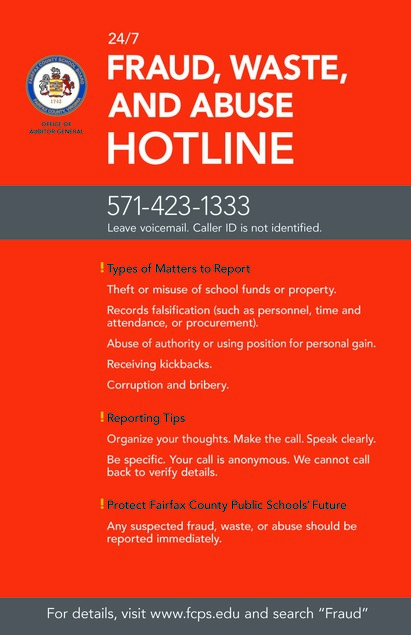
See Something, Say Something: Fraud, Waste, and Abuse Hotline
FCPS provides ways for employees and the public to report any suspected wrongdoing related to FCPS’ assets and resources. Reporting will help ensure taxpayers’ money is spent in the proper way -- on our students’ education. It can also help improve employees’ work environment. Reports can be made in person, by phone, by email, or online. All reports are taken seriously, and every effort will be made to review the reports according to the applicable laws, codes, policies, or regulations. Staff can assist the reviews by providing as much information as possible. Please visit the Auditor General webpage for more information.
 |
OAG aims at providing regular training to all staff members, covering topics related to mitigating financial and process risks to FCPS. OAG is a certified National Association of State Boards of Accountancy (NASBA) Continuing Professional Education (CPE) provider, on behalf of FCPS. FCPS can award employees with CPE credits required to maintain professional certification status.
Course Details: By the end of this session, participants will be able to internalize ethical core competencies and values and apply such competencies over decision-making in their everyday work. There is no pre-requisite for this training. This is a Part II of the April 24 training. Employees are welcome to participate without joining the Part I training.
Format and Date/Time: Synchronous online training via Zoom, on December 4 (Friday), from 9 a.m. to 12 p.m. Three CPE credits will be awarded for the entire training.
FCPS employees may sign-up here December 4, 2026 Training.
Upcoming Events
The next Audit Committee meeting is scheduled for October 12 at 4 p.m. Please refer to BoardDocs for meeting information once it becomes available.
Fraud, Waste & Abuse Hotline:
(571) 423-1333 (anonymous voicemail)
InternalAudit@fcps.edu (email is not anonymous)
Online Submission Form
|