
|
 |



The Supreme Court’s “long conference” will take place on Monday. That’s when the Justices will consider petitions for review that have been piling up over the summer. That means that the first Monday in October, the start of the new term of Court, is just around the corner. But only a select few of the cases the Justices discuss will be heard by the high court, which hears fewer than 1% of the cases brought to it.
The cases scheduled for oral arguments early in the term include ones about whether federal law preempts filing state cases against energy companies for damages related to climate change (Suncor Energy v. County Commissioners of Boulder County), a case involving data and digital privacy protections (Salazar v. Paramount Global), and a case that raises questions about whether military projects can proceed when those projects raise environmental concerns (Department of the Air Force v. Prutehi Guahan). But of course, the big show this term will center on whether the Supreme Court will act as a real check against Trump’s ongoing power grab and protect our elections. The Court has been incredibly permissive with the president, seeming to draw the line only when he’s about to take the country off a cliff. We’ll discuss another example of that tonight.
Here are the developments we’ll be following this week:
A new lawsuit from Elias Group filed last Wednesday, seeking an injunction that would keep the administration from sending armed federal agents to the polls.
The complaint starts like this: “In our democracy, the polling booth is meant to be ‘an island of calm in which voters can peacefully contemplate their choices.’” They explain that means polling places are meant to be “free of intimidation.” In light of the recent mention by not one, but two top law enforcement officials—the head of the FBI and the head of ICE—of their willingness to send armed agents to the polls, Democratic groups like the DSSC, DCCC, and the Democratic Governors’ Association, as well as Leaders Chuck Schumer and Hakeem Jeffries, are asking the court to enjoin the defendants from carrying out a “Polling Place Policy” that would run contrary to the tradition and legal requirements around protecting the polls.
Specifically, the plaintiffs are asking the court to prohibit the government from: “Operating or carrying weapons in the vicinity of open polling places, including drop boxes, curbside voting locations, and any similar places where votes are taken, collected, received, counted, or certified during early voting periods, on election day itself, and, during any post-election day ballot curing period for any reason not authorized by law, and from threatening to engage in any such action.”
The day after they filed the lawsuit, the plaintiffs filed a motion seeking permission to file a document under seal. No word on what that might be.
 |
Last week we discussed a similar lawsuit filed by the NAACP, other major civil rights groups, and labor unions against DHS, ICE, DOJ, FBI, the head of each agency, and Tom Homan. This lawsuit might be combined with the one brought by the Elias Group, and as I flagged last week, an early defense offered by the government is certain to be ripeness—they’ll argue that a couple of random statements don’t add up to what the Elias Group plaintiffs are calling “a policy.” We’re likely headed for a rehashing of what the government did with the USPS case, where it maintained that no sufficient plans in the works up until the very minute it acted. That makes the sealed document notice even more interesting. Without knowing for sure, it’s possible it could provide more detailed evidence about what the administration is working on or planning. Regardless, there is a compelling case for the courts to step in and protect the polls now, because it's hard to undo anything the government might do on Election Day or while votes are being counted.
CNN v Trump
The plaintiff news organizations may have gotten their TRO, but the Trump administration is testing its limits. Yesterday, they banned CNN from a trip to Tennessee aboard Air Force One. And the administration was indignant at any suggestion that the TRO didn’t go that far. The White House Pool, which had gone back into operation after CNN employees’ access to the White House was restored after the judge’s decision, has stayed in operation despite CNN being blocked.
In other words, there’s a lot more coming in this case this week, with major implications for the free press.
News from Nevada
On September 4, Nevada Secretary of State Frisco Aguilar was our guest for Five Questions. He discussed the Trump administration’s claim that almost 16,000 non-citizens were registered to vote in the state, and his pushback demanding actual proof. It turns out he was wise to do that because Trump’s claims don’t hold up. “On Tuesday, the state sent a strongly worded rebuke to the federal government: Every single person on the list was a lawful citizen.”
But the administration had already started to walk back the 16,000 number before it got Nevada’s response. DHS rolled it back to 185 noncitizens voting. Even that number was wrong.
This is important not just for Nevada, but beyond. It’s an important reminder, and proof that, not everything that comes out of Trump’s mouth, or his administration, is true. And especially when it comes to claims of noncitizen voting, the outsized claims are suspect. When conversation turns to fake claims of noncitizens voting, remind people about Nevada. “Every single person on the list was a lawful citizen.”
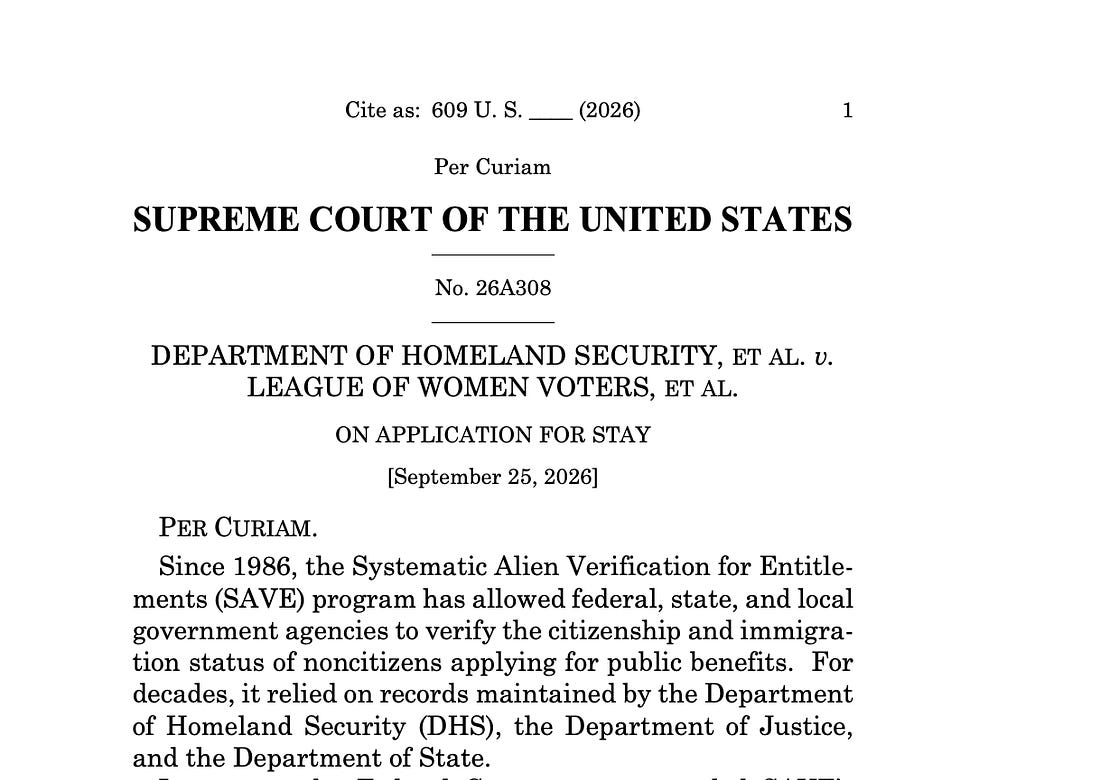
What happened in Nevada is the correct frame for understanding precisely how bad this administration is at getting it right: From 16,000 to 185 to zero. But the Supreme Court still doesn’t get it. Last week, they decided an emergency petition in DHS v. League of Women Voters in favor of the administration, over a dissent from Justice Jackson, who was joined by Justices Sotomayor and Kagan.
 |
Justice Jackson explains the harm the Supreme Court has done succinctly:
States have used a Department of Homeland Security (DHS) database called Systematic Alien Verification for Entitlements (SAVE) to ensure that registered voters are American citizens. For most of its life, SAVE consisted almost entirely of immigration records from DHS. In 2025, however, DHS and the Social Security Administration (SSA) decided to connect SSA’s database of master files, including all its sensitive information, to SAVE. A group of organizations sued, arguing that the modifications to SAVE violated various federal privacy laws, and that the staleness of SSA’s citizenship records risked disenfranchising recently naturalized U. S. citizens. After months of litigation, the District Court agreed and vacated the modifications. The D. C. Circuit denied a stay of the District Court’s order while reviewing the pending appeal. But, without full briefing or oral argument, this Court now grants one—rendering questionable interim rulings about two statutory provisions it has never before interpreted. The Court also focuses only on the harms the Government will purportedly suffer absent a stay, disregarding the harms that the modified SAVE system has caused, and will likely continue to cause, to lawful voters.
And the Court has done that just as we’ve seen, yet again, that this administration’s claims about noncitizen voting frequently lack any basis at all. Ironically, the per curiam majority acknowledges that federal law prohibits broad voter purges in the weeks leading up to an election. In other words, the bigger problem they may have created is for 2028, not 2026. The substantive merits of the case will now be litigated, and it’s possible that the administration will ultimately lose—it certainly should. But having this Court handle matters like this as we head towards the 2028 election underscores the importance of getting it right in the midterms and restoring a Congress capable of providing a meaningful check on this administration.
En Banc argument in the District of Columbia considers whether Judge Boasberg can pursue contempt proceedings against the administration after it ignored his order to stop planes transfer