
|
 |


Last Thursday, the White House, almost as soon as Judge Kelly entered his order forcing the administration to restore access to CNN, MSNOW, and Politico, began searching for play in the joints. What could they do to punish the news outlets that had offended Donald Trump without getting hauled back into court? Even after the Judge had ordered restoration of hard passes to journalists, CNN’s Betsy Klein and MSNOW’s Laura Barrón-López were denied entry into the White House and had their passes confiscated. It wasn’t clear why they were refused entry—Barrón-López said on air that it wasn’t clear whether she was refused entry because the White House was defying the court order or due to “some kind of incompetence or lag in the system.”
It wasn’t until later in the day, after their lawyer appealed to the Judge for help, that they were able to enter. No explanation from the White House, which, in a court filing, attributed the early morning issues to an administrative delay in reactivating badges. However, journalists were still being denied access at 11 a.m., an hour after the White House said it had restored them in the system. And the notion that Secret Service agents were confiscating passes, even after Klein showed them the court order, is inconsistent with a White House seeking to follow the court’s decision in good faith.
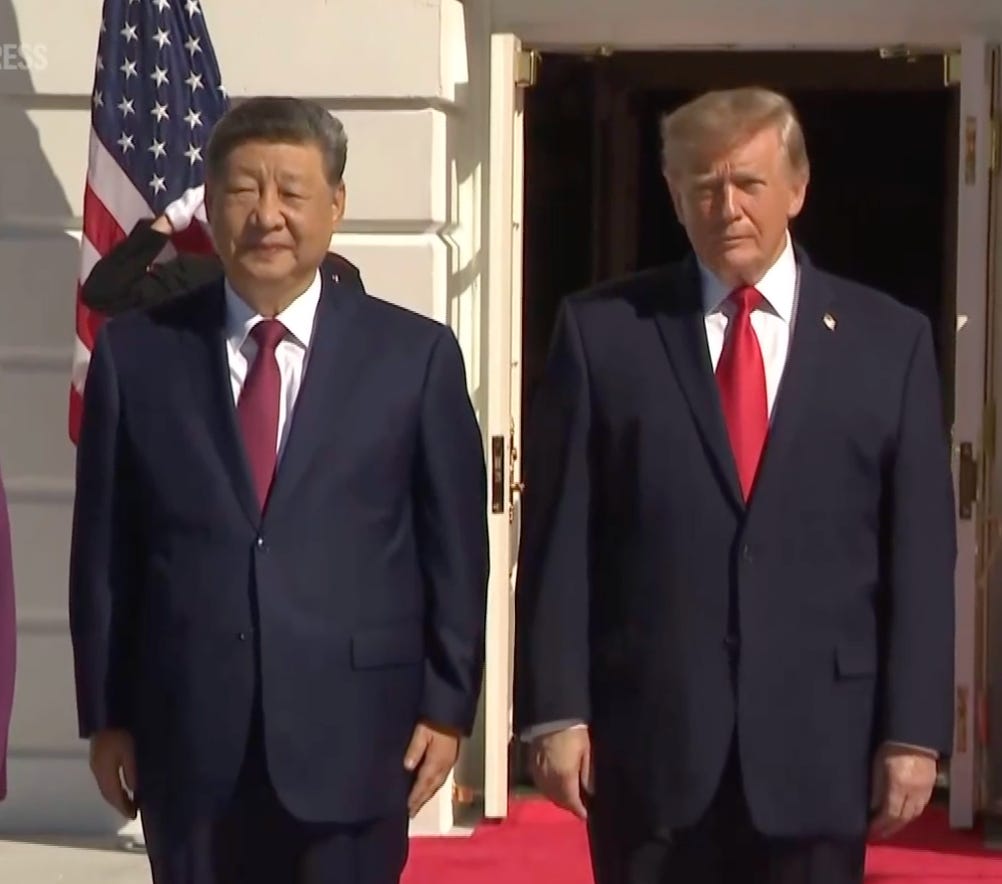 |
It got worse. That evening, as reporters arrived to cover Xi Jinping’s arrival at the White House for the State Dinner Trump threw for him, reporters for CNN and MSNOW learned that they would not be admitted, as other reporters began to cover the event. Was the White House in violation of the court’s order? Technically, perhaps not. It applied to hard passes, and this was a question of whether the editorial journalists each organization selected could cover the dinner. But excluding them without warning, while admitting other journalists, hardly seems neutral or justified. Nor did the exclusion of CNN from pool coverage of Trump’s trip to Tennessee Saturday morning.
When Trump first posted his ban on social media, he didn’t invoke national security as a justification for doing so. That didn’t happen until three days later, with his plan under attack in court. So his White House turned to the same argument they’d used with success to justify the ballroom—that it had a national security purpose. Judge Kelly noted the late adoption of that argument: “nothing in the record that predates this suit suggests that the revocation of Plaintiffs' hard passes was motivated by national security concerns.” It was hard to read the government’s pleadings, which suggested CNN and MSNOW are threats to national security, with a straight face, and the government had left itself an out in the letters it sent to them, which referenced reporting that “threatened national security and/or spread falsehoods.” But one man’s falsehood is another man’s truth, which is why we have a First Amendment in this country, and banning CNN and MSNOW for what Trump decreed spreading falsehoods would clearly violate it.
In other words, excluding the two from the Xi dinner and CNN from the Tennessee trip violated the spirit of the order, if not its letter. It’s clear defiance of the Constitution and our tradition of a free press.
So what should happen?
It’s time—past time, really—for courts to hold this administration in contempt when it is. No bending over backward, no second chances. If the president of the United States fails to comply with court orders, he needs to be held to account. Here, the government arguably purged its contempt by restoring passes. But the fact that it turned around and retaliated against CNN and MSNOW should be more than just a footnote to the story.
I say this with all due respect because I suspect the Judge, and perhaps even the lawyers who could pursue the point, would disagree with me. Why poke the bear? Why pick the fight? They may think it’s better to get things back on track and move forward.
But respectfully, that approach has not served us well. After taking office, Merrick Garland didn’t jump into investigating and prosecuting Trump and those around him for January 6. He likely hoped the country could move forward without becoming even more fractured. And I get that. Truly I do. But it didn’t work. Donald Trump doesn’t respect the law; he simply sees it as an impediment to doing what he wants to do. And when he learns he can get away with flouting it, he will not hesitate to do so again. And again.
If Trump gets away with retaliating against the press in this context, he’ll continue to do it, perhaps to others and in still more situations. And we cannot afford that.
He banished the AP for refusing to call the Gulf of Mexico the Gulf of America. He called a journalist “Piggy,” telling her to be “quiet.” And on and on. Technical compliance with the law is enough for a judge, but it can’t be enough for the American people. Without a free press to keep us informed, Trump would be running roughshod. Sunlight is, in fact, the best disinfectant, as we saw again today when Justice Alito recused himself from hearing a climate change case where he has conflicts—after the press exposed them and activist groups called on him to step aside.
On Tuesday, the Court of Appeals in the District of Columbia will hear en banc argument in a case involving whether a federal judge can pursue contempt proceedings against the administration when he believes they violated his order, even though it was subsequently reversed by the Supreme Court on appeal. The law here is relatively clear—parties can’t ignore court orders, hoping that they’ll be reversed down the road. But as they so often do, this administration plays to the court of public opinion as well as courts of law, minimizing its conduct because of the subsequent reversal. They argue technicalities, because this is the case where Judge Boasberg ordered them to turn around flights carrying immigrants to El Salvador’s notorious CECOT prison, and the administration’s line was that his orders were oral, not written, not clear, and that the planes were already out of U.S. airspace before the orders were given. Emil Bove, the DOJ employee who a whistleblower said under oath had told other lawyers at the Department “that D.O.J. would need to consider telling the courts ‘fuck you’ and ignore any such order,” is now a Third Circuit Court of Appeals judge, appointed by Donald Trump and confirmed by the Senate.
The world might look very different right now if Judge Boasberg had been permitted to pursue contempt proceedings back in the spring of 2025 and the administration had been held accountable. Instead, emboldened by his success, Trump has continued to treat the courts like a game to be played, not like a Constitution and an oath of office to be upheld. It would look different if the other news organizations that make up the White House pool continued to refuse to cover the president, so long as he violated the First Amendment right to a free press. But they haven’t.
And so, the Attorney General of the United States took to the Sunday shows to maintain that national security justified the decision to exclude CNN for Air Force One. ABC’s Martha Raddatz pushed Blanche for an example of CNN reporting inaccurately after Blanche—oh the irony—suggested that persistent misinformation and one-sided coverage can become a national-security concern. Then, they had the following exchange:
RADDATZ: The president said nothing about national security when he announced this ban, and clearly you're very interested in what the press says and how they say it
BLANCHE: What they say is exactly the issue when it comes to national security
RADDATZ: Give us an example
BLANCHE: You cannot be asking me that!
RADDATZ: But the judge decided this was not based on national security
BLANCHE: It is a privilege not a right to be in the White House
MSNOW’s Ken Dilanian underscored the point on Twitter, writing that “When the Justice Department lawyers filed papers in court about this—where there are repercussions for making false or unsupported assertions—they didn’t come up with a single example of misinformation or incorrect reporting to justify banning news organizations.”
Heather Cox Richardson reported that as all of this was unfolding, Trump told reporters: “I love an open, free press. What I don’t like is the fake press. What we don’t want is—we don’t want fake news.” But it’s not up to Donald Trump to decide what’s free and what’s fake. It’s why we have a marketplace of ideas in this country, so that we can decide for ourselves. It’s time for the courts to remind Trump that he too is accountable, that truly, no man is above the law. It should have happened before this, but it’s not too late; it can happen now. Trump needs to understand that there are consequences for going after the press.
If you’ve been reading Civil Discourse for free, I’m glad you’re here. I mean that. I keep almost everything I write outside of paywalls because I think understanding what our government is doing—and what the courts are doing about it—shouldn’t depend on whether you can afford a subscription.
But if you can afford $50 a year, I’m asking you to become a paid subscriber. There’s a lot happening right now, and much of what matters most is buried in court orders, filings, and de