
|
Will Democrats offer Americans a New New Deal?
A new social pact will be needed in the wake of Trump’s trail of ruin.
|
| |||||||||||||||


 |
Ahead of PN’s 5th anniversary next week, we’re offering paid subscriptions at the special yearly rate of $40 (or about 16¢ per edition). This newsletter is only possible thanks to the support of paid subscribers. If you’re not already one of them, please sign up and keep PN thriving for many years to come.
Thanks!
The recent months of Democratic primaries frequently appeared to be battles among factions for control of the party in advance of 2028.
But, as the end of the Trump era approaches, the question should not be which faction will prevail, but whether a broad and resilient Democratic coalition can be forged in a time of political and economic crisis, as happened nearly 100 years ago during the presidency of Franklin Delano Roosevelt — resulting in the New Deal policies that remade the nation for the better for decades.
The plague of growing economic inequality, and a growing national recognition that decades of radically regressive GOP policies have utterly failed, can provide an historic opportunity for Democrats to establish a “New New Deal.” The question is whether the party and its leaders will be up to that task.
Taking on fear
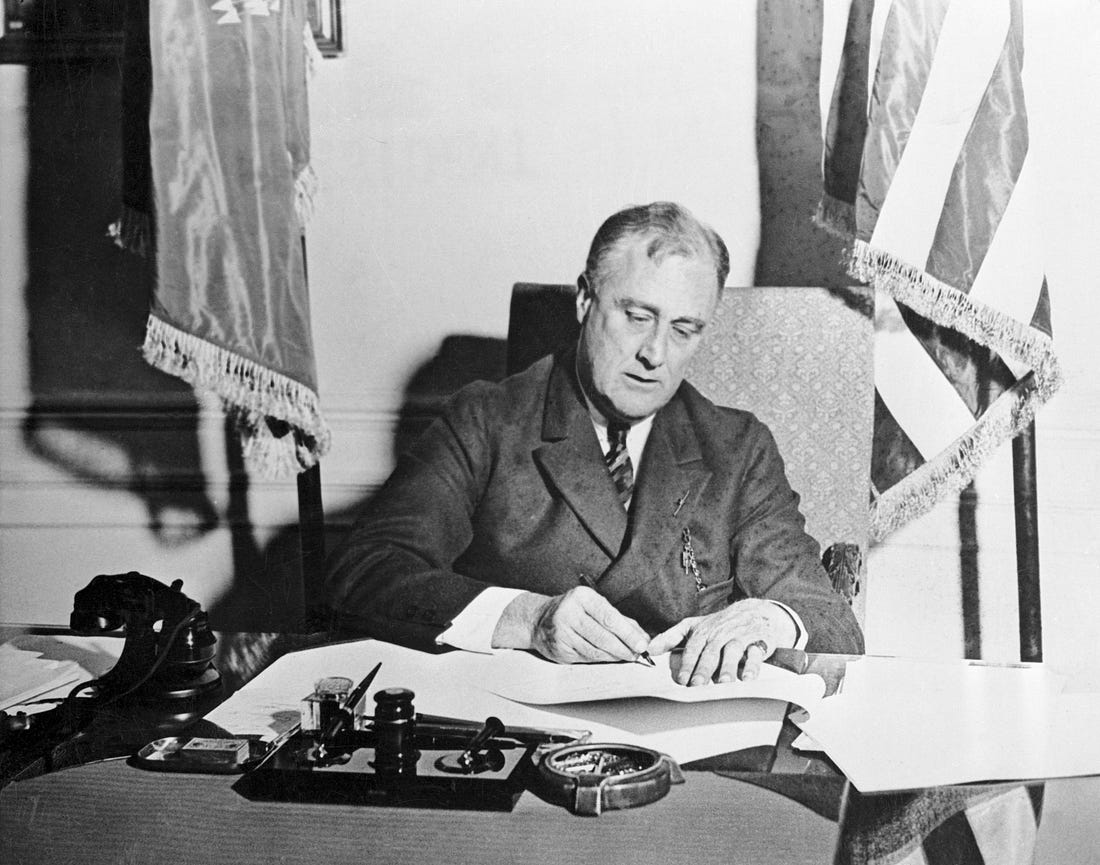
In 1932, FDR accepted the Democratic nomination for president by promising “a new deal for the American people” in the midst of a catastrophic Great Depression that had crushed the lives of virtually all but the wealthiest Americans.
Upon entering office, Roosevelt famously declared “the only thing we have to fear is fear itself,” and called Congress into a special session to commence the first tranche of what was to become a remaking of the federal government, and with it the nation.
 |
|
By 1936, the New Deal Congress had enacted, among many other things, the comprehensive regulation of the banking and financial systems, Social Security and the nation’s first robust protections of labor rights, ultimately overcoming opposition from some of the most powerful constituencies inside and outside the government.
But more importantly, the New Deal Democratic Party established — through hard-fought political battles, but also coalition building — a national consensus that government had an essential role to play in improving Americans’ lives.
While the New Deal was intrinsically liberal, it was constructed with buy in from every constituency. It was the pluralism of the New Deal coalition that proved to be its strength and source of resilience. It welded together constituencies that had long been in tension, and even kinetic conflict — including farmers and urban laborers and Easterners and Southerners — because all of them had substantial stakes in key elements of the programs FDR’s administration implemented.
The political and normative impact of the New Deal was extraordinary. It set much of the agenda of the federal government for decades, as the nation accepted the once radical liberal proposition that government has the authority — and even the duty — to blunt the abuses of concentrated power and wealth, attempt to end the scourge of poverty, and promote the growth of a middle class that achieved relative prosperity based solely on wages.