|
|
|
|
Good morning. We’re a few months out from tax season and all the frustration and questions that come with it. One of those questions is always, “Where does my money go?” We set out to answer that with a new tax and spending tracker. More on that below. |
|
|
|
|
Programming note
There will be no newsletter on Wednesday Sept. 30 as the team observes Truth and Reconciliation Day. However, our website will be staffed through the day so please visit us online. We’ll be back in your inbox on Thursday. |
|
|
|
|
|
|
|
|
|
|
|
|
|
|
|
|
|
Trade: On the eve of new import bans on Canadian goods taking effect, Trump says he expects Canada to cave in the trade war, while tariffs drive Stelco layoffs. |
|
|
|
|
|
|
|
|
|
|
|
|
|
|
|
|
|
|
|
|
|
|
|
|
|
|
|
We asked notable figures – from the C-suite to the ivory tower – to pitch a big, bold change to the tax system. Illustration by D. McFadzean
|
|
|
|
|
|
|
|
|
|
|
Four takeaways from our tax project |
|
|
|
|
Hi, this is Jason Kirby, an economics reporter with The Globe and occasional tax grump. |
|
|
|
|
As part of our Tax and Effect series on tax reform, we wanted to dig into how Ottawa and the provincial and territorial governments spend the income tax Canadians pay. |
|
|
|
|
|
|
|
|
Needless to say, it was eye-opening. Here are four takeaways: |
|
|
|
|
We spend A LOT on seniors: Programs like Old Age Security, the Guaranteed Income Supplement and the allowance cost the federal government $82.8-billion in fiscal 2024-25, roughly 16 per cent of what Ottawa spent from its own revenue. That’s more than the government’s health and social transfers to the provinces combined. Expect that to keep rising as Canada’s population rapidly ages. |
|
|
|
|
Other people’s money: To keep things simple, our tax and spending tracker only focuses on personal income tax and how those dollars get spent. But income tax only accounted for 43 cents of every dollar Ottawa spent in fiscal 2024-25. The rest came from things like corporate taxes, the GST, fees and, you guessed it, debt, with 6.7 cents coming from borrowing. |
|
|
|
|
That’s interest-ing: All that borrowing comes at a cost. In fiscal 2024-25, roughly one-tenth of the money Ottawa forked out in spending went to cover interest charges on the national debt. That was more than federal health transfers to the provinces and territories and well more than it paid on defence – though the latter cost has risen sharply with Ottawa’s boost to military spending. |
|
|
|
|
Marginally speaking:
The tax brackets Ottawa and the provinces publish on paper only tell part of the story of the tax your next dollar faces. The real tax schedule has far more steps, built from things that aren’t called tax rates, like credits that shrink as income rises, surtaxes that are charged on tax itself and basic amounts that phase out at higher incomes. And none of that is what anyone pays on average, anyway. An Ontarian who earns $100,000 at a job faces tax of 31.5 cents on the next dollar earned, but hands over 20.5 per cent of their income to income taxes, because most of that income is taxed at lower rates or not at all, and only the last $3,300 is taxed at the top rate. |
|
|
|
|
|
|
|
|
|
|
What do you think? Are there steps Canada should be taking to overhaul its tax system and revive growth, or do you have questions about how the tax system works? At 11 a.m. today, my colleagues Erica Alini and Patrick Brethour will be answering reader questions. Submit your questions in advance here. |
|
|
|
|
|
|
|
|
|
|
|
|
|
|
|
|
|
|
|
|
|
|
|
|
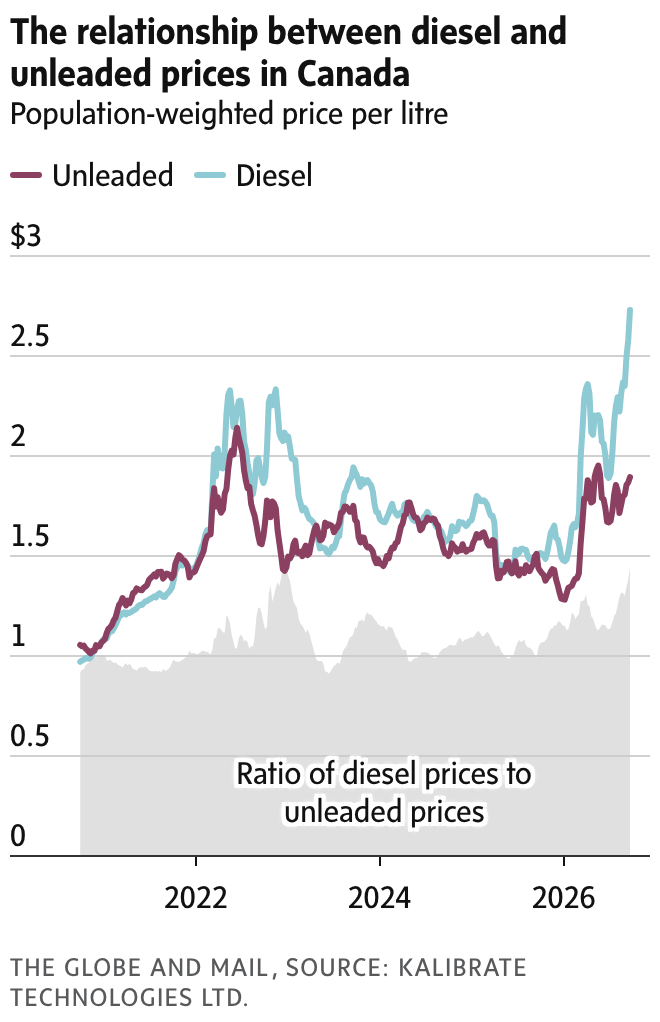
For most Canadians, the shock from skyrocketing fuel prices is felt most directly at the pump, with average prices hovering near multi-year highs. But diesel prices have soared even more, and that’s going to bite in other ways, with the trucking companies that haul foods and goods across the country expected to pass on some of the cost to their customers. |
|
|
|
|
|
|
|
|
|
|
|
|
|
|
|
|
 |
Hockey Night in Canada wasn’t valuable simply because it aired hockey on Saturday nights. It was valuable because virtually every Canadian could participate in that same experience, regardless of income or geography. — Raj Shoan, the executive director of Friends of Canadian Media |
|
|
|
|
|
|
|
|
|
|
|
|
|