| | In today’s edition: Qatar’s gas remains trapped, a flydubai scare, and Temasek hedges its Gulf bets.͏ ͏ ͏ ͏ ͏ ͏ |
| |  | Gulf |  |
| |
|
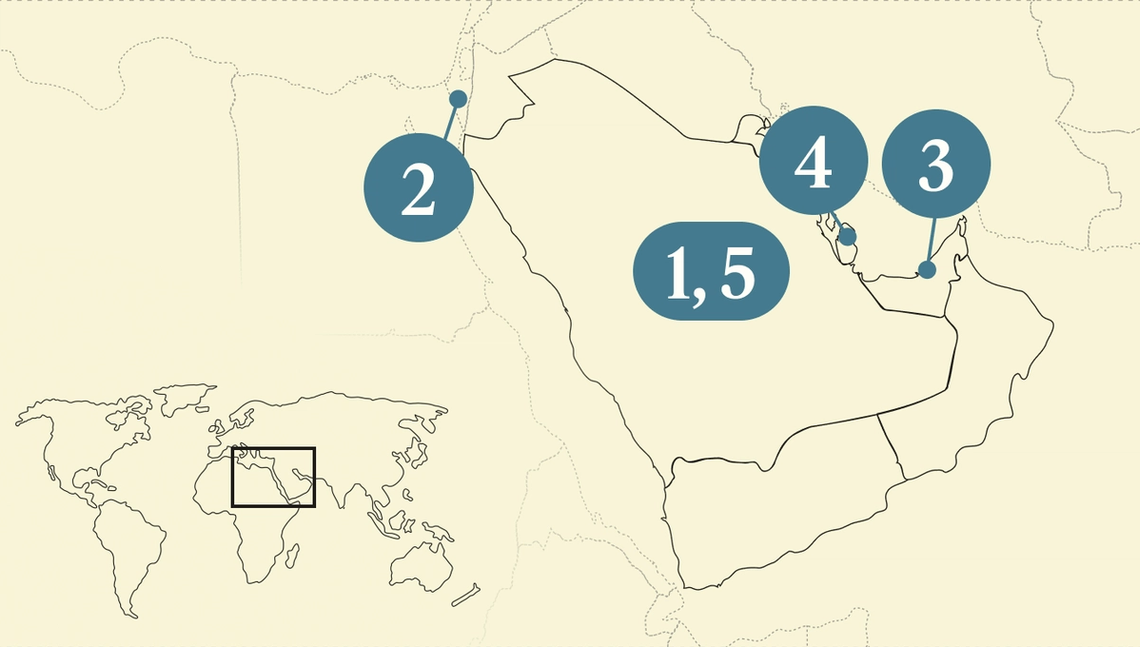 - Saudi-UAE ties warm
- Flydubai flight emergency
- Temasek enters the Gulf
- Qatar extends LNG halt
- Cutting Hajj middlemen
 How to rent a camel in the kingdom. |
|
Iran war mutes Gulf rivalries |
 Bandar Algaloud/Courtesy of Saudi Royal Court via Reuters Bandar Algaloud/Courtesy of Saudi Royal Court via ReutersThe biggest breakthrough yet in the Saudi-UAE rift came in a bland statement about “brotherly bilateral relations and regional developments.” UAE Vice President Sheikh Mansour bin Zayed’s meeting with Saudi Crown Prince Mohammed bin Salman in Riyadh is the most prominent effort to repair ties, which have ruptured over competing interests in Yemen, Sudan, and elsewhere. Tuesday’s “fraternal visit” signals that intra-Gulf rivalries are taking a back seat as the US-Iran war threatens trillions of dollars invested in transforming the region’s economies. The UAE delegation included the heads of its national security council, crisis management authority, and defense procurement body, highlighting the focus on security. Ali Shihabi, a Saudi commentator close to the royal court, told the Financial Times that Riyadh wants Abu Dhabi to manage southern Yemeni factions and prevent them from undermining the anti-Houthi front. Meanwhile, Pakistan’s defense minister pledged to use “whatever means are available” to defend Saudi Arabia against the Houthis, whose missile attacks have hit critical infrastructure and major cities in the kingdom over the past month. “Any enemy of Saudi Arabia is an enemy of Pakistan,” he told reporters during a visit to Rome. |
|
Flight survives suspected hijacking |
 Flightradar24.com/Handout via Reuters Flightradar24.com/Handout via ReutersA flydubai flight from the UAE to Israel made an emergency landing in Saudi Arabia on Wednesday, after an altercation between the pilots led to the plane plunging more than 14,000 feet before climbing sharply. The Dubai-based budget carrier, sister airline of Emirates, said the aircraft had “experienced an incident while en route,” without disclosing details. Israel said it was treating the event as a potential terror attack based on suspicions one of the pilots may have intentionally tried to crash the plane, according to Haaretz. The aircraft issued a general distress call before switching to a code signaling a hijacking. The plane landed in Tabuk, in northwestern Saudi Arabia, where the pilot and co-pilot were hospitalized. All passengers on board are reportedly safe. |
|
Singapore’s Temasek deepens Gulf bets |
 Edgar Su/Reuters Edgar Su/ReutersSingapore’s $400 billion sovereign wealth fund will open its first offices in the Gulf early next year, adding to the list of major global investors expanding into the region despite ongoing conflicts. Temasek’s openings in Abu Dhabi and Riyadh — a presence it said it will use to deepen engagement in Qatar, too — mean it will dodge the politically fraught choice between the competing financial hubs. Separately, UK-based private markets firm Pantheon, which manages $84 billion, also announced plans on Wednesday to open an office in Abu Dhabi’s financial center ADGM. Foreign investors are still seeing opportunities in the Gulf, even as conflicts roil oil markets and government finances. Regional sovereign funds are on track for one of their busiest years ever of dealmaking, while investment in AI infrastructure and logistics projects to bypass the Strait of Hormuz are creating openings for new partnerships. — Matthew Martin |
|
Oil recovers, Qatar gas struggles |
 Middle East crude exports have nearly recovered to prewar levels, but liquefied natural gas remains trapped in the Gulf. Before the US-Iran war, almost 20% of global LNG supplies passed through the Strait of Hormuz. Qatar, one of the world’s largest exporters, has virtually halted shipments since Feb. 28, with LNG exports plunging 96% from the beginning of the war through August compared with a year earlier, Reuters reported. The few shipments that made it through Hormuz did so after buyers negotiated passage with Iran, Qatar’s Prime Minister Sheikh Mohammed bin Abdulrahman Al Thani told UK journalist Piers Morgan. State-owned QatarEnergy has reportedly extended force majeure for customers in Asia and Europe, which is driving up prices and intensifying competition for alternative supplies. Europe hasn’t been able to replenish its gas stockpiles this summer, likely resulting in higher utility bills this winter. — Mohammed Sergie |
|
 Saudi Press Agency via Reuters Saudi Press Agency via ReutersHajj, the once-in-a-lifetime pilgrimage required by every able Muslim, is among the world’s largest annual gatherings. Moving those bodies has long involved layers of middlemen. Saudi Arabia is now squeezing some of them out. The Ministry of Hajj and Umrah has bundled the four services every pilgrim needs — holy site arrangements, lodging in Mecca and Medina, transport, and catering — into a single electronic agreement on one government platform. Some 1.7 million people made the trip in 2025, with spots rationed by country at roughly one per 1,000 Muslims. It’s a major expense for many pilgrims, paid with years of savings, won by lottery, or covered by charities. For the kingdom, it’s a source of pride and revenue: Religious tourism is on track to contribute 10% of GDP by 2030. — Manal Albarakati |
|
 Behind closed doors, a new era of healthcare policy is taking shape. From AI and access to care, to the race for new drugs, and China’s growing role in global medicine, the forces remaking healthcare are accelerating, with implications for systems worldwide. Introducing Semafor Healthcare, your weekly read on the politics, policy, and business driving the industry. Brought to you weekly by David Lim, the briefing will deliver the analysis and reporting leaders need to understand the forces reshaping healthcare, and what comes next. Subscribe for free. |
|
 Banks- Tightening liquidity, not rising interest rates, is the bigger threat to Gulf banks, according to risk consultant Andrew Cunningham. Nearly all banks in Kuwait, Oman, Qatar, and Saudi Arabia now have loan-to-deposit ratios above 100%, constraining future lending as demand for credit grows. — AGBI
Finance- Beijing-based investment bank China Securities plans to open a regional office in Dubai’s financial free zone, DIFC. It joins a Chinese cluster there that includes the country’s five biggest banks, which together hold more than 30% of the assets in DIFC’s banking sector.
Logistics- The property arm of Chinese e-commerce giant JD.com will build a 150,000-square-meter logistics hub in KEZAD, AD Ports Group’s industrial zone in Abu Dhabi. The warehouse is expected to create about 1,000 jobs.
|
|
 Mohammed Bimansour/Reuters Mohammed Bimansour/ReutersInterested in hiring a camel in Saudi Arabia, but worried about what it might entail? Fear not, as the country has finally introduced a rulebook for leasing grumpy, humpy dromedaries. For camel rentals, owners must be registered with the authorities, contracts must be documented electronically, and records must be updated when animals are transferred or their location changes. Camels must be returned to their original owner’s registry when the rental agreement ends. Violations may result in fines and prosecution. But the paperwork belies how serious this matter is: Camels are revered, and prize animals can command eye-watering sums. In 2021, a Saudi owner leased a camel for 20 million riyals ($5.3 million) for just 48 hours. Chew on that. — Ed Clowes |
|
|


