| | In this edition, new AI tools reveal the industry’s compute bottleneck, and amputees in developing n͏ ͏ ͏ ͏ ͏ ͏ |
| |  | Technology |  |
| |
|
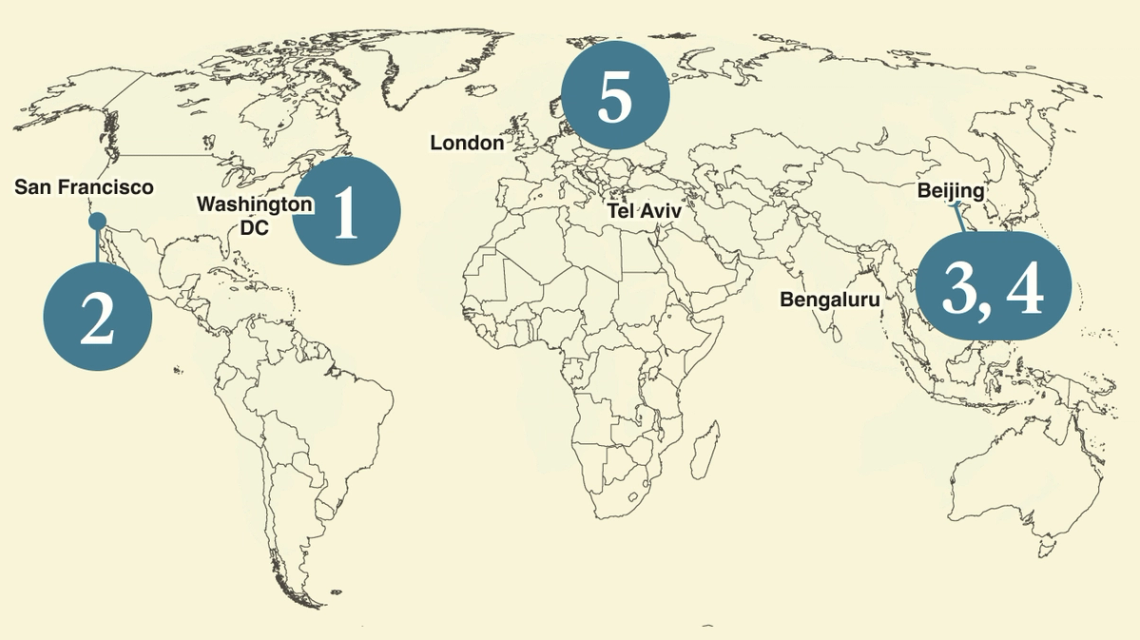 - Washington’s AI pledge
- Solving for the hand
- China’s tech talent
- A lifeline for Nvidia
- Oura delays IPO
 New AI tools reveal the industry’s compute bottleneck, and the White House’s new AI tool has Easter eggs for video game aficionados. |
|
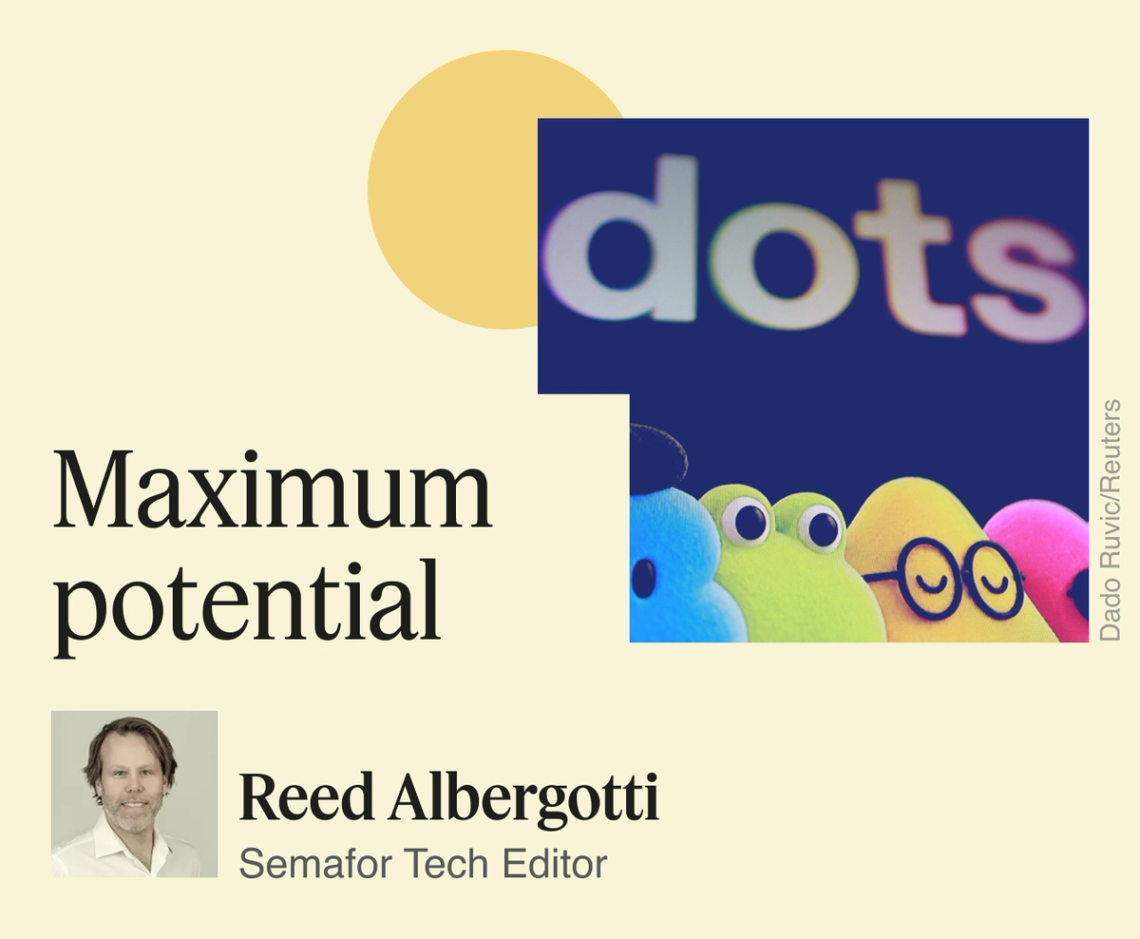 While OpenAI’s new tool, dots, stole much of the spotlight at its annual developer day Tuesday, it was the change to its pricing tiers that says more about the company and the AI industry. OpenAI’s $200-per-month plan now comes with half the tokens. And there’s now an eye-popping $500-per-month plan that makes the price of diesel these days seem like nothing. The cost creep is another indication there is a severe compute bottleneck in AI. Offering always-on, agentic assistant tools will cost OpenAI and Meta — which recently launched its cutesy agent Muse — a ton of money, and it’s not clear yet that these agents will work well. AI products often overpromise because there just aren’t enough tokens to go around (and it would be too expensive) to make them capable at their maximum potential. I haven’t yet worked with dots, but people are so far finding Meta’s Muse runs into paywalls and CAPTCHA hurdles they have to troubleshoot. Meanwhile, my Codex is humming away doing cool and useful things for me, and it’s not clear that my dot will be able to replace some of the projects I’ve already put time into building. Dots will likely wind up like a lot of new AI tools and features: completely amazing and, simultaneously, not quite there yet. It costs OpenAI fortunes to do its more ambitious tasks, too. It recently spent about $10 million over roughly a weekend to solve part of the Navier-Stokes math equations. If AI was getting to the point where it’s so efficient it can take out humanity by Christmas, as so many fear, the price of tokens would be going down, not up, and it would cost a lot less to solve math problems. |
|
Trump releases ‘Super Intelligence’ pact |
 Kevin Lamarque/Reuters Kevin Lamarque/ReutersPresident Donald Trump is hailing an “Accord on Super Intelligence” following his meeting with AI CEOs. Meta’s Mark Zuckerberg, Nvidia’s Jensen Huang, xAI’s Elon Musk, OpenAI’s Greg Brockman, and Google’s Sundar Pichai signed on. The agreement is short on details, but outlines a voluntary pledge by these companies to implement internal controls for AI security and “alignment” — something they’re already doing — and to submit to independent auditing, an idea companies have floated in recent weeks. It’s not a regulatory framework or a bill, but it is a shift from just last year, when the Trump White House sought to ban all state AI laws. For now, the political winds remain in AI companies’ favor, to the CEOs’ relief, though the accord itself nodded to that changing someday: “Over time, it may make sense to codify these steps into laws or regulations.” — Ashley Gold |
|
 Courtesy of Psyonic/Semafor Courtesy of Psyonic/SemaforAmputees in developing nations may hold the key to giving humanoid robots hands that actually work. Psyonic, a San Diego startup, wants to give people its bionic hands — and pay them — so it can capture data on how they grip, lift, and fold, with the ultimate goal of perfecting the robotic hand, a longstanding challenge in physical AI. CEO Aadeel Akhtar said Psyonic is now in the early stages of an effort to deploy thousands of bionic hands globally — it is specifically eyeing Pakistan, where his parents are from, and India. Users would go about their everyday tasks; the data from every grip would then be used to train a robotics model, making the prosthetic wearers a data-collection workforce. Hands are particularly puzzling for robotics engineers in part because of how compact and complex they are. Robotics also “has a data problem,” especially around hands, Akhtar told Semafor. Companies are scouring for new data sources that can be used to train robots. Psyonic’s hands can sync to a wearable camera, so a model learns both what a task looks like and how much force it takes. — J.D. Capelouto |
|
US is still magnet for AI talent |
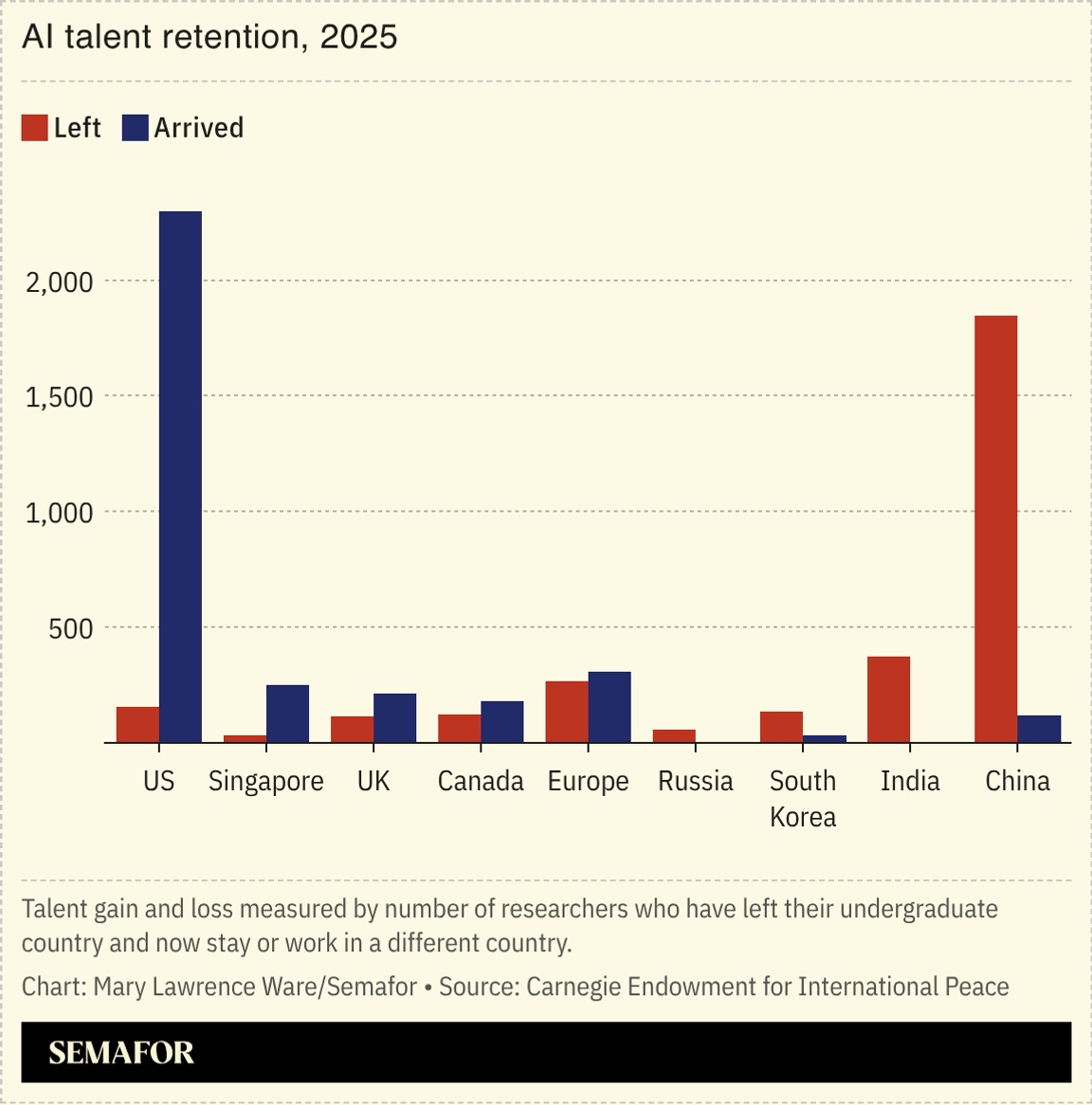 China now produces 57% of the global AI talent pool, up from 46% in 2023, but the US remains the strongest magnet for those researchers, according to a new study. The findings, published by Carnegie China, showed, however, that more Chinese researchers are staying in their home country as the domestic AI industry booms and Washington’s visa restrictions make it harder to study in the US. China is also enforcing stricter measures to retain its top AI minds: Beijing expanded overseas travel restrictions to include the family members of some AI and chip executives, Bloomberg reported, in moves that could have a further chilling effect on the sector, leaving Chinese tech professionals with hard choices. |
|
Nvidia gets an opening to sell chips to China |
 Kylie Cooper/Reuters Kylie Cooper/ReutersBeijing is considering allowing some Chinese companies to buy cutting-edge chips from Nvidia. The US chip giant’s market share in China cratered after Washington blocked sales of Nvidia’s most advanced products and Beijing largely barred companies from buying the ones that were allowed, part of a strategy to boost domestic manufacturers. But Chinese firms “are rolling out AI products and services faster than they can find the chips to run them,” The Information reported. And while Chinese researchers have made progress on developing cutting-edge chips, they don’t yet have a way to mass-produce them without the advanced lithography tools that US trade controls restrict. |
|
 Oura’s CEO Tom Hale. Pedro Nunes/Reuters. Oura’s CEO Tom Hale. Pedro Nunes/Reuters.Oura’s delayed $2 billion IPO shows how the two big upcoming AI IPOs — OpenAI and Anthropic — are creating an attention and capital vortex, making it harder for the investors who back other tech IPOs to justify spending their time and money on much else. The company cited market “uncertainty,” a term usually reserved for pandemics, wars, and tariff shocks, not when the Nasdaq is hitting record highs. Indications that the smart ring’s shares were likely to price at the low end of the $40-to-44 range delayed the plans, a person familiar with the matter said. Other rallies have lifted all boats; this one is creating haves and have-nots. “I just think this is a terrible year to go public,” Databricks CEO Ali Ghodsi said this summer. — Rohan Goswami |
|
 Behind closed doors, a new era of healthcare policy is taking shape. From AI and access to care, to the race for new drugs and China’s growing role in global medicine, the forces remaking healthcare are accelerating, with implications for healthcare systems worldwide. Introducing Semafor Healthcare, your weekly read on the politics, policy, and business driving healthcare. Brought to you weekly by David Lim, Semafor Healthcare will deliver the analysis and reporting leaders need to understand the forces reshaping healthcare, and what comes next. Subscribe for free. |
|
 America.gov website/Screenshot/Semafor America.gov website/Screenshot/SemaforUsers have already found hidden features in the White House’s new America.gov AI chatbot. The bot, which was launched Tuesday with the goal of helping citizens navigate the government’s online bureaucracy, seems to come to life when users ask it to “play Minecraft,” the 3D sandbox video game. The bot starts to answer users with language that mimics messages Minecraft players see on their screens when they beat the game: “It thinks we are a chatbot.” And, “It is reading our thoughts as though they were words on a .gov.” The question, now, is whether the answer is an intentional Easter egg for video game players, and if so, whether it belongs on the same interface guiding Americans through Medicare enrollment. |
|
|


