| | In this edition: How Democrats learned to stop worrying about gender politics, NC candidates get rur͏ ͏ ͏ ͏ ͏ ͏ |
| |  BEXLEY, OH BEXLEY, OH | WESTBROOK, ME | CHEROKEE, NC |
 | Americana |  |
| |
|
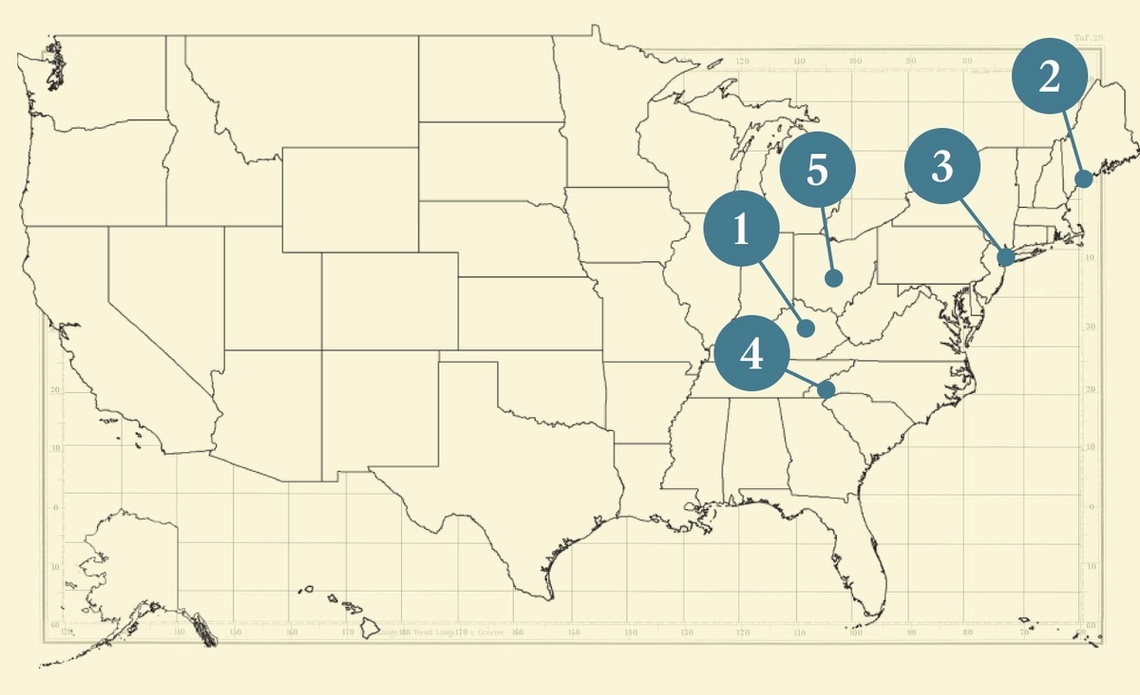 - Dems stretch the map
- Jackson’s progressive problem
- A ‘third Reconstruction’?
- N.C. authenticity contest
- Ohio’s up for grabs
|
|
 As they prepared for Republicans to drop another billion dollars of ads on their heads this summer, Democrats passed around fresh advice on gender politics. A memo from the Transgender Freedom Alliance, based on focus groups and polling in battleground states, warned that Democrats lost ground if they ignored anti-trans attacks — ubiquitous GOP ads about “boys in girls’ sports” and “child sex changes.” The group advised Democrats to respond, then accuse Republicans of being “focused on transgender people instead of helping you.” Right now, as they compete for states that Trump won by double digits, Democrats are feeling great about that guidance. Former Ohio Sen. Sherrod Brown used it nearly word-for-word for one of his ads: “With everything going on, that’s what they’re talking about?” New ads from a Democratic super PAC chide Republicans for running hundreds of millions of dollars in ads “just about trans people.” The theory is simple. In 2024, when the Trump campaign warned that Kamala Harris was for “they/them,” the subtext was that Democrats were focused on identity politics instead of economic needs. In 2026, voters can’t blame the out-of-power party for the cost of groceries; it’s MAGA Republicans who are obsessed with “they/them,” not “you.” I’ve seen some analysis of the Democrats’ enough-already messaging that calls it a “new” strategy. It’s not totally new; Brown lost his 2024 race after running ads about how he opposed letting “transgender biological men” play women’s sports, which was already “banned in Ohio.” What’s new is that conservatives won, and their opponents retreated. The Trump administration has rolled back every significant executive-branch advance for transgender Americans — in healthcare, in schools, even at historic sites. In red states, the limits that Republicans passed during Biden’s presidency are in no danger of being overturned. Pro-LGBTQ rights groups, now aware of how much they lose when Democrats don’t run things, aren’t saying much about the new Democratic approach. |
|
Emboldened House Democrats start spending bigger |
 Aaron Schwartz/Reuters Aaron Schwartz/ReutersHouse Democrats are trying to stretch the map, making new investments in districts that the president won by double digits in 2024 — and some that were redrawn last year to elect Republicans. As first reported by Semafor, the party’s campaign arm is spending in 35 seats, including the central Kentucky district being vacated by Rep. Andy Barr, R-Ky., and some Florida districts redrawn to force out Democrats. In several of those races, Republicans who won primaries by advertising their support for the president have stripped him from their paid media and campaign websites. Republicans were dismissive of the buys; after all, this is still the first cycle, in more than a decade, where the GOP has more money to spend than Democrats. “House Democrats are scrambling to catch up with the very limited resources they have,” said Mike Marinella, a spokesman for the National Republican Congressional Committee. But some of those resources are being used to match Democrats in seats that had looked to be off the board — like Virginia’s 5th District, which includes Charlottesville but hasn’t voted Democratic since 2008. Now former Rep. Tom Perriello is making a comeback bid. |
|
How critiques from the left pushed Jackson on Gaza |
 Brian Snyder/Reuters Brian Snyder/ReutersMaine Democrat Troy Jackson got a wave of criticism from progressive media outlets this week, as a New York Times/Siena poll found him trailing GOP Sen. Susan Collins for the first time. The struggle session started with Rebecca Traister’s Sept. 22 profile of Jackson, which questioned whether DC consultants working for the new nominee had pushed aside progressive Mainers who could have been running a more grassroots, populist campaign. Three days later, Drop Site News profiled the Jackson campaign as a test of “how far Democratic Party consultants are able to drag a candidate away from his grassroots supporters” — specifically, alleging that he was pushed to give a toothless answer when asked if Israel was carrying out a genocide in Gaza. Jackson had been using the word “genocide” in his answer, but in The American Prospect, Robert Kuttner reported that the campaign “realized that they had a problem” after Traister’s story and put more events on Jackson’s schedule. In fact, the progressive demand that Jackson keep talking about “genocide” raised the profile of the issue, creating a minor problem for the candidate. Asked again about it, he told a Maine TV station that it was unfortunate how some Jewish Mainers rejected the term “genocide” with respect to Israel’s actions in Gaza due to its associations with the Holocaust. |
|
A ‘third Reconstruction’? |
 Maya Wiley. Brendan McDermid/Reuters Maya Wiley. Brendan McDermid/ReutersAmid growing worries about election security and civil rights, new polling from the The Leadership Conference on Civil and Human Rights — shared first with Semafor — found 54% of voters in favor of a “third Reconstruction.” The first Reconstruction, in historical parlance, refers to the more inclusive Republican civil rights agenda after the Civil War. Activists often call the 1960s civil rights movement a “second Reconstruction” for its empowerment of Black Americans. “A third Reconstruction has resonance,” said Maya Wiley, the CEO and president of the Leadership Conference. “I was struck by how closely economic issues and civil rights, freedom issues are intertwined. There’s such a dramatic shift.” The survey also shows backlash to the nationwide racial justice protests of 2020 fading as voters grew more concerned about their economic needs. The Civil Rights Monitor poll, conducted Aug. 23 to Sept. 6 with 1,000 voter interviews, found majority support for a “systemic, constitutional, and cultural overhaul” that would include term limits for Supreme Court justices. That result is driven by Black voters, a supermajority of whom feel their “heritage, traditions, and cultural identity is under attack in America.” Just 45% of white voters now agree with that statement about cultural identity under attack, down from 54% during Joe Biden’s presidency. Eighty-one percent of Black voters agree with it. |
|
North Carolina open-seat race hosts a rural values battle |
 Jamie Ager/YouTube Jamie Ager/YouTubeNorth Carolina’s 11th Congressional District, like most of the state’s map, was drawn to keep electing Republicans. By moving part of Asheville into another district, overwhelming urban liberals with rural conservative voters, two Republicans who flamed out — disgraced ex-Rep. Madison Cawthorn, then retiring (and censured) Rep. Chuck Edwards — won this seat fairly easily. But both parties now see the 11th as competitive in a potential blue wave year, and both candidates are playing up their rural values to go for swing voters. In “Barn Dance,” Democratic nominee Jamie Ager shows the monthly barn dances that he and his wife host: “Politicians dance with the lobbyists, but I’ll take a good mountain hoedown any day.” And GOP state Rep. Jennifer Balkom, who replaced Edwards on the ballot, is running “Mom” to emphasize just how down home her upbringing was: When burglars broke into their home, her “tough mountain” mama shot them. |
|
How Ohio truly became a swing state again |
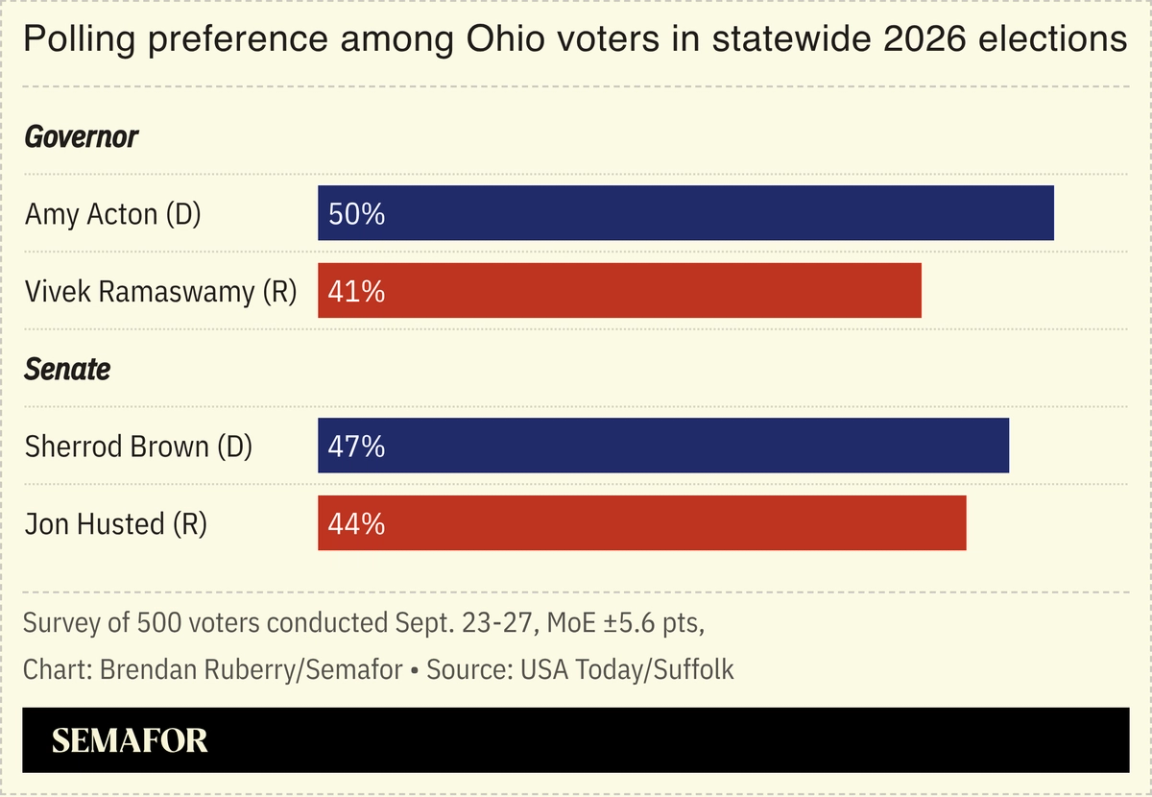 Both parties are treating Ohio like a state Republicans could lose, after a Trump-era streak of wins that made Democratic victory look impossible. Democrats simply didn’t win statewide elections there without dominating northeast Ohio; in 2024, when he lost his seat, Brown lost the counties east of Cleveland for the first time in his political career. Places like Mahoning County, which never voted for a Republican until Trump in 2020, hosted reporters on “Trump voter safaris” to understand the shift. Suddenly, however, the GOP looks truly vulnerable in the state. Acton and Brown lead statewide despite trailing by single digits in Portage County, a traditional bellwether county in northeast Ohio; Democrats haven’t won statewide without it. Both Democratic candidates have a different coalition now and are beating their opponents in the suburbs of the state’s major cities, while losing northeast Ohio by less than Brown did in 2024. In that year, now-Sen. Bernie Moreno won 51% of the vote there, but neither Husted nor Ramaswamy cracked 49% in this poll. Both Democrats are very competitive with white voters, two years after they broke for Trump by 21 points. |
|
 Drone Base/Reuters Drone Base/ReutersOne of the most entertaining campaign spending stories of this cycle was Invest in Tomorrow, the PAC created quickly by clean energy investors to unseat conservative Republicans who had voted to rescind Biden-era tax credits and investments. (Americana readers met this PAC a few weeks ago, after its win in Tennessee.) Kainoa Lowman wrote the followup I wanted to read, for the Washington Monthly. She talked to investors and strategists in that industry, some of whom were wracked by disbelief that Republicans really want to blow up their investments, and others who were confident that the GOP can be reached with the right message. |
|
 I spent some of my downtime last week finishing The Science Fiction Hall of Fame, which turned 53 this year and has never been updated or re-ranked. Inside are short stories taken (mostly) from speculative fiction magazines from 1934 to 1963, from the beginnings of the atomic age (the neutron was a new discovery) to the thick of the space race. Some of them have unforgettable twists, some are thoughtful extrapolations about new technologies that hadn’t become problems yet, and others were straight-up turned into TV episodes. (Among them: “It’s a Good Life,” adapted for The Twilight Zone three times.) |
|
|


