| | US President Donald Trump’s economic approval hits a new low, the flydubai plane attack upends Israe͏ ͏ ͏ ͏ ͏ ͏ |
| |  | Flagship |  |
| |
|
The World Today | 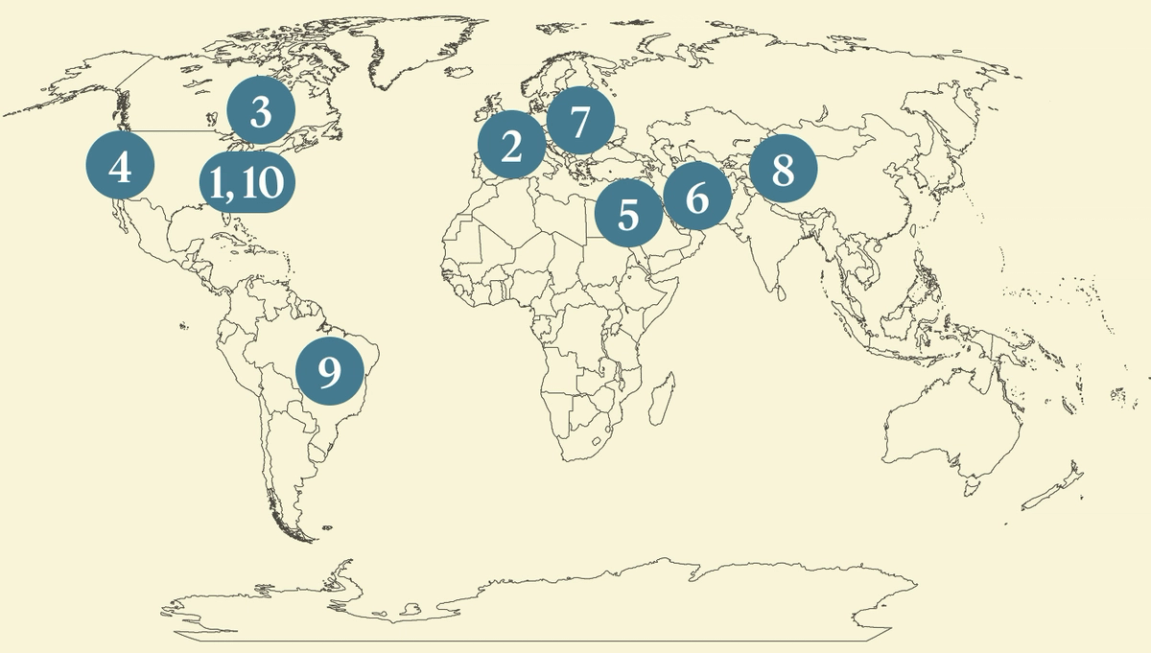 - Trump’s economic worries
- EU feels US diesel pressure
- Canada’s trade diversification
- Chipmakers finance AI boom
- Attack upends Israeli elections
- Iran’s long letter to Americans
- Europe wary of hybrid war
- Starbucks opens in Xinjiang
- Land defenders face violence
- Americans don’t like hosting
 A guide to the ‘bizarre historical phenomenon’ of 17th-century witch hunts. |
|
Republicans fret over high costs |
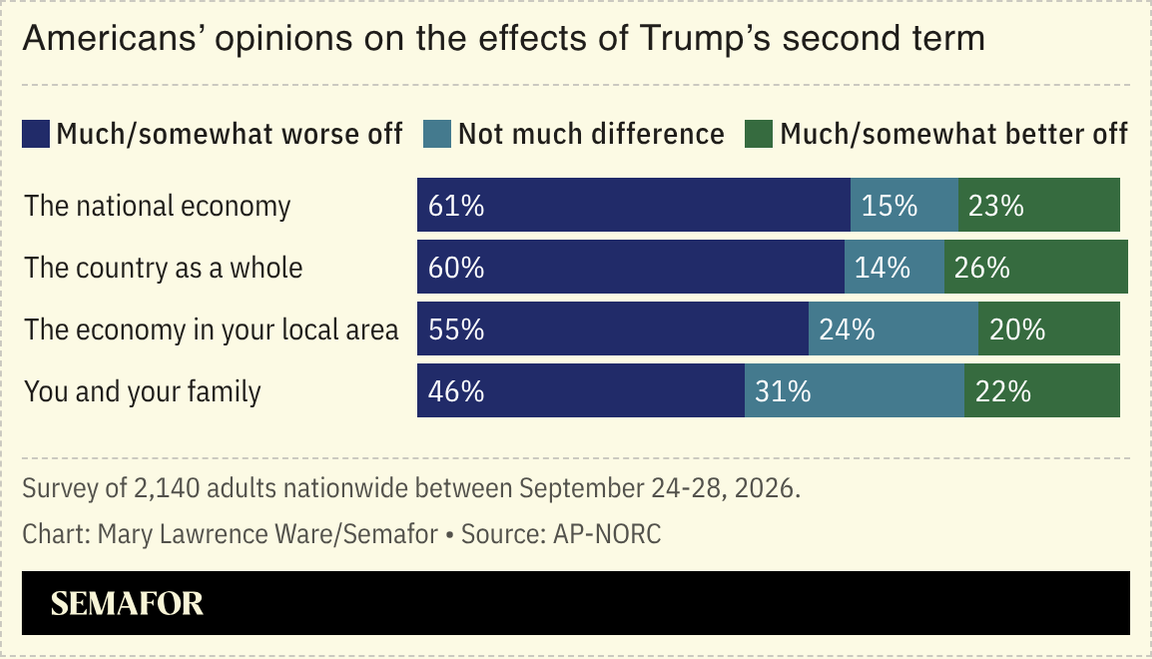 Republican lawmakers are fretting over the party’s inaction in addressing Americans’ mounting economic concerns ahead of the midterm elections, with one senator telling Semafor it’s “the No. 1 thing that everyone’s campaign is talking about.” Some worry that US President Donald Trump’s focus on the unpopular Iran war, instead of kitchen table issues, will turn voters away. Trump’s economic approval hit a new low in a poll Thursday, as only 17% of US adults approved his handling of the cost of living crisis, and many were concerned about soaring gas prices. Several states are now offering gas tax holidays, as the issues threaten Republicans’ House and Senate majorities in November: “If you’re not worried, you’re living in a cave,” another senator said. |
|
WH pressures EU on diesel supplies |
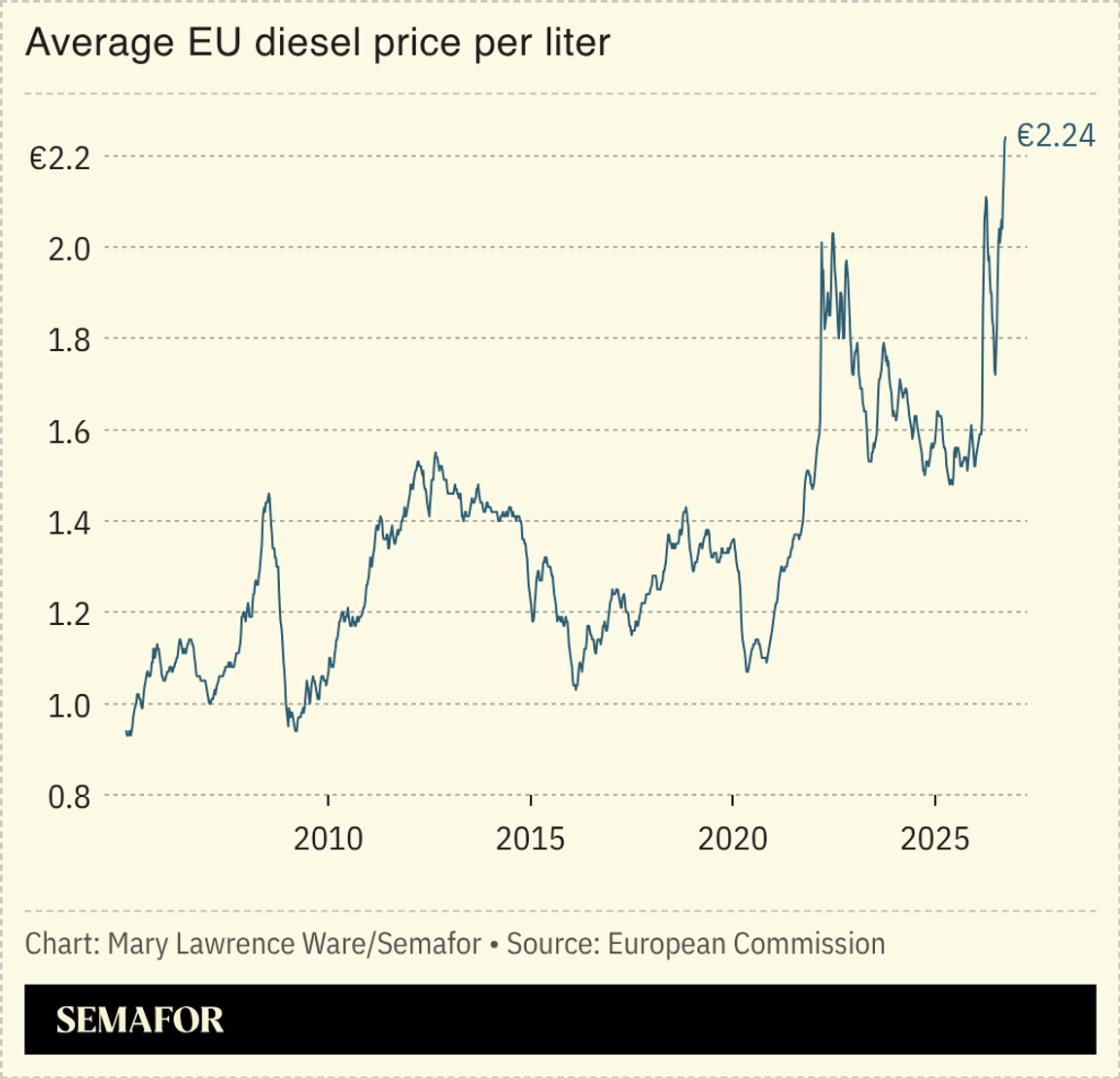 The Trump administration is pressuring European capitals to release their emergency diesel supplies or else face a US diesel export ban, as the White House turns to coercion in efforts to tame surging fuel prices. France, Germany, Britain, Italy, Ireland have all been pressured to draw down supplies, Politico reported. They are preparing to respond with “one voice,” a source told the outlet, hoping to defuse a situation that could spike fuel costs throughout the EU, which receives more than half its diesel exports from the US. Russia extended its own diesel export ban for at least another month, while China suspended fuel exports for October, a move that will further squeeze global energy supplies. |
|
US brushes off EU-Canada deal |
 Annabelle Gordon/Reuters Annabelle Gordon/ReutersUS Trade Representative Jamieson Greer on Thursday tempered expectations of an imminent trade deal with Canada, saying “gaps remain” between the North American neighbors amid their spiraling trade war. Greer’s remarks at a US-hosted G20 trade ministers’ meeting came days after President Donald Trump suggested a deal could be weeks away. At the Milwaukee gathering, Ottawa took the opportunity to huddle with officials from the EU, as the two prepare to finalize a sweeping partnership pact that has riled some in Washington: The Canadians “will stab you in the back [and] stab you in the front,” Trump’s trade adviser said. But Greer brushed off the pending EU-Canada agreement, telling Semafor and others, “there’s not actually juice left to squeeze in that.” |
|
Broadcom gives Anthropic a boost |
 Jonathan Ernst/Reuters Jonathan Ernst/ReutersBroadcom plans to lend Anthropic up to $42 billion to lease its chips, Reuters reported, adding to the trend of chipmakers financing the AI buildout that’s driving demand for their products. Nvidia is also financing a slew of frontier labs, in the process becoming a kind of “central bank of AI,” The Economist wrote, as demand surges for the scarce chips powering compute. But bankers are raising questions about Nvidia’s $500-billion chip-backed financing plan, Reuters reported, with some seeking stronger guarantees than originally outlined. “Anthropic is one of the most important companies in the world,” Semafor’s Liz Hoffman wrote earlier this year, but deals like this show “its parents need to cosign its lease.” |
|
Plane attack scrambles Israeli elections |
 Netanyahu and flydubai passenger. GPO/Handout via Reuters Netanyahu and flydubai passenger. GPO/Handout via ReutersThe narrowly-avoided catastrophe aboard a flydubai flight has electrified Israel’s highly polarized election debate, with Prime Minister Benjamin Netanyahu claiming vindication, and his opponents drawing parallels to the government’s pre-Oct. 7 security failures. With less than a month remaining before Israelis vote, Netanyahu’s allies said he warned of exactly such a pre-election “attack” from the country’s “enemies” — claims that Israel’s opposition leader called “a pathetic attempt to hitch a ride on the heroism of Israelis who prevented a disaster that [Netanyahu], once again, was unprepared for.” Other critics argued that if the government was expecting such attacks, it should have prevented the pilot stabbing rather than relying on civilians’ intervention. “It’s exactly like October 7,” a former prime minister said. |
|
Iran asserts victory in 14,390-word letter |
 Majid Asgaripour/WANA via Reuters Majid Asgaripour/WANA via ReutersIran published a 14,390-word letter to Americans this week proclaiming the regime’s victory over the US, suggesting the two sides were no closer to resolving their seven-month war through diplomatic means. Iran claimed it “decimated America’s military bases across the Gulf, forced the US Navy into retreat and destroyed billions of dollars-worth of high-end radar and aircraft,” a Bloomberg columnist wrote, which is all “partly true, though overstated, just as the letter wildly understates the IRGC’s own losses.” Tehran is preparing a more forceful response if Washington resumes large-scale strikes, Reuters reported. Iran’s leaders “never had much faith in American negotiators; now, they have virtually none,” an Iranian-American expert wrote in Foreign Affairs, and are preparing “a strategy… defined by escalation and continuous offense.” |
|
Russian actions are ‘war,’ Estonia warns |
 Janis Laizans/Reuters Janis Laizans/ReutersEuropean leaders should describe covert Russian actions as “terror attacks” amounting to “war,” instead of calling them “hybrid,” Estonia’s foreign minister told Politico Thursday. His remarks came days after Tallinn blamed Moscow for an arson attack against an Estonian factory supplying unmanned vehicles to Ukraine, amid a surge in Russia-linked sabotage, surveillance, and violence across the continent. European policymakers should refrain from responding to Russia only with “the language of force,” the director of Carnegie Russia Eurasia Center argued in the Financial Times. A purely offensive approach means both sides could end up “one mass-casualty event away from a different world,” he wrote, suggesting that Europe should instead boost domestic security and negotiate guardrails with the Kremlin. |
|
 Why does the world’s richest country have more homicides than any other? Malcolm Gladwell’s new audiobook, The American Way of Killing, investigates America’s gun violence epidemic through original reporting from Chicago to Alabama, painting a picture of a country that doesn’t understand its most pressing social problem, nor how to fix it. Listen now. |
|
Starbucks opens cafés in Xinjiang |
 A Starbucks booth at an expo in China. Florence Lo/Reuters A Starbucks booth at an expo in China. Florence Lo/ReutersStarbucks opened its first cafés in China’s Xinjiang region, prompting criticism from activists and US lawmakers over the coffee giant’s decision to expand into an area widely scrutinized for human rights violations. Beijing has denied allegations that it represses Xinjiang’s Muslim Uyghur population, and has invested heavily to rebrand the region, efforts that are paying off: Chinese state media reported a 22% year-on-year increase in new foreign-funded enterprises and a 10% rise in foreign investment in 2025, while more than 300 million foreign visitors generated $53 billion. The chairman of the US House committee on China called Starbucks’ move “morally bankrupt,” saying it “ties an iconic American brand to the CCP’s brutal campaign against the Uyghurs.” |
|
|


