|
|
|
|
|
|
|
|
|
Some courthouses are much faster than others even for the same type of estate certificate. ARLYN MCADOREY/AFP/Getty Images
|
|
|
|
|
A few months ago, I wrote about how the time it takes to obtain an estate certificate can vary widely in Ontario based on which courthouse you apply to. We now have more data showing how those average wait times vary based on whether the application involves a will and a few other scenarios. |
|
|
|
|
Maxwell Shiffman, a lawyer based in Cambridge, Ont., has been collecting the data by surveying other lawyers and law clerks around the province who deal with wills and estates. I’m not aware of another publicly accessible source of similar information. |
|
|
|
|
After someone dies in Ontario, it’s often necessary to apply to the Superior Court of Justice to obtain a certificate that clears the way legally to administer the deceased’s estate. That process is called probate. |
|
|
|
|
Wait times matter because there can be a lot riding on them, said Mr. Shiffman. “It could be a sale of a home, liquidation of investments that potentially cannot be done without this certificate.” |
|
|
|
|
|
|
|
|
Mr. Shiffman’s previous survey found that those timelines vary significantly – from under a month to as long as a year – depending on the courthouse one applies to. (And where to apply is not a matter of choice in Ontario, it has to be the courthouse that serves the area where the deceased used to live.) |
|
|
|
|
His more recent version of the survey, which he sent out in July, has more granular data. It shows average wait times for estates with a will, those without one, those that have secondary wills (used for certain types of assets) and those seeking what’s known as a small estate certificate, which goes through a simplified process. |
|
|
|
|
The findings continue to show that some courthouses are much faster than others even for the same type of estate. For example, probate with a will typically takes less than 30 days in Parry Sound and between six and eight months in Kingston, according to the responses collected by Mr. Shiffman. |
|
|
|
|
But they also show just how much longer, on average, probate processing takes when someone dies without a will. With a will, most courthouses produce an estate certificate within one to three months, according to the data. Without it, you’re looking at two to five months. |
|
|
|
|
Having a secondary will, which is used for certain assets that don’t need to go through probate, often involves more complexity and also leads to longer wait times of two to five months. |
|
|
|
|
But, surprisingly, applying for a small estate certificate, reserved for estates valued at $150,000 or less, does not seem to meaningfully speed things up. The timelines were roughly in line with probates involving bigger estates that have a will. |
|
|
|
|
What likely makes everything slower, regardless of courthouse and circumstances? A system that still largely relies on paper documents and snail mail. |
|
|
|
|
While courts have to have the original signed copy of a deceased person’s will, which can only be submitted in person or through the mail, an electronic portal could handle much of the rest of the process, Mr. Shiffman said. |
|
|
|
|
Tell me about dealing with a loved one’s estate outside Ontario. What was your experience? ealini@globeandmail.com |
|
|
|
|
Subscribe to the On Money newsletter
Are you reading this newsletter on the web or did someone forward the e-mail version to you? If so, you can sign up for On Money here. |
|
|
|
|
|
|
|
|
|
|
|
|
|
|
|
| ‘Buy Canadian’ is still going strong
Consumer boycotts tend to fade quickly, writes David Coletto, founder and CEO of Canadian polling firm Abacus Data. But not the “Buy Canadian” trend. Nineteen months after the start of the trade war, Canadians say they are doubling down on patriotic shopping. | | |
| AI could be a threat to low-interest savings account (paywalled)Having too much cash sitting in bank accounts that pay little or no interest is a “silent wealth killer” for scores of Americans, but AI bots could help change that by making it easier to move money to higher-yielding accounts, writes the Wall Street Journal. Canadians, with their gobs of money sitting in uncompetitive big-bank savings accounts, should pay attention. | | |
|
Estate planning beyond a willSpeaking of wills and estates, here’s another important nugget. Just because you have a will doesn’t mean your affairs are in order. This article from Advisor.ca has a list of possible headaches that can come up even with an up-to-date will in place. |
|
|
|
|
|
|
|
|
|
|
|
|
|
|
|
|
|
|
|
|
|
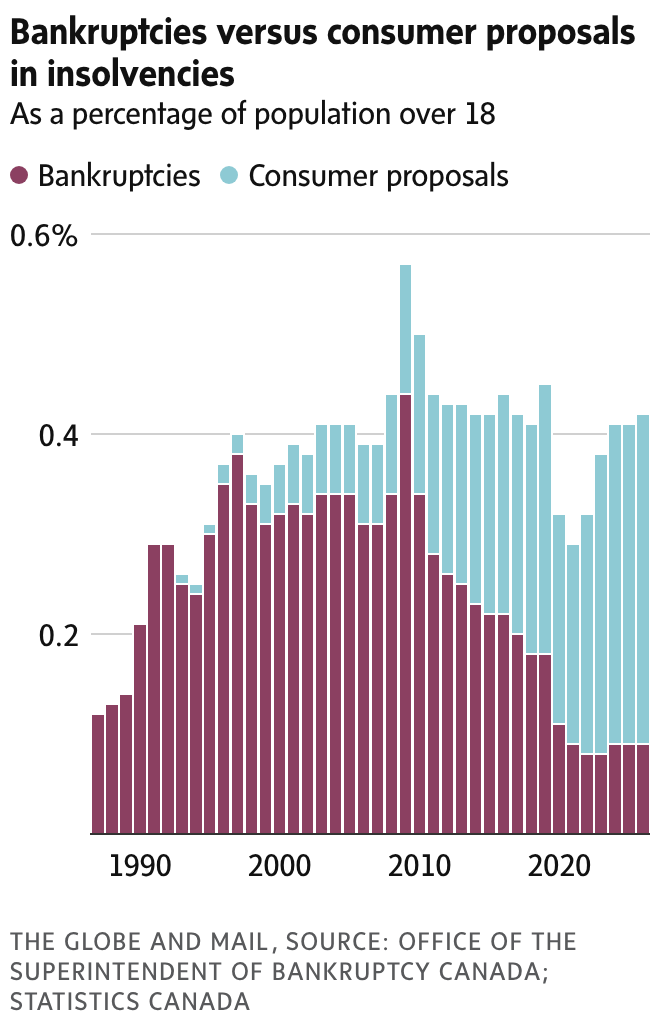
Insolvencies per adult are up 46 per cent since 2021, and nearly four in five insolvent Canadians now choose a consumer proposal rather than bankruptcy, according to Hanif Bayat. |
|
|
|
|
|
|
|
|
|
|
|
|
|
|
|
|
Mr. Shiffman, the Cambridge, Ont., lawyer, has an online tool that lets you look up where to submit a probate application in Ontario. The website now also indicates average probate processing times based on his survey findings. (A quick note here to say that the tool also promotes Mr. Shiffman’s business. It’s still a handy tool that anyone can use it for information purposes.) |
|
|