|
|
Trudie’s Tavern Is Equal Parts Sleekness and Schmaltz |
The new spot in Brooklyn joins its siblings, Gertrude’s and Gertie, as a bastion of playfully Ashkenazi-ish cooking. |
By Helen Rosner |
|
Photographs by Isabelle Zhao for The New Yorker |
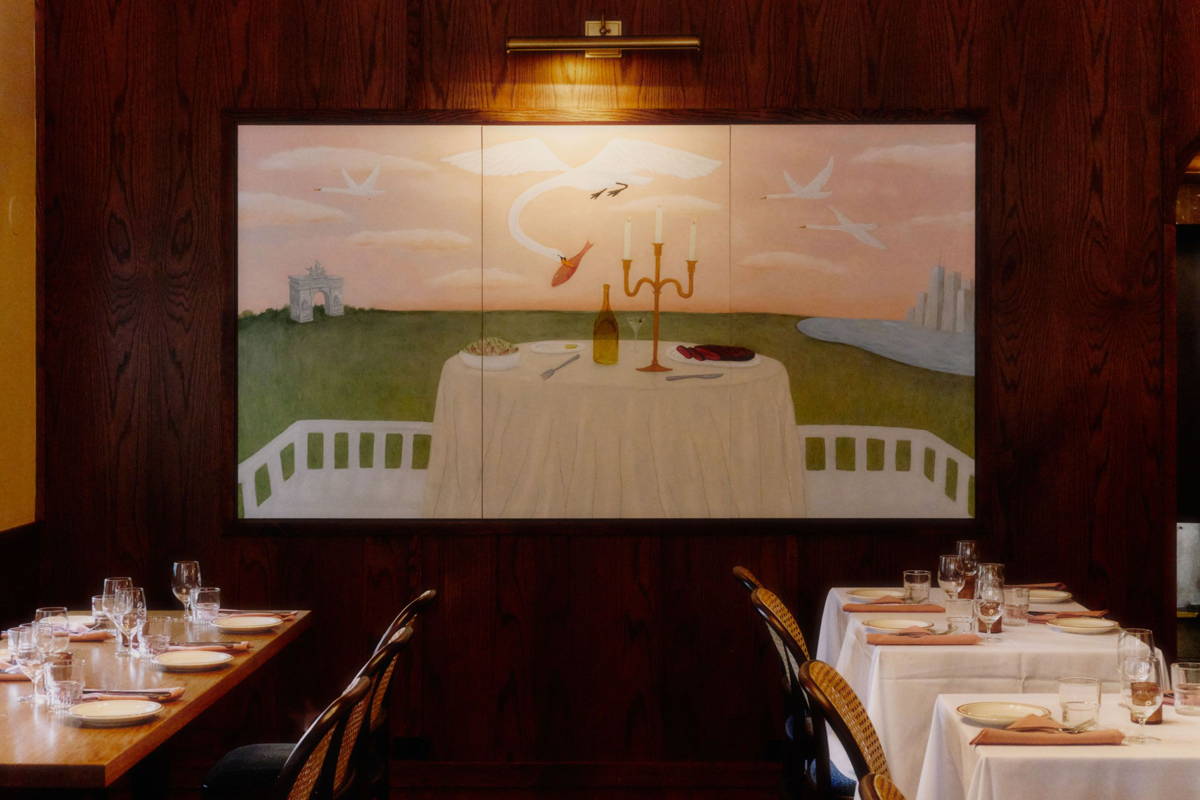
Gertrude Aronow, the grandmother of the restaurateur Nate Adler, was, by Adler’s account, an eccentric woman of uncommon charisma, the sort of person who made any room feel like a party. Adler and his wife-cum-business partner, Rachel Jackson, who together own the group RAD Restaurants, have graced three establishments with variations on Aronow’s name, all of them devoted to a sort of modern version of Ashkenazi American cooking. Gertie began as a Jewish diner in Williamsburg and was recently reborn in Prospect Heights, as a bagel shop. Gertrude’s, down the street, is a playful bistro with duck pastrami and challah-bread Parker House rolls. And now there is Trudie’s Tavern, which opened this past summer in Carroll Gardens, a smart little restaurant that’s the most ambitious, and the most accomplished, of the three. For sixteen years, before it was Trudie’s, this sunny Court Street corner was Buttermilk Channel, a restaurant famous as much for its status as a pioneer of the Brooklyn restaurant culture of the late two-thousands as it was for its magnificent fried chicken. When it closed, in 2024, the owner, Doug Crowell, joked that if he were doing it all again, he’d skip the white tablecloths, and it’s true that the ritziness that they connoted was a bit out of synch with the comfort-food menu. But I always liked them, and the softening effect of their snowy drape on what was often a clattery, raucous room. I was delighted to see white tablecloths at Trudie’s, too, though the open rectangle of space has also been tamed by a few strategically placed half-height walls, which lend a sense of intimacy. The décor is pleasingly colorful: pink napkins on the tables, blue velvet upholstering the chairs and banquettes, a pink sky filling an enormous painting of swans against the gentle brown of a wood-panelled wall. |
|
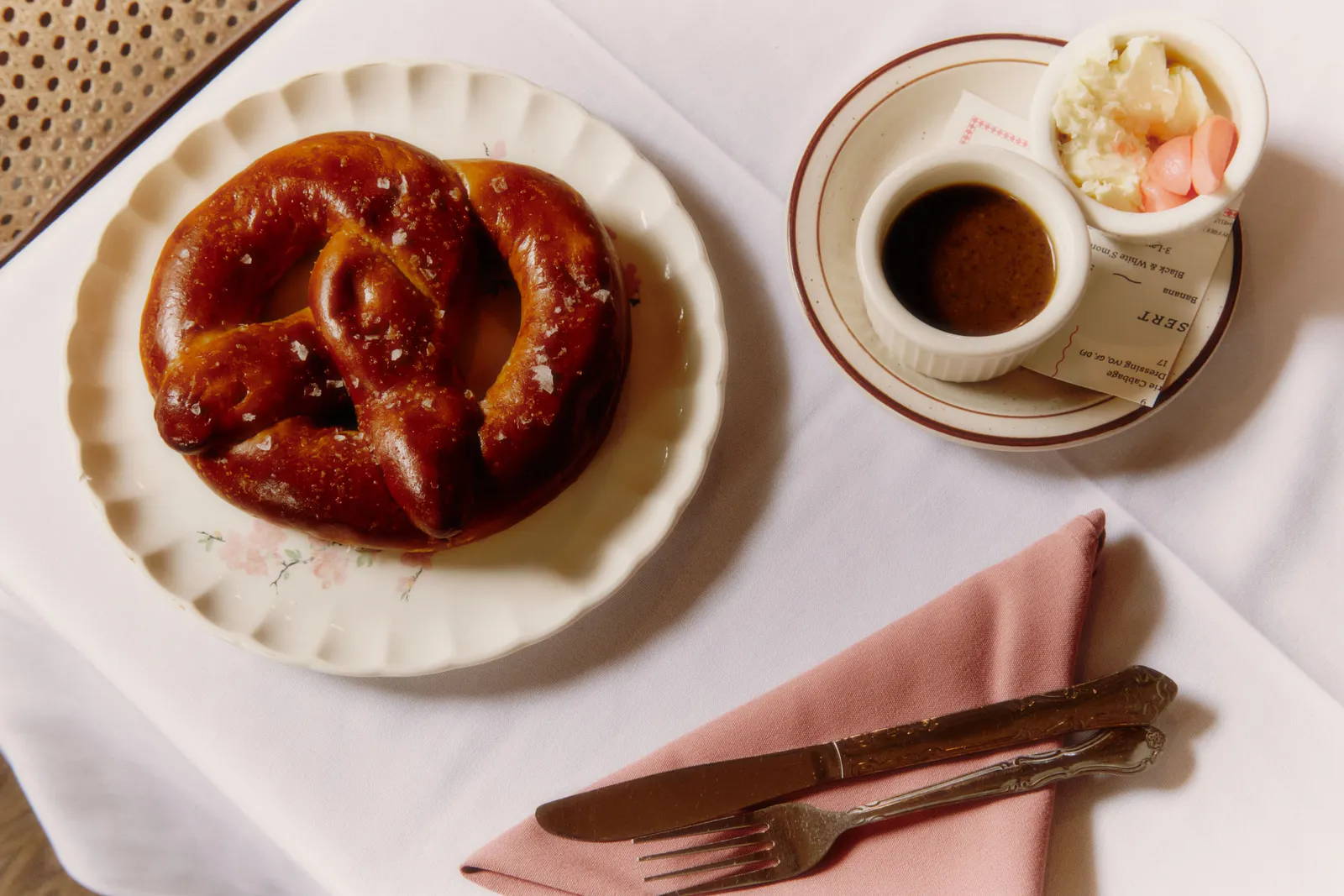
The “warm pretzel service” includes sides of mustard, butter, and pickled radish. |
If you wanted Trudie’s to be romantic, as the pink and the linens might imply it to be, there’s a romantic restaurant in there for you: a dirty Martini, a plate of oysters, a lusty strip steak dripping in bone-marrow butter. But it’s also a casual restaurant, good for a burger and a beer with a friend, or an early dinner with the kids—my three-year-old and I both, one evening, were transfixed by the old tube TV mounted over the bar, which streams classic movies with wobbly warmth. It’s a little kitschy, too: the bathroom, with eighties-era baseball memorabilia and multicolored party lighting, gave me haunting flashbacks to the many bar mitzvahs I attended in my youth. Families stream in for the early seatings; dates and double dates take over the tables as the evening sets in. I’m not entirely sure what sort of restaurant Trudie’s thinks it is, or wants to be, or how exactly it wants me to feel, but—oddly—that ambiguity works out into its own quite wonderful thing: a bit of poise, a bit of roughness, a not quite emulsified admixture of crisply ironed and easygoing. The menu is a similar mishmash. You’ve got comfort-food elements that speak to the “Tavern” part of the restaurant’s name, such as a huge puffy pretzel dotted with salt or hunky pigs in a blanket rolled in everything-bagel seasoning. But there’s something more sophisticated happening in the kitchen, evident in such dishes as a swordfish on a late-summer pool of pepper-and-watermelon gazpacho, and a potato pancake extravagantly dressed in a dill-and-cucumber crème fraîche and strewn with smoked trout and orange bubbles of flying-fish roe. It’s a latke, of course, even if the menu doesn’t call it one. Trudie’s is the least overtly Jewish of the couple’s three restaurants, but the menu is woven with the motifs of American Jewish cuisine: egg noodles, cucumber salad, schmaltz for miles, droplets of it even floating on top of a Martini. One of the things that I like best about these spots is how they play on memory and tradition without getting hokey or shticky or—the worst possible restaurant sin—maudlin. Trudie’s offers snow crab, three marshmallow-white claws served chilled on ice, with a bit of dijonnaise for dipping. It’s a preparation lifted directly from the Miami Beach fixture Joe’s Stone Crab, which, though utterly unkosher in virtually every way, is arguably the most Jewish restaurant in the city’s history, at least in a Philip Roth kind of way. |
|
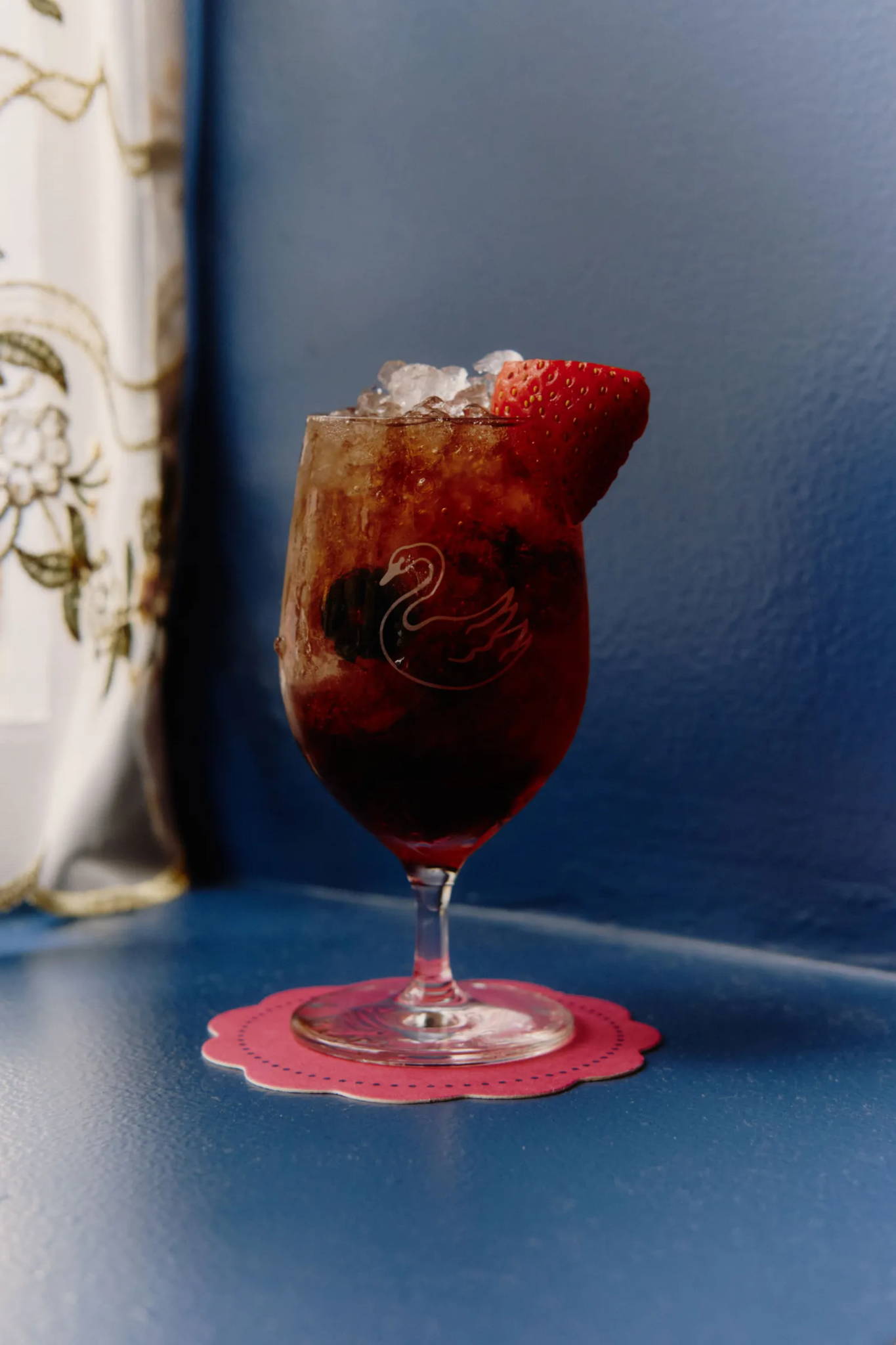
A sherry cobbler. |
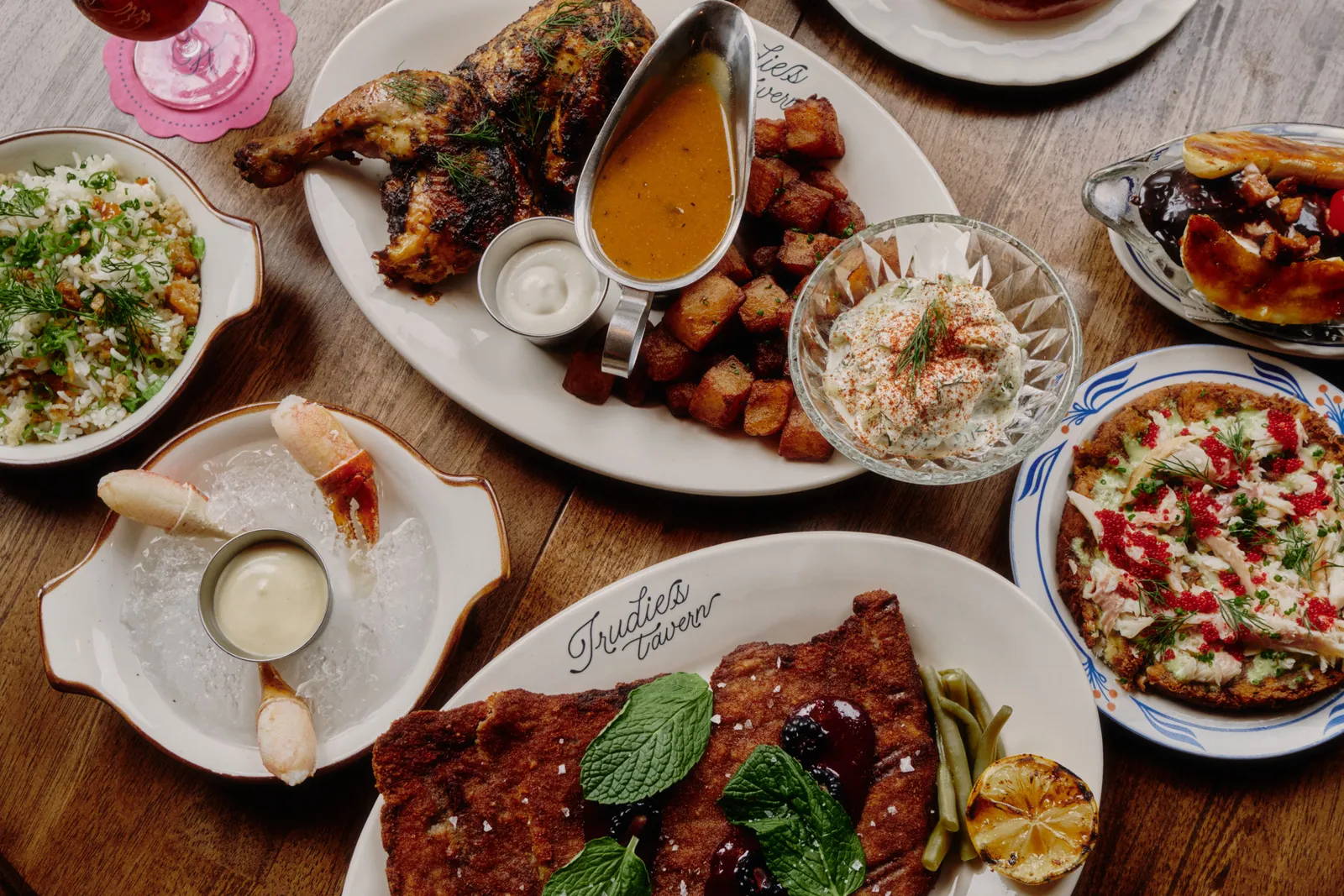
The menu, overseen by the chef Mike Cain, is largely playing the hits. One night I paused, knife in position over a steak, to watch a platter of roast chicken travel through the dining room, burnished and glossy alongside a crisp pile of roasted potatoes. It was served with a white-and-green scoop of creamy cucumber salad flecked with dill (a recipe from Adler’s other grandmother) and an entire gravy boat of what I would discover, ordering the dish on my next visit, was a dense, onion-sweet chicken gravy, with just a hint of sharp, vinegary kick. Best of all was the lamb schnitzel, perhaps the restaurant’s biggest swing. Schnitzel is usually the province of subtler, tenderer meats—your chicken breasts, your veal rounds. But, pounded thin, breaded, and fried, served under lashings of sweet-sharp blackberry sauce, with a confetti of whole blackberries and leaves of mint, the lamb version was brilliant and bizarre, a symphony of strong-willed flavors. It put me in mind of a meal that might be found in a lush and gently ominous Mitteleuropa folk tale, and also, a little bit, of a cowboy-style chicken-fried steak. The portions are hearty, but it would be a mistake to skip the side dishes, a broad selection of salads, cooked vegetables, and other odds and ends that showcase some of the kitchen’s surest work. You could make a meal of an utterly dreamy bowl of garlicky braised Rancho Gordo butter beans, paired with the Schmaltz Fried Rice, gleaming and toothsome and studded with bits of crispy gribenes, and maybe a fresh green salad—dressed simply in a bright, sunny vinaigrette—to cut through all the richness. Wedges of rotisserie-cooked cabbage, in a funky, anchovy-rich vinaigrette, could maybe stand a bit more fire. (So, on some nights, could the service, which drifts a bit to the spacey side of welcoming.) Save room, as well, for a banana split with pretzel-infused ice cream, or a slice of cake, three towering layers of carrot sponge, with a coconut filling and a dense cream-cheese frosting. It’s the whole restaurant in one slice: sweet and not-too-sweet, happily a bit of one thing and happily a bit of another. |
|
From the left: schmaltz-fried rice, crab claws, roast chicken, lamb schnitzel, and “one big potato pancake.” |
|
|
Recommended Reading |
|
|
Popular on The New Yorker |
|
 |
Get more New Yorker in your inbox. |