|
|
|
|
Good morning. I’m filling in for Chris Wilson-Smith on today’s business newsletter. In focus this week: Quebec’s election is upon us, Ottawa and Washington are releasing trade data, and high gas prices won’t abate. But first, today’s top headlines: |
|
|
|
|
|
|
|
|
|
|
|
|
|
|
|
|
Diplomacy: Canadian farm and seafood producers hope to soon know whether China will extend tariff rollbacks on various goods that were granted on a temporary basis earlier this year. |
|
|
|
|
Energy: During Quebec’s election campaign, some party leaders showed an openness to revisit the provincial ban on oil and gas development, which triggered swift corporate backlash in 2022. |
|
|
|
|
Transaction: Suncor Energy Inc. is selling its interests in three oil fields off the Newfoundland coast to London-based Ithaca Energy in a deal worth up to $1.55-billion that marks a major reduction in its presence in the region. |
|
|
|
|
|
|
|
|
|
|
|
|
|
|
|
Voters in Montreal cast advance ballots in the Quebec provincial election, which takes place Monday. Christopher Katsarov/The Canadian Press
|
|
|
|
|
|
|
|
|
|
|
|
|
|
|
|
|
Separation anxiety: Quebeckers cast their ballots today and if the polls
are correct (granted, that is a big “if” these days), the separatist Parti Québécois seems set to form the next provincial government. |
|
|
|
|
The PQ has promised to hold a “popular consultation” on independence, though not until Donald Trump leaves office. It would be the third time la belle province has formally considered bailing on Confederation. For those worried the third time could be the charm, take solace in the fact that fewer than 30 per cent of Quebeckers support the idea of leaving Canada, which is far lower than where anti-federalist sentiment stood in the leadup to the province’s 1980 and 1995 referendums. |
|
|
|
|
Still, context is everything. In exactly two weeks, the people of Alberta will hold their own referendum on independence (or, more accurately, a referendum on whether to hold a referendum, but let’s not get bogged down in semantics). Support for separation in Wild Rose Country is also around 30 per cent. |
|
|
|
|
|
|
|
|
While the threat of separation on two fronts might sound scary given Canada is locked in a trade war with the Trump administration where our national sovereignty is at stake, Eric Andrew-Gee offers a valuable perspective
on this unique circumstance: “Separatist movements are as old as Confederation and as authentically Canadian as maple syrup,” he writes. “They are a case of chronic inflammation in the Canadian body politic, not a sudden infection.” |
|
|
|
|
Fresh ammo for a trade war: Both Canada and the U.S. will release trade data for the month of August on Tuesday. Given the tariff/counter-tariff tit-for-tat raging across the 49th parallel, those numbers will be watched even more closely than usual for any changes in the usual cross-border patterns. |
|
|
|
|
Trump seems to believe a trade imbalance is equivalent to a direct financial loss,
so right now, the size of the U.S.’s trade imbalance (or deficit) with Canada is of greater consequence than should rightfully be the case. In 2025, the U.S. had a US$48.3-billion trade deficit with Canada, meaning our southern neighbours bought nearly fifty billion USD more in products from us than we did from them. |
|
|
|
|
Regardless of whether the August data show that figure narrowing or widening, one can assume Trump will claim victory either way. |
|
|
|
|
Lower oil prices, but no help at the pump: Record diesel prices pushed the G7 to collectively dump 100 million barrels of petroleum products (including “substantial” amounts of diesel) onto the world market starting late last week. |
|
|
|
|
The repercussions of that move will continue to be felt over the coming weeks, but for most Canadians, the key question from all this is whether they will stop feeling gouged at the gas pump. |
|
|
|
|
I’m afraid I have some disappointing news on that front: As Joy SpearChief-Morris writes, gasoline prices are likely to remain high for some time as damage to global refining capacity has led to shortages that cannot quickly be solved. |
|
|
|
|
Budget watch: Pre-budget consultations for the federal government’s 2026 spending plan concluded nearly a month ago and Finance Minister François-Philippe Champagne met with his provincial and territorial counterparts late last week. |
|
|
|
|
|
|
|
|
|
|
Bond bust: Late last week, the global bond benchmark that is the 10-year U.S. Treasury hit a yield of 5.34 per cent. Yield refers to the amount of interest a bond pays out and goes up as the price goes down. In this case, the price is at its lowest (and its yield the highest) since 2002 (when Nickelback’s How You Remind Me was topping the charts, in case you needed that reminder). |
|
|
|
|
This means the cost for governments (and everyone else) to borrow money is at its highest level in decades. While there is a case to be made
that now would be a good time to buy into the bond market ahead of a possible rebound, experts say this is the new normal for borrowers. |
|
|
|
|
|
|
|
|
|
|
|
|
|
|
|
|
|
|
|
|
|
|
|
|
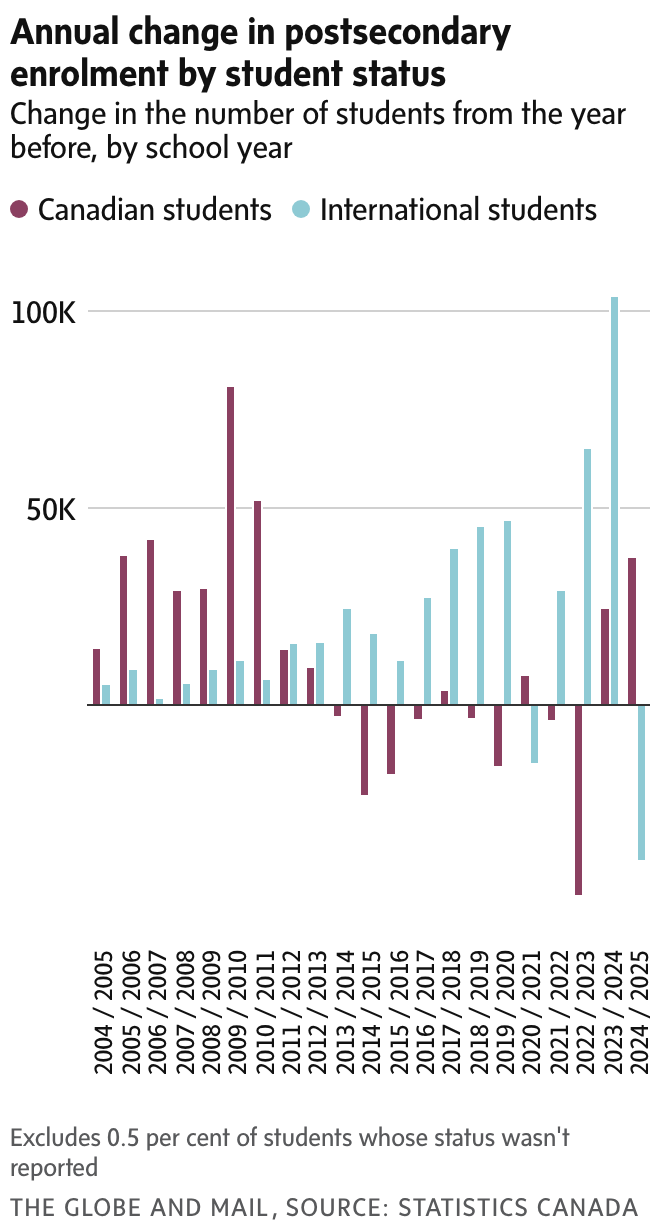
The number of Canadian students enrolling in colleges and universities is growing at the fastest pace in more than 15 years, |