| | In this edition, Brookfield Asset Management’s CEO sees no end in sight to demand for the energy and͏ ͏ ͏ ͏ ͏ ͏ |
| |  | | | Global Capital Edition |
| |
|
 - AI’s odd Wall St. bedfellows
- OpenAI’s Slack war
- Europe’s debt problems
- Saudi’s IPO damper
- Chinese microdramas hit the US
 What’s happening this week, and how AI solved a 200-year-old Napoleonic cipher. |
|
 On Aug. 28, a researcher at OpenAI said its models hadn’t been able to solve any of mathematics’ thorny Millennium Prize problems. Eleven days later, they had. Things are happening fast. News cycles are shorter, financial markets are twitchier, and business plans are being rewritten in real time. I have milk in my fridge that’s older than the consensus view that the Federal Reserve will raise rates again before the year is over. Predictions of a European economic renaissance born of necessary self-reliance have quickly curdled into concerns about another regional debt crisis, as you’ll read below. In under a year, we went from chucking about data centers in space (what will those silly billionaires think of next?) to doing it. It’s a lot to keep up with. So we’re taking this newsletter daily, starting this week, to cover and unpack the conversation around business, markets, deals, capital, and corporate power. We’re also growing our network of reporters and editors to better cover this moment. Ellen DiMauro joined us last month from Bloomberg to cover the world of credit and AI money flows; send her, Rohan, and me scoops! |
|
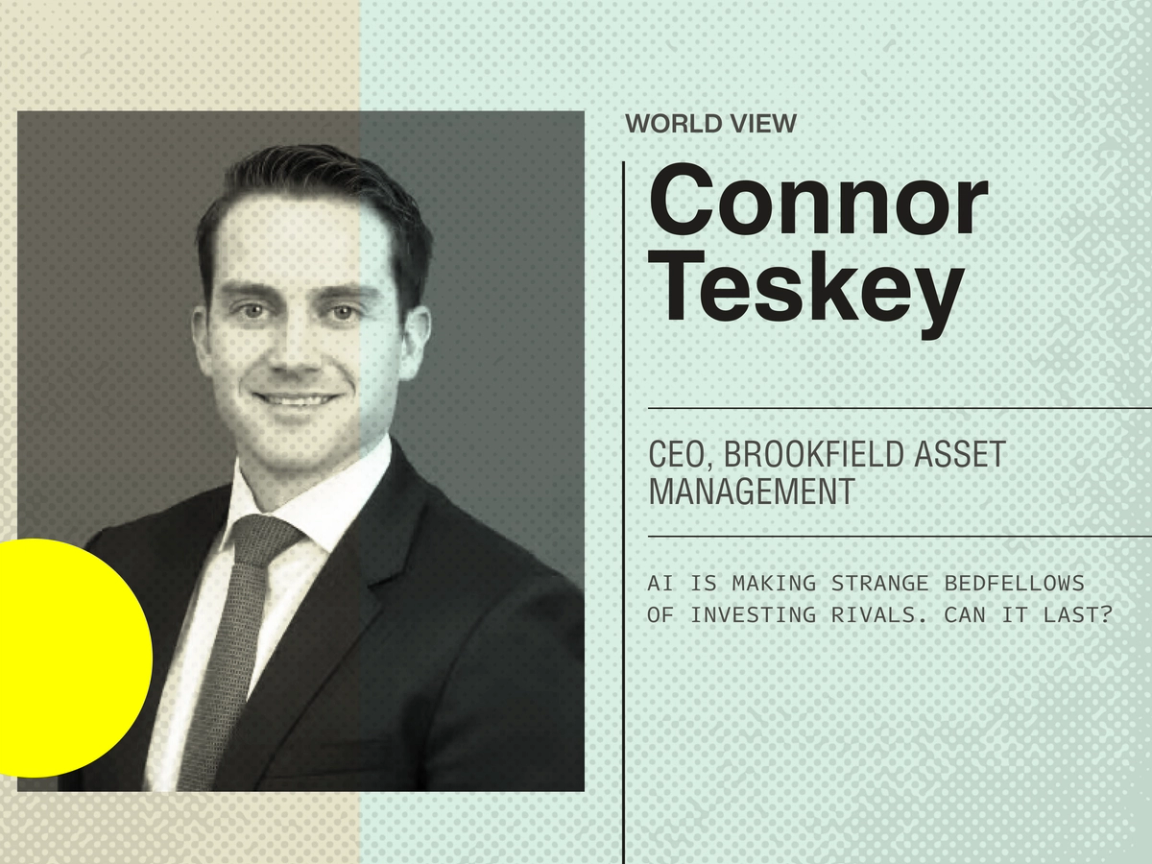 The image of Wall Street heavyweights sharing a CNBC screen earlier this summer to back Nvidia’s $500 billion AI buildout was a rare one for the investing world, where firms outperform rivals by snaking away their deals, not sharing them. “Why can you get five or six of the leading players at one table? Because there’s enough to go around for all of us,” Connor Teskey, the CEO of one of that consortium’s members, Brookfield Asset Management, said in an interview with Semafor. Chalk it up to Canadians’ go-along-to-get-along instincts, maybe. But the race to shift the cost of the AI buildout — $7 trillion over the next decade, by Brookfield’s estimate — from the hyperscalers themselves to external money managers is making strange bedfellows. The proliferation of consortia and joint financings, like Apollo’s and Blackstone’s backing of Broadcom, means less dispersion among competitors and a higher risk that they’ll rise or fall together. Teskey said there will still be gaps between “who performs well and who has some disappointing results.” To be absolutely clear, he said: “We’re not doing every opportunity we see. We are doing the tiniest fraction. And even with that very tight filter, we can deploy a tremendous amount of capital.” |
|
 Kevin Lamarque/Reuters Kevin Lamarque/ReutersThe employee activism at Facebook and Google may have withered over the last decade as wokeness waned and Silicon Valley shifted rightward, but it never went away. It was that sort of internal mutiny that pressured OpenAI’s Greg Brockman to abandon a planned contribution to a political action committee pushing against AI regulation, Garrison Lovely reports for Semafor. OpenAI employees took to Slack this summer to warn of a dangerous trade-off: The company’s political activity threatened to drive researchers to Anthropic, and hamstring it in the all-out race to recursively self-improving AI. OpenAI was “taking reputational hits,” Jason Kwon, its chief strategy officer, acknowledged. AI workers are racing hardest to fully replace themselves with machines, which they realize will drive their labor power to zero. But for now, they hold all the leverage in the world, and they’re learning to use it. |
|
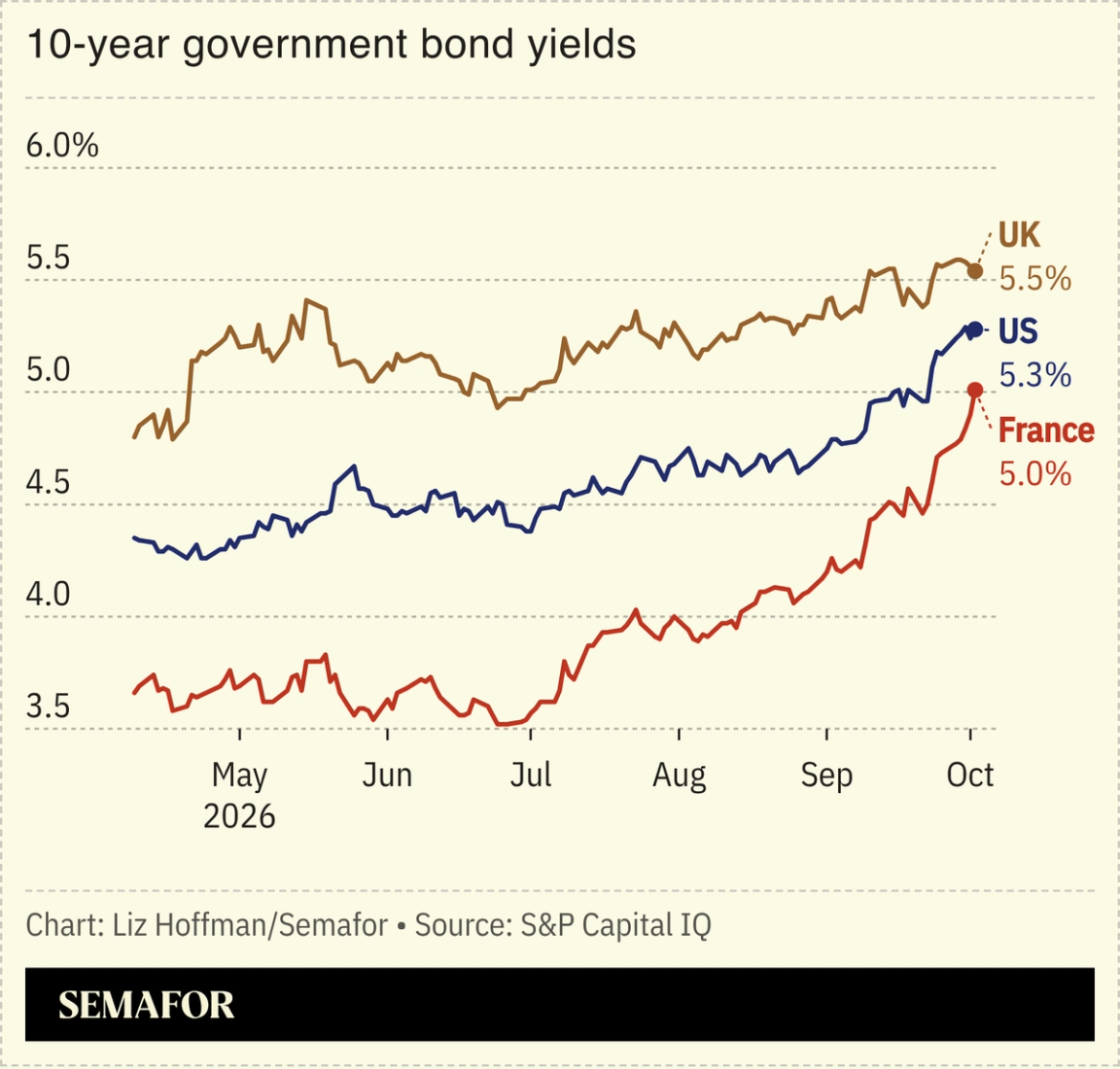 Europe’s bond selloff has been blamed, in part, on Washington policies driving Treasury yields higher, but analysts are warning of a “broader contagion” that’s sparking flashbacks to the region’s debt crisis of the early 2010s. The currency union ultimately pushed through, and indeed added members in the following years, but differences in how things are playing out today offer some reasons to worry. Back then, the trouble started in Greece, a relatively small economy, and metastasized to Ireland and Spain, but the continent’s economic giants held steady. The European Central Bank issued a now-famous “whatever it takes” promise, and Germany relaxed its fiscal rules to accommodate a fix. Now, France — an economy 10 times larger than Greece’s — is the epicenter, with a combination of record issuance upcoming, rising yields, and divisive budgetary politics. The far-right National Rally party, which is leading polls for 2027’s presidential election, is a noted critic of the EU. And Germany, which was ultimately the euro’s backstop then, has a historically unpopular chancellor who might lack the political capital to back a rescue. On Monday, the euro sank to its lowest level in more than a year after Spain called a snap election, compounding existing fiscal and political worries. The head of the IMF, which bailed out Greece a decade ago, deflected when we asked in a recent interview whether the world’s lender of last resort expected another advanced economy to come calling. |
|
Saudi’s cure for IPO fizzles |
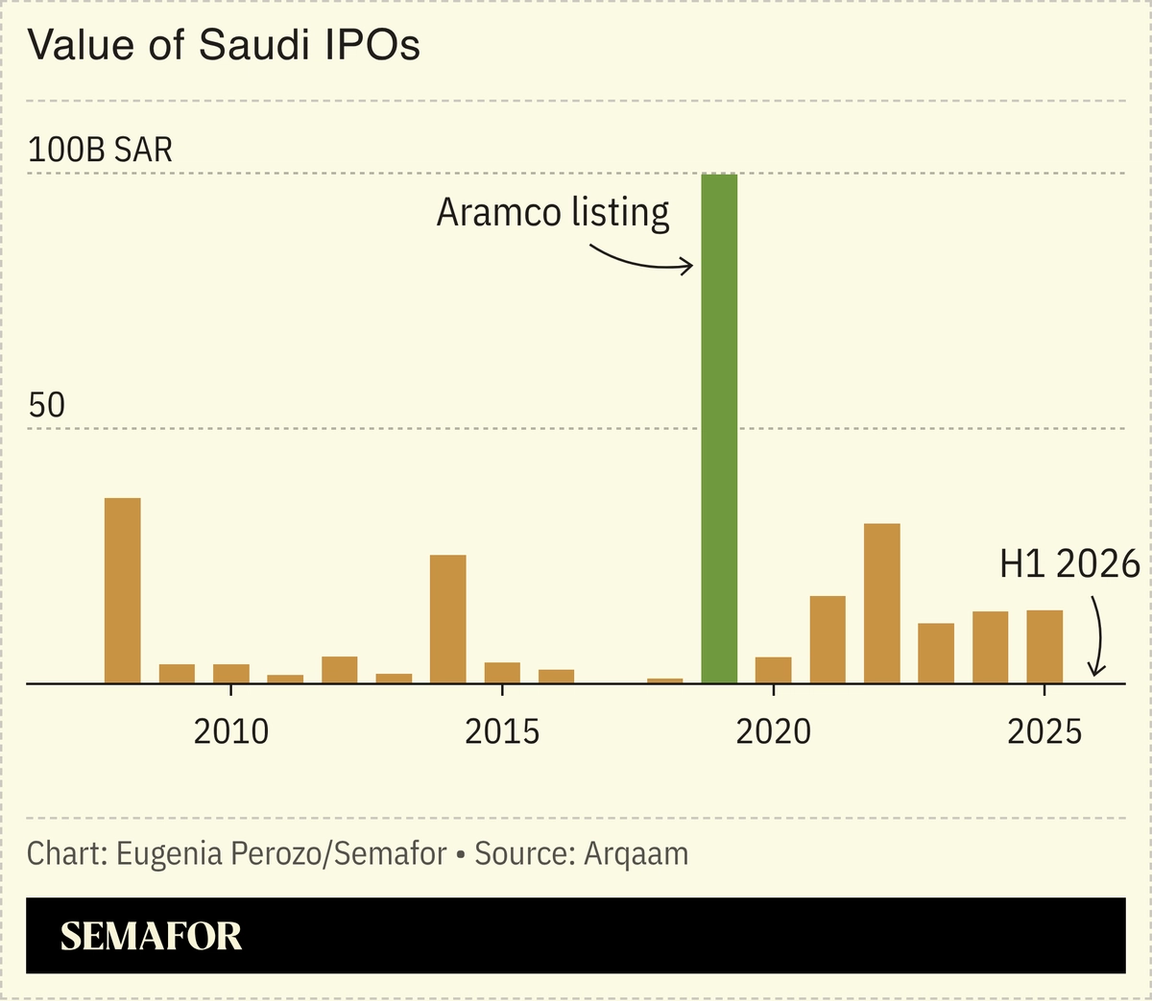 Saudi Arabia’s markets regulator wants to fix the country’s IPO market by tightening IPO rules. Proposed changes to the Capital Markets Authority’s listing rules would require banks to commit to buying any unsold shares, which is meant to favor mature companies over the run of many of the half-ready listings that have since sagged, Semafor’s Matthew Martin reports. Critics warn the changes could stall deals already in the pipeline and shut out smaller banks that can’t risk their capital on floats that might fizzle. The Saudi stock market, the Tadawul, has more than 250 public companies but nearly two-thirds of its total value comes from Saudi Aramco, the state oil giant. The government needs a healthy market to sell down its domestic holdings and fund the crown prince’s economic overhaul. Therein lies the government’s dilemma: By weeding out listings that aren’t ready for public markets, the regulator could end up depressing IPO activity, and ultimately, dragging down valuations. |
|
Microdramas hit Hollywood, via Shanghai |
 Quibi torched more than $1 billion trying to make premium short-form video for smartphone watchers. Today, vertical video “microdramas” are a fast-growing corner of Hollywood — by way of Shanghai — that has attracted interest from NBC’s Peacock and Netflix. The genre’s leading frontman, actor and producer Kasey Esser, joined Semafor’s Mixed Signals show to break down the business model: Chinese producers and writers, churning out over-the-top, low-production melodramas with titles like The CEO’s Mermaid Bride, chopped up into two-minute chunks and sold for 50 cents apiece. Production costs run as little as $100,000 — that’s what Quibi budgeted per minute for its star-studded shows — but marketing costs can easily be 10 times that, Esser said. Production shops “make their show based on data and what they think people will watch,” said Esser, who got his break answering a casting call for an “alpha werewolf” part. “And then they spend enough to make sure you see it.” The leading microdrama app, ReelShort, brought in $15 million last month, according to Sensor Tower, and YouTube’s Short series passed 6.5 billion views in the first half of this year. Jeff Katzenberg wasn’t wrong, just early. |
|
 Media is being reshaped by two powerful forces: the rise of the creator economy and the rapid evolution of AI. Once disruptive forces, both are now central to how media is created, distributed, and consumed. On Thursday, Nov. 5, Semafor co-founder & Editor-in-Chief Ben Smith and Media Editor Max Tani will host The New Media & Marketing Playbook, convening leaders including Ben Davis, Senior Partner & Co-Head of Digital, WME, and Melissa Hobley, Chief Marketing Officer, Tinder, to explore how creators and AI are converging and what it means for the future of media and marketing. NYC | Nov. 5 | Request Invite |
|
 - Oct. 6: Paramount’s takeover of Warner Bros. Discovery is set to close after a year of political fights, talent backlash, and questions over how the Ellison empire, stretched by AI investments, can afford it. The bonds are trading rockily, and the newly renamed Skydance’s celebratory sizzle reel starts with a clip from … Titanic.
- Oct. 7: Amazon’s Prime Day is a dry run for holiday-season demand among increasingly anxious consumers.
- Oct. 9: University of Michigan consumer-confidence numbers follow a September collapse to its weakest level in 12 years. It’s the last pulse check of an inflation-weary American public before the midterms home stretch.
|
|
 @CarterWChurch/X @CarterWChurch/XAI just cracked a Napoleonic cipher that has eluded history buffs for 217 years. An engineer used OpenAI’s GPT-6 Astra to decode the dispatch, revealing a never-before-seen set of orders from the French emperor to one of his generals during the 1809 campaign in Austria. Frontier models are solving uncrackable math problems and discovering new enzyme systems, but along the way are delighting history and true-crime sleuths. (There are still unsolved Zodiac-killer ciphers.) Encryption only holds until the translation tools catch u |
|
|


