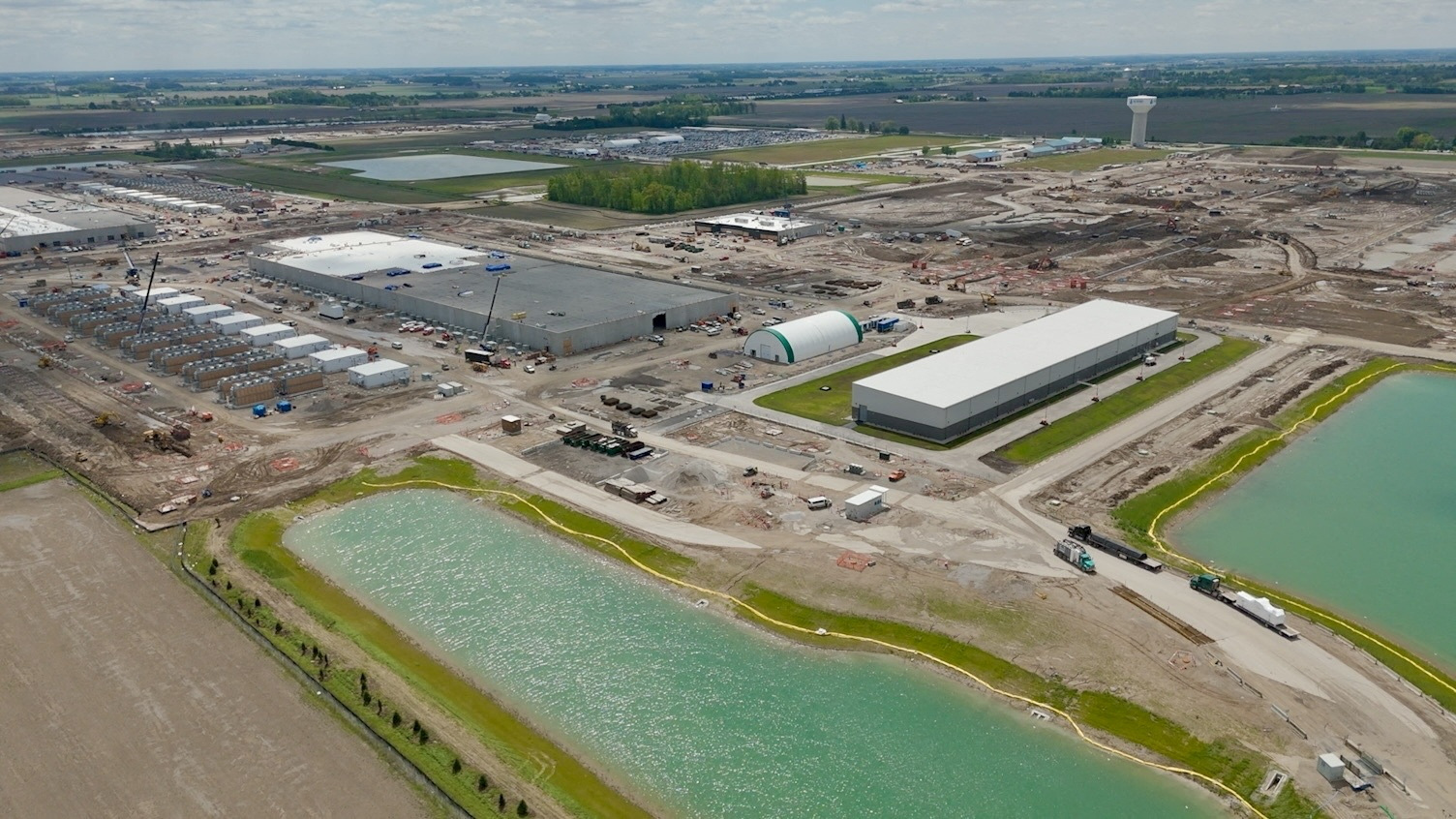
Hello! Over the past few months, I’ve been speaking to big tech companies, environmental activists and startups about one thing – data centers. I have been fascinated by their sudden proliferation around the world, their intensive resource consumption and the public outrage that has sparked, prompting protests and demonstrations against their build out.
This side of the story has already been well documented by my colleagues, and you can click here to keep up to date with the latest data center stories.
I wanted to explore whether these data centers could be built in a sustainable way and the public and private initiatives that are in place or in the works to enable this shift. Also on my radar today: |
|
|
A drone view shows construction underway on Meta's new data center in Middleton Township, Ohio, U.S. REUTERS/Eric Cox |
What do government bodies say? |
As governments race to attract AI investment and data centers, some jurisdictions are starting to impose environmental guardrails.
Just last month, the European Commission proposed rules requiring data centers in Europe to disclose how efficiently they use energy and water and proposed a rating scheme for facilities to incentivize companies to build more resource-efficient data centers.
Meanwhile, Australia's Victoria state proposed that new data centers in the region will have to secure their own renewable energy supply and storage and bear the connection costs and network upgrades.
Over in New South Wales, the state developed its own framework and guidelines for data centers requiring a minimum 40% wind generation component, storage capacity of at least 25% of generation capacity over a four-hour duration and agreements of at least 10 years’ duration. Where recycled water is unavailable, companies must negotiate a plan with their water utility to fully offset interim potable water use. A UK government spokesperson said that new data center developments must be considered through the current planning system which includes local community and environment assessments as well as using "AI Growth Zones to support data centre development in areas with access to clean energy."
The US, the largest data center hub globally, has conflicting methods of dealing with the rise of data centers. On one hand, the Senate blocked legislation requiring state utility regulators to consider whether large electricity users, including data centers, should bear the incremental costs of power infrastructure built to serve them and thus ease the burden on households.
And on the other, there are currently lawmakers in 16 states that are considering banning their development, according to the National Conference of State Legislatures.
In fact, most US voters think President Donald Trump's administration and Congress are not taking the risks of AI seriously enough and want the government to write new regulations for the technology, according to a six-day opinion poll by Reuters/Ipsos.
Worth noting that 56% of voters in the Reuters/Ipsos poll back limits on building data centers, including 69% of Democrats, 55% of independents and 43% of Republicans. Click here for the full poll results. |
|
|
|
How about tech companies? |
Matt Parry, head of energy demand and power at the Renewable Energy Association, said that mandatory regulations for data centers “may not be the best route” as companies would simply opt to go to a country with fewer requirements — also known as regulatory arbitrage.
I spoke to a few Big Tech company executives to understand whether water and energy efficiency are considered when rolling out a data center and what innovations they are already applying or aim to use to help lower their resource intensity. Brandon Oyer, head of energy & water for the Americas at Amazon Web Services (AWS) said that the company now uses air cooling 90% of the year in all of its operations globally. Oyer said that the method allows AWS to limit the number of hours that it uses any water, and that it leans on sewer water “that nobody else would want to use if it's available in the community” which is a recycled water method being applied in 26 facilities, with 130 more coming online later this year.
We also spoke about the challenges in investing in startups that do have sustainable solutions as they are hard to scale up to fit in such a huge operation as AWS. Since I couldn’t fit it all into one newsletter, you’ll have to tune in to next Thursday’s Switch to read about some of the innovative startups that aim to solve some of these issues. |
Bally Bagayoko, mayor of Saint-Denis, is evacuated amid a nationwide day of protests and blockades in Paris, France. REUTERS/Abdul Saboor |
-
France protests: Demonstrations swept across France this week as teachers and parents took to the streets with high school pupils. The government is under pressure to tame public debt amid weak growth and has struggled with basic tasks such as passing a budget since President Emmanuel Macron's allies lost their majority in a 2024 parliamentary vote. Click here for a story on the mayor who went viral for shielding students during the protests, Bally Bagayoko, the mayor of the French town of Saint-Denis.
-
Spain’s housing protests: Maricarmen Abascal, the 87-year-old Spanish woman whose dramatic eviction last month sparked mass housing protests that led to an early election, has died, the Madrid tenants' union said on Wednesday, as thousands demonstrated over her death. Abascal had been in hospital for severe anxiety and exhaustion since her eviction on September 23 from her home of more than 70 years, when police and social workers removed her by stretcher.
-
Aussie climate case: An Australian community group has won the first climate change case to come before the country's top court, with judges upholding a decision to block a two-decade extension of a coal mine operated by MACH Energy in the state of New South Wales. The expansion would have allowed it to extract an additional 406 million tons of coal.
-
US consumer protection: Examiners at the US Consumer Financial Protection Bureau resumed examinations in the spring after President Donald Trump's administration had suspended most of the agency's work upon taking office last year and gave a largely clean bill of health to most of the companies they inspected earlier this year — a light-touch approach that marked a departure from the past for the watchdog, according to three people with knowledge of the matter. Click here for the exclusive story.
-
Child migration: More than 20,000 of the 31,100 children who arrived in European countries including Bulgaria, Cyprus, Greece, Italy, Malta and Spain in 2025 were recorded as unaccompanied or separated from a parent or guardian, a report by the International Organization for Migration, UNHCR and UNICEF found.
-
EPA moves: Aaron Szabo, an attorney who led the Environmental Protection Agency’s Office of Air and Radiation since 2025 and oversaw some of the Trump administration's most consequential efforts to roll back climate and air pollution regulations, resigned effective last week, the agency said. The EPA said Justin Schwab, who serves as a senior adviser to EPA Administrator Lee Zeldin, has been nominated to replace Szabo.
|
|
|
|
Japanese scientist Kenso Soai, co-winner of the 2026 Nobel Prize in Chemistry, attends a press conference in Tokyo, Japan. REUTERS/Kim Kyung-Hoon
|
It’s another Nobel Prize winner in today’s spotlight.
|
|
|
|
|