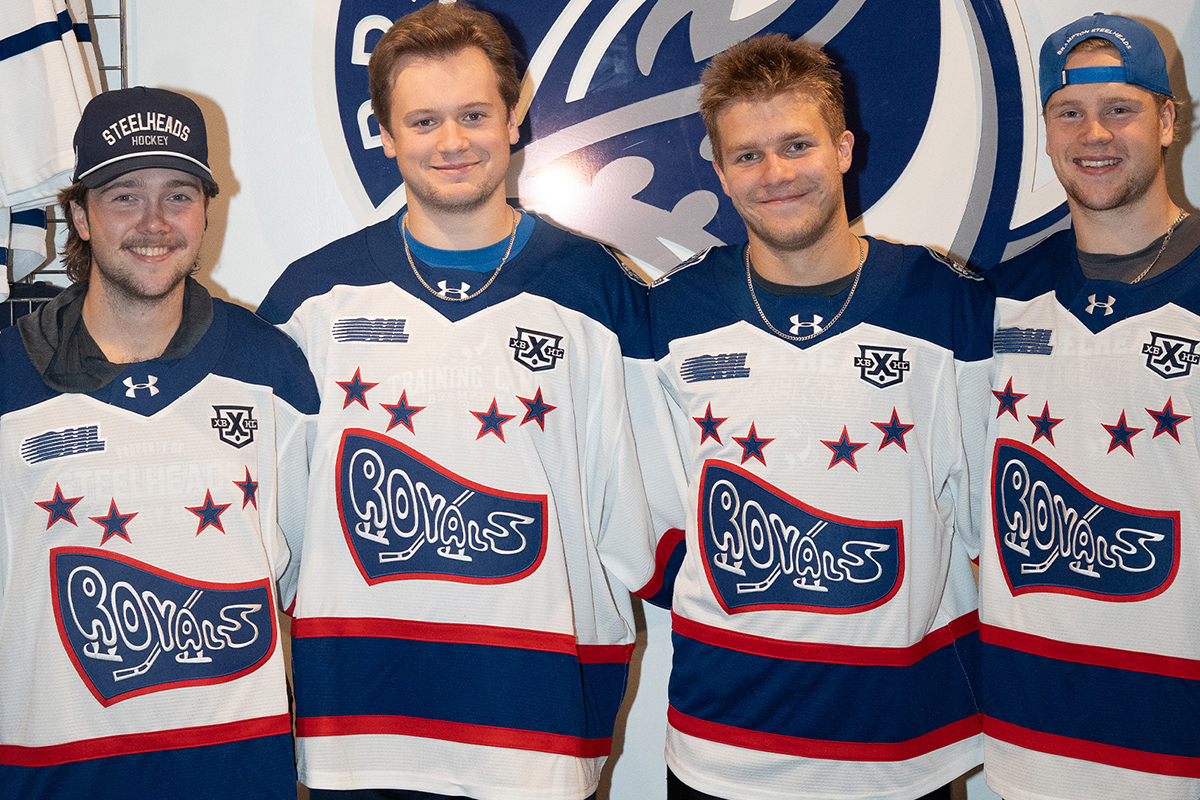
From left, Brampton Steelheads players MacGregor Richmond, Reed Gee, Kieran Witkowski, and Easton Mikus in the Cornwall Royals jerseys the team will wear during the Seaway Shootout games to be played in Cornwall on Oct. 16-17, 2026. (Handout/Cornwall Standard-Freeholder/Postmedia Network) |
|
|
Before dropping a bombshell trade ahead of the NHL regular season, Toronto Maple Leafs general manager John Chayka wondered aloud if the trade rumours would ever really stop.
Similarly, in the OHL, expansion rumours are all the rage, and the league seems to be leaning into the sphere of rampant speculation by announcing that the Brampton Battalion will wear Cornwall Royals jerseys at the Seaway Shootout series on Oct. 16-17.
Whether you're a fan full of nostalgia or interested in the business of sports, Nick Dunne's story, "Are the Royals coming back to Cornwall?" in the Cornwall Standard Freeholder is a must-read.
"It’s long been a pipe dream for nostalgic fans who’ve been waiting 34 years for another sniff at the major Jr. A hockey through the Ontario Hockey League (OHL), according to Cornwall Mayor Justin Towndale. But a confluence of events, from the league’s aggressive vision for expansion to the city’s investment in the Ed Lumley Arena, has generated more than the usual hum of idle chatter," Dunne writes.
For now, the OHL seems to be in an "if you build it, we might come" holding pattern.
“There are very, very few — next to none, quite frankly — facilities that are sitting there available and ready to host," OHL commissioner Bryan Crawford said.
|
|
|
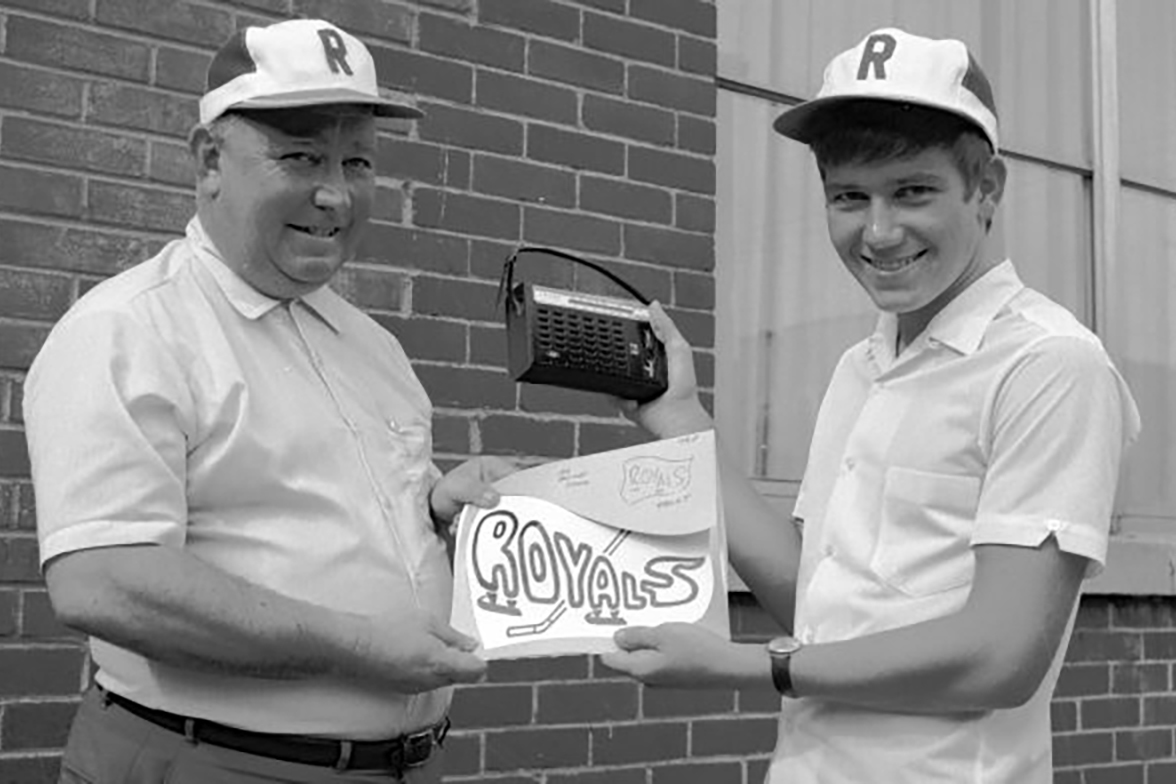
A file photo published on Aug. 16, 1969, of Cornwall Royals Hockey Club president Bunny Markell, left, presenting Roger Healey a transistor radio for submitting the winning design for the team’s new crest. Click on the photo to read that story. (Cornwall Standard-Freeholder) |
|
|
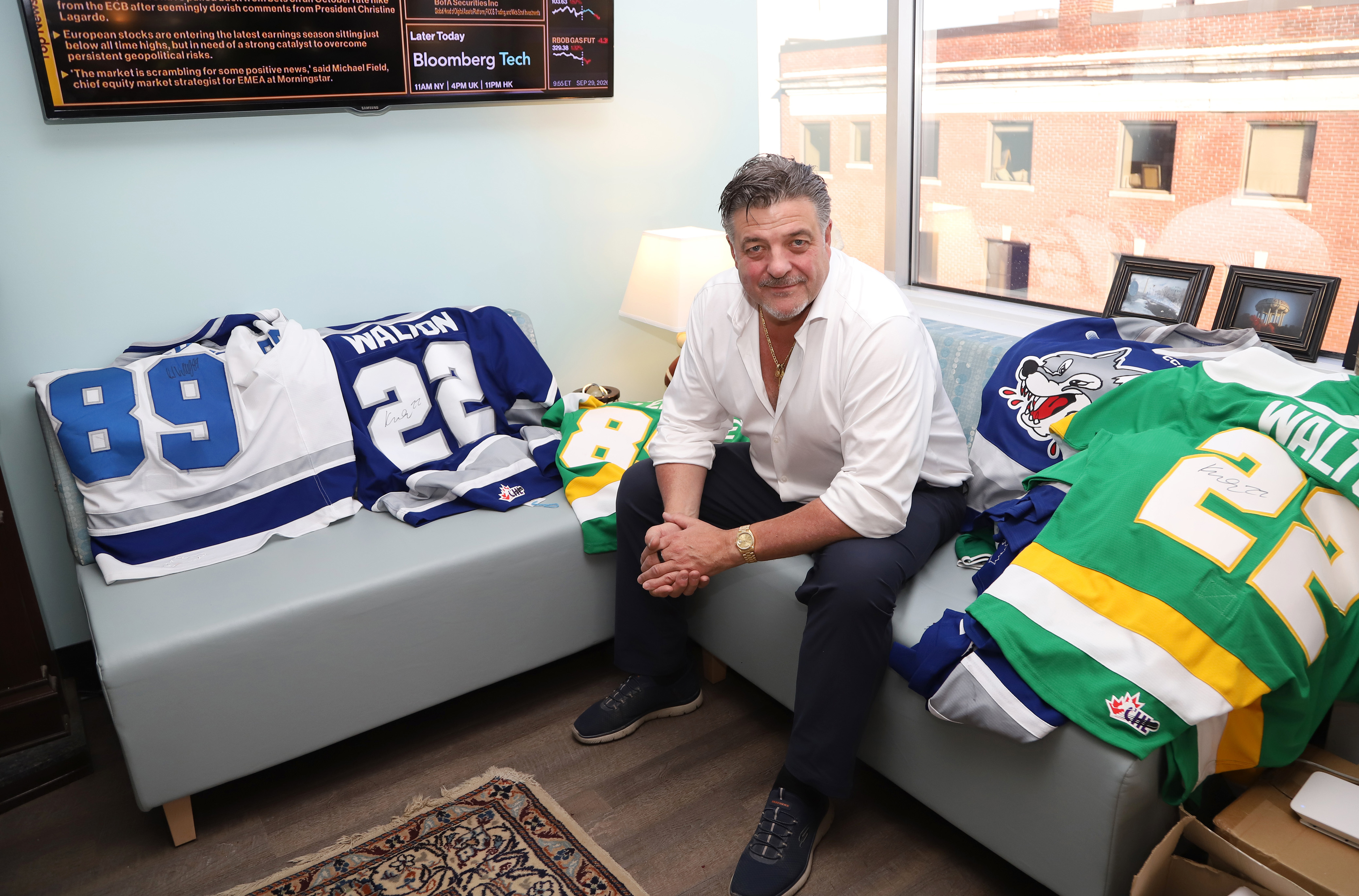
Dario Zulich is president and CEO of SW Sports and Entertainment. (John Lappa / The Sudbury Star) |
|
|
Dario Zulich: from investor to ‘guardian’ of Sudbury Wolves
|
|
|
Dario Zulich sat in his living room, his dog by his side and a scotch in his hand, wondering where things went wrong.
It was mid-April 2024 and the ink was barely dry on the game sheet for the Sudbury Wolves’ final contest of the season, a lacklustre 5-0 loss to the North Bay Battalion in Game 4 of their second-round series. It was a shocking, disheartening defeat for a team owner who was just as hopeful as his staff, players and many fans heading into the season that a high-powered squad led by scoring stars David Goyette, Quentin Musty and Dalibor Dvorsky might finally bring a J. Ross Robertson Cup championship to the Nickel City.
“It really, really hurt,” Zulich recalled during a recent interview in his office on Larch Street. “It stung so bad, when we lost four straight to North Bay when we had the triple-headed dragon. We needed to go further and I was upset.”
It was quite a comedown from just two nights earlier, when Greater Sudbury councillors voted unanimously to build a new downtown event centre to replace the aging Sudbury Community Arena, the city having killed a previously approved event centre project at Zulich’s own Kingsway Entertainment District property due to spiralling costs.
He was eager to share the news with fans who had gathered at the old barn on Elgin that same Tuesday evening to watch the Wolves take on the Battalion in Game 3 of their OHL Eastern Conference semifinal. Even after losing the first two games in their best-of-seven series, the locals appeared to be very much in the fight, using a dominant second period to build a 5-2 lead entering the third.
Then disaster struck ...
|
|
|
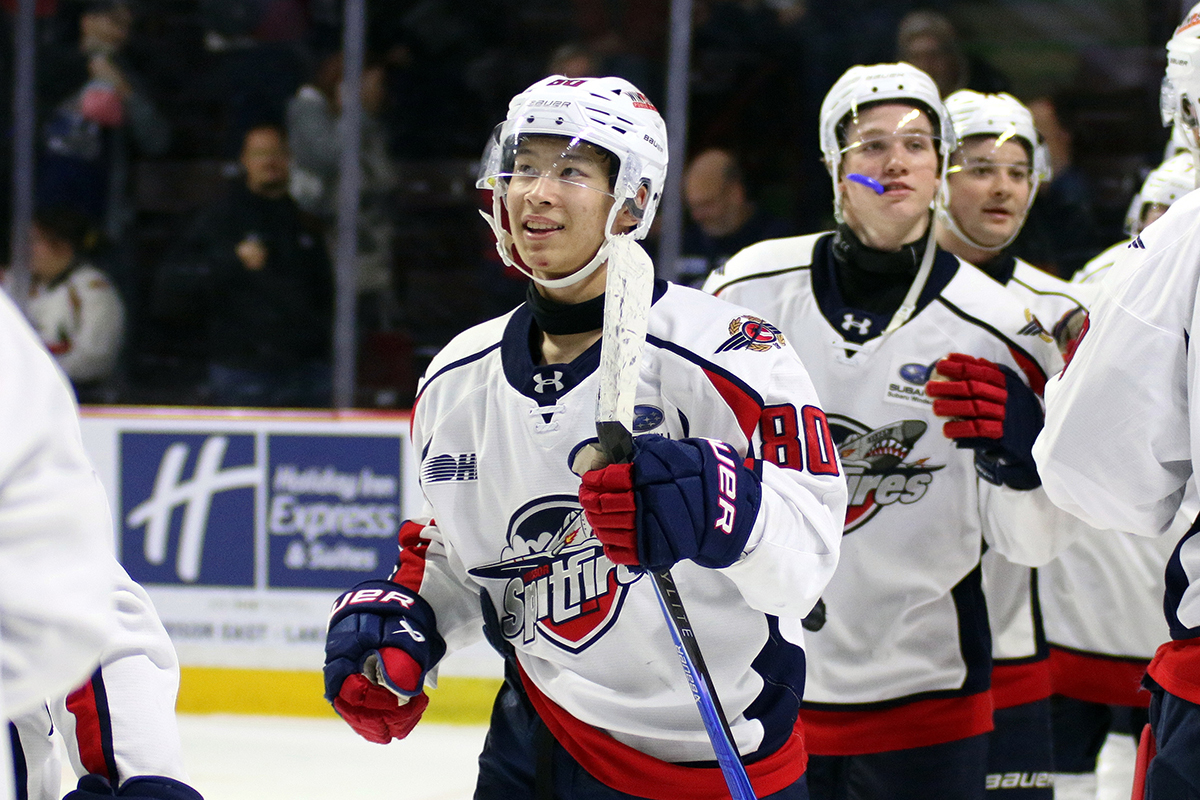
Beksultan Makysh (Tim Cornett/OHL Images) |
Each week we'll try to profile someone in the league with an interesting story. Sometimes that may be a Q&A. This week, it's a little story on the Kazakh Kid they call "Beks." If you have someone in the OHL you'd like to know a little more about, be it a player, coach, executive or otherwise, let us know by e-mailing ohlnewsletter@postmedia.com.
It's quite the journey from Kazakhstan to Windsor.
Beksultan Makysh, 18, first jumps on a six-hour flight from his home city of Astana to Istanbul, in Turkey. From there, he has a nine-hour layover before another plane takes him to Detroit. Then, it's a short drive to his hockey home with the Spitfires.
The culture shock lingers like jet lag. He deals with new things in North America, like using rudimentary tools such as physical payment systems.
"In Kazakhstan we can pay with our hand."
"Pardon me?" Says the caveman-like newspaper reporter.
"We can pay with our palm. They scan your palm. In the store," Makysh explains patiently to the wide-eyed credit-card waving dolt. "There's a scanner that scans your palm. It reads your hand."
Astana, the Kazakh capital with a population of 1.7 million within its city limits, is a rapidly developing, modern city ranked 46th in the global Smart Centres Index. The contactless palm-vein biometric payment system works by allowing scanners to read unique subcutaneous blood vessel patterns and palm geometry. Users hover their hand over a scanner at terminals, such as the ones at a grocery store, and the transaction is complete.
In a way, Makysh represents the future of the Ontario Hockey League.
He's a young, skilled player from half a world away, playing in the OHL because it's a viable path to an American college scholarship. In fact, Makysh committed to the University of Maine in September and is expected to enroll next season.
Prior to the NCAA rule change, international players who signed deals in the Canadian Hockey League were pretty much pot committed to playing professional hockey or returning home. Now, players can parlay their CHL experience into a lucrative NCAA scholarship, which widens the pool of interested parties.
"Since the rule change, I think this was the better decision for me, because the OHL they develop a lot of NHL players. I think it's the best league there is for junior leagues," Makysh said.
This past summer, OHL teams selected two players from Astana. The Oshawa Generals selected Ratmir Shalapayev from the New Jersey Selects in the eighth round, and the Niagara IceDogs took Miras Zhumabay in the 15th round of the draft from the Pittsburgh Penguins Elite program. The IceDogs took the rare step of signing the 15th-round pick to an OHL Scholarship and Development Agreement after Zhumabay impressed at the team's training camp.
“Miras was arguably the biggest surprise of rookie camp and then into main camp,” IceDogs general manager Dale DeGray said at the time. “Being a late pick and really no expectations for him going in, he made it difficult for us not to consider him. We wanted to make sure we could sign him, get him designated for junior B, and continue to watch his development from nearby. We look forward to seeing his development throughout the winter months with the (St. Catharines) Falcons.”
For Makysh, it was a dream, but he never expected to play in North America.
It wasn't until his team travelled from Kazakhstan to Nashville for a hockey tournament that the Boston Hockey Academy reached out — rather quickly.
"I was just having a nap after a game, and they texted me," Makysh said. "I didn't have an agent, so I just talked to my parents. Honestly, my parents didn't want me to go because I'd be all alone there. It was a hard decision for them, but they made the right decision."
The then-15-year-old went home, completed his paperwork to play internationally, and began learning English.
He scored 66 goals in just 55 games in his first season in Boston. He also learned English quickly.
"English is one of the easiest languages to learn . . . Russian is the hardest," he said.
The Spitfires selected Makysh in the second round of the 2025 CHL Import Draft. He scored 14 goals and added 25 assists as a rookie with the Spits.
"It was hard to adjust. I had a hot start, but then the guys from the NHL came back, and it was hard for me to adjust. They're all big, strong, fast," he said. "But at the end of the season and going into the playoffs, I felt really, really good. I felt confident going into the season and playing against the older guys."
Change can happen quickly. It's happening in the OHL right now.
For Makysh, over the past three years, he's moved from Astana to Boston to Windsor — and the University of Maine is his next destination. He's learned a new language, and he's played against future NHL superstars. All because of one text message, sent while he was taking a nap.
"I always wanted to be here. I just didn't know it would be that day."
|
|
|
The On the OHL Mailbag is open for the 2026-27 season. This week we solicited questions from X, Reddit and HFBoards. If you submitted a question and don't see it below, we'll try to answer it in a future newsletter. If you have a question for the On the OHL Mailbag, email ohlnewsletter@postmedia.com. Or, drop us a line on X (@GregCowanST, @Ben__Leeson). Questions this week were answered by Greg.
Here we go.
Q: What was the feeling around the league regarding the Tanner Adams trade? (Submitted by Reddit user OuateDaPhoque)
A: I think changes are coming, partially as a result of what happened with Tanner Adams.
For some context, Adams is one of the best young prospects in hockey. The Brampton Steelheads selected the 16-year-old from South Porcupine (near Timmins) with the third-overall pick in the 2026 OHL Priority Selection, despite knowing the six-foot-one, 203-pound centre wanted to play closer to home, with the Sudbury Wolves. Adams and his agents told Brampton he wouldn't report, and, a few months later, the Steelheads traded his rights to Sudbury for a total of 15 draft picks and two compensatory picks, which the OHL awards to teams when a player originally chosen in the first round of the OHL Priority Selection fails to report and the team trades that player’s rights between September 1 and September 15 of that year.
That's all been well-documented, but here's where it gets interesting. With the league's current ruleset, the Brampton Steelheads really had no other choice. They could pass up on a player who many thought was the most talented prospect in the draft, or pick him and wait until the Wolves pay a bounty, which they did.
However, with the OHL returning to a live, in-person draft and the "player experience" becoming even more important with so many leagues for talented kids from all over the world to choose from, holding a player's rights for ransom doesn't exactly scream positive public relations.
So, I expect that, perhaps as soon as next year, OHL general managers will be able to move first-round picks in some form. Whether that's during the regular season or only during a short off-season window leading up to and including the draft. I know general managers have already discussed this possibility, and it seems there's a favourable push to make it happen now.
In Adams's case, the Steelheads and Wolves could have done their business behind the scenes, and Adams could have walked down the steps and onto the arena floor in Kingston on draft night into the waiting arms of his "hometown" team.
I think that's where we're going next.
Q: Is there any reason behind the league being hesitant, or reluctant to tell the fans conditions on draft picks in trades? (Submitted by HFBoards user StingUpdates)
A: This is something teams are certainly getting better at being transparent about. It was always frustrating to me that some OHL trades could have multiple draft picks exchanged with "conditions" attached, and fans of those teams would have no idea what those conditions were.
I've been told that, in some cases, general managers don't think it's fair or appropriate to make performance-based conditions public.
For example, when Owen Sound traded Caden Taylor to the Oshawa Generals before the season, it included a conditional 15th-round pick that would improve to a third-round pick in 2029 if Taylor scores 20 or more goals this season.
Another recent example: Owen Sound's trade of Matthew Koprowski to the Peterborough Petes included a conditional 15th-round pick that improves to an 11th-round pick if Koprowski remains with the Petes beyond January 10, 2027.
In both cases, one or both teams made the conditions public, but in other cases managers prefer to keep those things in-house, and I can understand why.
I think managers are worried about the optics. If Caden Taylor is hovering around 20 goals and is taken off the top power-play unit, fans might suggest it's being done to save the third-round draft pick from changing hands. Or, if Koprowski is cut on Jan. 9, fans might debate whether that's a sound decision based on the team's goaltending depth, or a move made to save the 11th-round pick heading to Owen Sound.
My personal opinion is that fans pay for us all to be here, and they deserve to have those debates and discussions about their favourite teams, even if it gets a little messy sometimes.
...
I'm going to cap it there, because apparently I have trouble answering questions concisely. Next week, we'll dive into a question about player cards and associated roster rules. That's going to take a few words . . . |
|
|
Have questions about the OHL? |
|
|
|