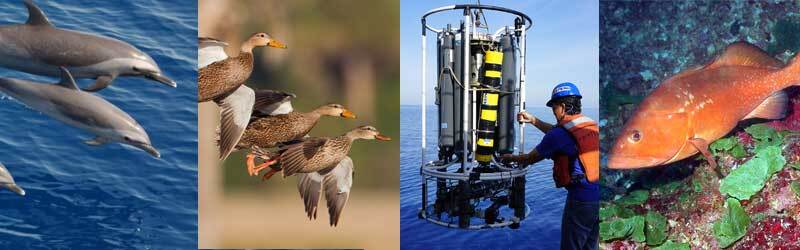
The NOAA RESTORE Science Program is awarding funding to five projects initiated in 2019 focused on long-term trends in living coastal and marine resources in the Gulf of America. These project teams earned an additional $24.7M in funding based on high performance and following an independent evaluation.
These funds will allow the project teams to continue long-term collaborative research that informs the management of reef fish; deep, open water fish and invertebrates; marine mammals; marsh birds; and Mobile Bay fisheries. The awards will support teams of researchers and resource managers from across 20 institutions including universities, state and federal agencies, and non-governmental organizations.
Click on each Project Title to learn more about individual projects.
Title: Optimization and Expansion of Gulf-wide Video Survey Efforts to Better Characterize Temporal and Spatial Variability in Reef Fish Assemblages in Response to Drivers at Multiple Scales: The G-FISHER (Gulf Fishery Independent Survey of Habitat and Ecosystem Resources) program
Lead Investigator: Theodore Switzer
Lead Institution: Florida Fish and Wildlife Conservation Commission
Award Amount: $7,420,550
Project Description: This project combines habitat and water quality information with three integrated reef fish video surveys to produce the most comprehensive database available for Gulf reef-fish abundance, size, and community composition. This data feeds into the stock assessment process and provides fisheries managers with critical fisheries independent information.
Title: DEEPEND|RESTORE II: Trends and Drivers in the Pelagic Gulf
Lead Investigator: Tracey Sutton
Lead Institution: Nova Southeastern University
Award Amount: $3,712,978
Project Description: This project uses net and acoustic sampling to identify long-term trends in fishes, shrimps, cephalopods, and other fauna in the deep-pelagic Gulf. This information is shared with resource managers responsible for the numerous species that rely on deep-pelagic fauna as prey, including marine mammals. Deep-pelagic waters are in the open ocean beyond the continental shelf, from below the surface waters to above the bottom waters.
Title: Assessing Long-term Trends and Processes Driving Variability in Cetacean Density throughout the Gulf using Passive Acoustic Monitoring and Habitat Modeling
Lead Investigator: Melissa Soldevilla
Lead Institution: National Oceanic and Atmospheric Administration
Award Amount: $4,627,344
Project Description: This project uses a comprehensive network of underwater microphones to gather critical baseline data on the abundance, location, and movement of marine mammals in the Gulf. By analyzing this acoustic data, the team characterizes long-term population trends and investigates the impacts of human activities and ocean conditions.
Title: Fire Effects in Coastal High Marshes: Microtopography, Management, and Monitoring of Mottled Ducks and Black Rails
Lead Investigator: Auriel M.V. Fournier
Lead Institution: University of Illinois Urbana-Champaign
Award Amount: $5,103,726
Project Description: This project investigates how black rails and mottled ducks respond to different prescribed fire management regimes within high marsh ecosystems across the Gulf. By monitoring bird distribution and habitat use, researchers identify optimal fire practices that support these vulnerable species and equip natural resource managers with the data needed to manage this habitat and its avian residents.
Title: Oyster, Blue Crab, Southern Flounder, and Spotted Seatrout Population Dynamics in Relation to Environmental Trends and Variability in Coastal Alabama
Lead Investigator: John C. Lehrter
Lead Institution: University of South Alabama
Award Amount: $3,834,439
Project Description: This project explores how oyster, blue crab, southern flounder, and spotted seatrout populations in Mobile Bay respond to human activities and changes in water temperature, salinity, oxygen, and other environmental factors. Using field sampling, laboratory experiments, and computer modeling, the team provides the information resource managers need to evaluate management options for these economically and culturally important species.
The projects were renewed for an additional five years following a rigorous process that included review by independent experts. Review criteria included scientific quality, project performance, and the relevance and utility to Gulf natural resource managers.
This funding is provided through the RESTORE Act, also known as the Resources and Ecosystems Sustainability, Tourist Opportunities, and Revived Economies of the Gulf Coast States Act. RESTORE was created following the Deepwater Horizon oil spill.
The mission of the NOAA RESTORE Science Program is to carry out research, observation, and monitoring to support the long-term sustainability of the Gulf ecosystem, including its fisheries.
|