|
Contact: Maribel Alonso, Maribel.Alonso@usda.gov
A New Spring Wheat Germplasm Promises to Reduce Economic Losses Caused by Fusarium
Researchers at USDA’s Agricultural Research Service (ARS) are helping American wheat farmers fight a devastating crop disease.
Researchers released a new spring wheat germplasm line with resistance to Fusarium head blight. This challenging fungal disease leads to significant annual economic losses in cereal crop production, estimated at $2.7B over the period from 1998 to 2000, and poses health risks to consumers.
Fusarium head blight (FHB), or scab, is the number one fungal disease impacting small-grain cereal production in the U.S., particularly wheat and barley. The primary cause of the disease is the fungus Fusarium graminearum L., although it can also be triggered by multiple strains or species of Fusarium.
FHB pathogens produce a toxin that contaminates the grain and flour, leading to production losses as it poses health risks for humans and animals. Over the years, it has become clear to farmers, researchers, and breeders that the most effective way to control this disastrous disease is by enhancing cereal crops with genes that show resistance to FHB. However, the source of effective resistance to FHB is currently limited in wheat and barley. Therefore, there is an urgent need to find new resistance genes that could be used to fight the disease, especially in durum wheat and barley.
In a scientific breakthrough led by ARS Research Geneticist Xiwen Cai with the Wheat, Sorghum, and Forage Research Unit in Lincoln, NE, scientists at ARS and the North Dakota Agricultural Experiment Station leveraged insights from previously published studies to develop a new spring wheat germplasm line named ‘WGC002.’ This germplasm carries a novel gene [Fhb7The2] found in wild grass that provides significant resistance to Fusarium under diverse environments. The scientists used plant breeding techniques to select genes with the desired traits from wild grass in their breeding lines, which have now been successfully integrated into different market classes of U.S. wheat.
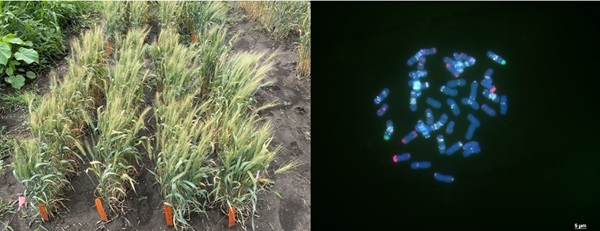
Plant image of the spring wheat with FHB resistance gene Fhb7 (left) and its chromosome image (right). The terminal green segments on two chromosomes contain Fhb7. Photos provided by Xiwen Cai.
“This is a significant discovery because there are very few resistance genes currently available. This marks the first effective FHB resistance gene identified in wild species that has been bred into spring, winter, and durum wheat,” said Cai. “Moreover, this gene exhibits what we refer to as an additive effect, meaning it enhances and strengthens the resistance level of another gene.”
WGC002 Spring Wheat Germplasm has already been utilized by many wheat breeding programs locally and around the world. ARS scientists in Lincoln, NE, have now been deploying this novel FHB resistance gene in elite varieties of winter, spring, and durum wheat.
Scientists anticipate a substantial reduction in U.S. economic losses from wheat crops affected by FHB within just a few years if farmers begin growing new varieties with this resistance gene.
WGC002 was developed with financial support from the Agriculture and Food Research Initiative, the USDA National Institute of Food and Agriculture, the US Wheat & Barley Scab Initiative, and USDA-ARS CRIS Project.
This research was part of a series of collaborative studies conducted by ARS scientists and partners to identify FHB resistant genes in wheat and wild relatives. Multiple genes have been found to be resistant to FHB, but only two of them [Fhb1 and Fhb7] have been used and characterized as effective sources of resistance in breeding for wheat variety development. Selecting multiple genes simultaneously to provide robust and durable resistance is a common and effective practice in this effort.
###
The Agricultural Research Service is the U.S. Department of Agriculture's chief scientific in-house research agency. Daily, ARS focuses on solutions to agricultural problems affecting America. Each dollar invested in agricultural research results in $20 of economic impact.
|