|
|
|
|
|
|
|
|
|
Shayne Savage, a retired police officer who is now a flight attendant for Porter Airlines. Supplied
|
|
|
|
|
Oh, hi again. Welcome to another instalment of our “Second Act” series, where we explore how Canadians are reinventing life after retirement. Let’s get into it. |
|
|
|
|
A police officer turned flight attendant |
|
|
|
|
Shayne Savage, 56, technically lives in Ottawa. But in practice, home is wherever his latest flight touches down. He’s a flight attendant now, a second career he never imagined when he spent nearly three decades on the police force. |
|
|
|
|
Savage worked as a police officer in Vancouver for almost 30 years – a job he loved, alongside people he cared deeply about. But the work also took a toll. He said he developed post-traumatic stress disorder from what he experienced on the job, along with high blood pressure and chronic stress. Sleep became elusive. He’d wake up in the middle of the night and lie there, unable to drift off again. |
|
|
|
|
“I just decided I don’t want these health issues to get worse. I need to start looking after myself,” he said. |
|
|
|
|
In 2021, Savage made the difficult decision to retire early. He began counselling and said therapy helped him recover and regain his footing. Leaving the force early meant a smaller pension, and a divorce during the pandemic added financial strain. Still, he had enough savings to step away. |
|
|
|
|
What he struggled to leave behind was his sense of purpose. |
|
|
|
|
“I went into policing because all I wanted to do was help people,” he said. |
|
|
|
|
One day at an airport before retiring, Savage noticed an older worker cheerfully helping passengers. A few years after his divorce, he was living in a small town, feeling isolated and missing connection with people, he said. So, after nearly 30 years without doing a job interview, Savage applied to become a flight attendant. |
|
|
|
|
He went into the interview as himself, cracking jokes, talking honestly about why he wanted to be around people and help them. Soon after the interview, he got the call. |
|
|
|
|
|
|
|
|
“They offered me the job,” he said. |
|
|
|
|
Today, Savage says the work gives him something he didn’t realize he was missing: joy. |
|
|
|
|
“Find something you love to do,” he said. “If you can make people smile and help them have a better day, don’t keep it to yourself.” |
|
|
|
|
Subscribe to the Retire Rich newsletter
Are you reading this newsletter on the web or did someone forward the e-mail version to you? If so, you can sign up for Retire Rich here. |
|
|
|
|
|
|
|
|
|
|
|
|
|
What’s happening: Public-sector pensions are more generous
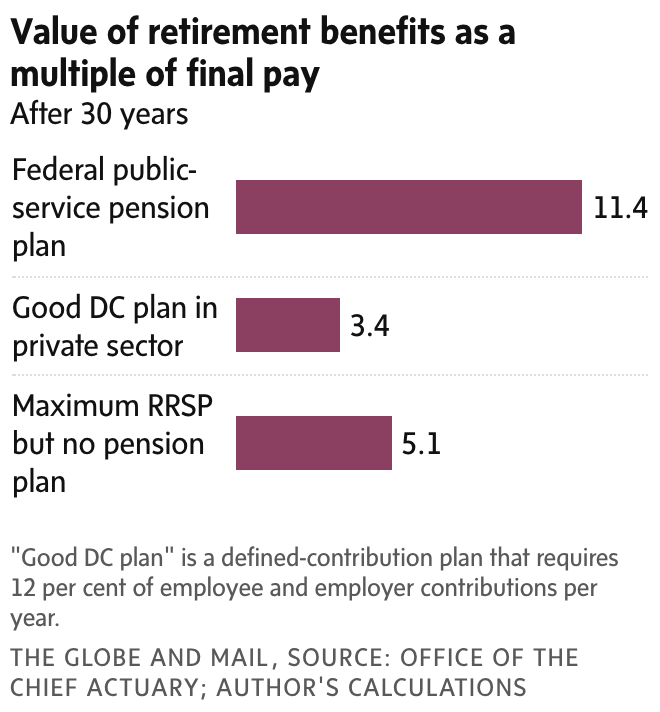
than most private-sector options. A worker with a federal public-service pension could retire with savings worth 11.4 times their final pay, compared with 5.1 times for someone maxing out an RRSP and 3.4 times under a strong private-sector defined-contribution plan, according to Frederick Vettese, former chief actuary at Morneau Shepell. |
|
|
|
|
What they’re saying: Without a workplace pension, “most private-sector workers will be in serious trouble in retirement,” Vettese warns, pointing to the stability and inflation protection built into public-sector plans. |
|
|
|
|
|
|
|
|
|
|
|
|
|
|
|
Illustration by The Globe and Mail. Source image: Getty Images.
|
|
|
|
|
|
|
|
|
|
|
What’s happening: Daniel, a 68-year-old retired accountant in Edmonton, has been married for more than 40 years and is financially comfortable after a lifetime of careful saving. He and his sister inherited nearly seven figures from their Depression-era father, who saved obsessively and rarely spent on himself. The money came with mixed emotions. “I really wish he’d spent this money on himself,” Daniel says. |
|
|
|
|
What he did with it: Daniel donated a portion to charity, paid off his daughters’ mortgages as formal, interest-free loans, and maxed out his grandchildren’s RESPs. The remaining money sits in a “rainy-day” investment account, replenished by his daughters’ monthly payments. |
|
|
|
|
What he learned: Daniel chose not to hoard the money, or blow it, but to use it with intention. He and his wife now travel more comfortably, spending on experiences his father never allowed himself, while still seeking to pass along financial discipline to the next generation. |
|
|
|
|
|
|
|
|
|
|
|
|