|
|
|
|
Good morning. Canadian corporate earnings this week highlight how key sectors are facing a wave of shareholder pressure and renewed takeover interest. That’s in focus today – plus, why banning U.S. alcohol is whisky business. |
|
|
|
|
|
|
|
|
|
|
|
|
|
|
|
|
Trade: Mark Carney has appointed Janice Charette, a former Privy Council Clerk and high commissioner to the United Kingdom, as chief trade negotiator with the United States. |
|
|
|
|
|
|
|
|
|
|
Labour: Major employers in tech and finance expect new recruits to be “AI-literate,” marking a clear shift in expectations of new employees. |
|
|
|
|
|
|
|
|
|
|
|
|
|
|
|
Mexico's Economy Minister Marcelo Ebrard and Canada's Minister responsible for Canada–U.S. Trade, Dominic LeBlanc, applaud as a signed memorandum of understanding between Mexico and Canada is shown while they attend the kickoff of the Team Canada Trade Mission to Mexico in Mexico City. Feb. 16, 2026. Henry Romero/Reuters
|
|
|
|
|
|
|
|
|
|
|
|
|
|
|
|
|
1. Under renovation: Representatives of more than 200 Canadian businesses are in Mexico this week for what’s being billed as the biggest bilateral trade mission in decades. |
|
|
|
|
Tensions are mounting around the future of the free-trade deal that the two countries share with the United States, but this trip is less about high-level trade negotiations than about Ottawa’s efforts to diversify exports, Mark Rendell and Adam Radwanski report. |
|
|
|
|
|
|
|
|
The trade mission is focused on five sectors for which Ottawa sees particularly strong growth potential for Canadian exports to Mexico: agriculture and food, advanced manufacturing, clean technology, information and communication technology, and creative industries. |
|
|
|
|
Efforts to reduce Canada’s reliance on the U.S. are taking on new urgency ahead of a scheduled review of the countries’ free-trade agreement. On Thursday, Statistics Canada is expected to report that the sectors most exposed to U.S. tariffs are contributing to a widening merchandise trade deficit. |
|
|
|
|
2. Under pressure: Executives at Canadian Tire Corp. Ltd. are probably hoping consumers will cut them some slack. And even if memories have faded of the retailer’s guilty plea to false advertising over knife sets, among other things, market watchers are likely to be far more focused on the state of consumer spending. |
|
|
|
|
As the largest non-grocery retailer in the country, Canadian Tire is a useful measure of the country’s economic mood, Globe and Mail retailing reporter Susan Krashinsky Robertson told me. |
|
|
|
|
“Between the behaviour it sees in its stores, and how customers are spending using its credit cards, the company has good insight into how Canadians are feeling and where they’re spending their money,” she said. |
|
|
|
|
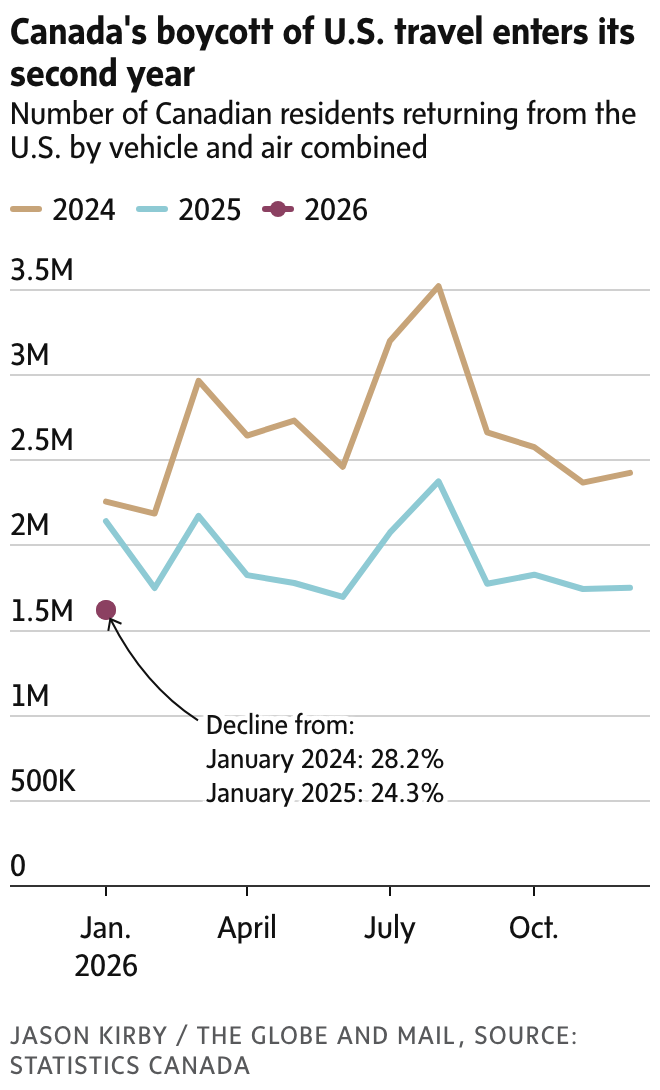
Its last quarter showed sales of things like patio furniture and gardening supplies were boosted by Canadians deciding to stay at home. But a boycott on travel south of the border seems to be softening: |
|
|
|
|
|
|
Consumers are also concerned about high prices and the U.S. trade war, reporting weaker spending plans in the Bank of Canada’s most recent survey of consumer expectations. |
|
|
|
|
3. Price check: Consumers widely expect the price of everyday goods are getting going up at an accelerating speed, the survey showed. The worry is understandable: This morning’s inflation report for January is expected to show overall prices of consumer goods are rising – if at a slower pace than feared. |
|
|
|
|
But food prices in particular have been going up, up, up, and we know they’re going to be growing. (If you are a KPop Demon Hunters fan or parent of one, that was for you.) |
|
|
|
|
Food inflation is expected to hit more than 7 per cent year-over-year – but that’s compared with last year’s tax-exempt levels. Still, grocery prices are expected to climb after the food price inflation rate hit 5 per cent in November. |
|
|
|
|
4. REIT place, wrong time: A consumer pullback is one reason real estate investment trusts are reeling. REITs, for short, are companies that own or finance income-producing real estate across a range of sectors – retail, commercial and industrial. |
|
|
|
|
Traditionally, that mix of assets was designed to make REITs safe, stable investments that paid reliable monthly distributions. But major shifts in consumer shopping habits, artificial intelligence fears and corporate work arrangements have hollowed out the bricks and mortar world. |
|
|
|
|
“Welcome,” Report on Business columnist Andrew Willis told me in his best movie-trailer voice, “to a sector under siege.” |
|
|
|
|
Allied Properties Real Estate Investment Trust surprised investors last week by collecting $560-million through a sale of new units to pay down debt, reporting that it also missed its year-end target for building occupancy. |
|
|
|
|
This week, a pack of REITs reporting that includes Choice Properties, RioCan and Dream Industrial REIT, will show how a fuller slate of how Canadian trusts are responding to a shared set of shifts. |
|
|
|
|
“Office occupancy isn’t improving because people don’t like coming back to work. Residential rents are going sideways as immigration slows,” Willis said. “Industrial real estate like warehouses is worth less because the economy is slowing due to trade wars.” |
|
|
|
|
For activist investors and private equity firms, public real estate companies with high-quality properties are tempting targets. Brookfield Asset Management Ltd. and Blackstone Inc., which carry some of the biggest capital pools in the world, are shopping. |
|
|
|
|
“There are more takeovers coming.” |