|


 |
I’m traveling today, so here’s a timely repost.
Two years ago, I wrote a post on AI and jobs that ignited a firestorm of discussion and criticism:
 |
|
Most people interpreted me as arguing that human beings will definitely have plentiful, high-paying jobs, no matter how good AI gets, because of the law of comparative advantage. If you only read the headline and the introduction, I guess maybe you could come away thinking that. But if you read down past the first half of the post, you’d see that my claim was much more nuanced.
What I actually said was that it’s possible that humans will always have plentiful, high-paying jobs no matter how good AI gets, and that one reason we might still have jobs is if there are constraints on the total amount of AI that don’t apply to humans. If there are such constraints, then the law of comparative advantage will make sure humans still have good jobs.
What are examples of AI-specific constraints? I can think of two:
Compute constraints
Restrictions on the amount of energy, land, etc. that can be used for data centers
Ultimately, these boil down to the same thing: some sort of restriction on data centers. In other words, the economic danger of AI isn’t really that it’ll take all our jobs; the danger is that it’ll gobble up all the land and energy, leaving too little for human use.
Thus, you can see my post as advocating some sort of limitation on data centers — perhaps not the hard cap that Bernie Sanders is advocating, but some sort of laws to make sure that AI never eats up too much of the energy and land that humans need to live.
Anyway, here’s the original post, which I’m still quite proud of.
I hang out with a lot of people in the AI world, and if there’s one thing they’re certain of, it’s that the technology they’re making is going to put a lot of people out of a job. Maybe not all people — they argue back and forth about that — but certainly a lot of people.
It’s understandable that they think this way; after all, this is pretty much how they go about inventing stuff. They think “OK, what sort of things would people pay to have done for them?”, and then they try to figure out how to get AI to do that. And since those tasks are almost always things that humans currently do, it means that AI engineers, founders, and VCs are pretty much always working on automating human labor. So it’s not too much of a stretch to think that if we keep doing that, over and over, eventually a lot of humans just won’t have anything to do.
It’s also natural to think that this kind of activity would push down wages. Intuitively, if there’s a set of things that humans get paid to do, and some of those things keep getting automated away, human labor will get squeezed into a shrinking set of tasks. Basically, the idea is that it looks like this:
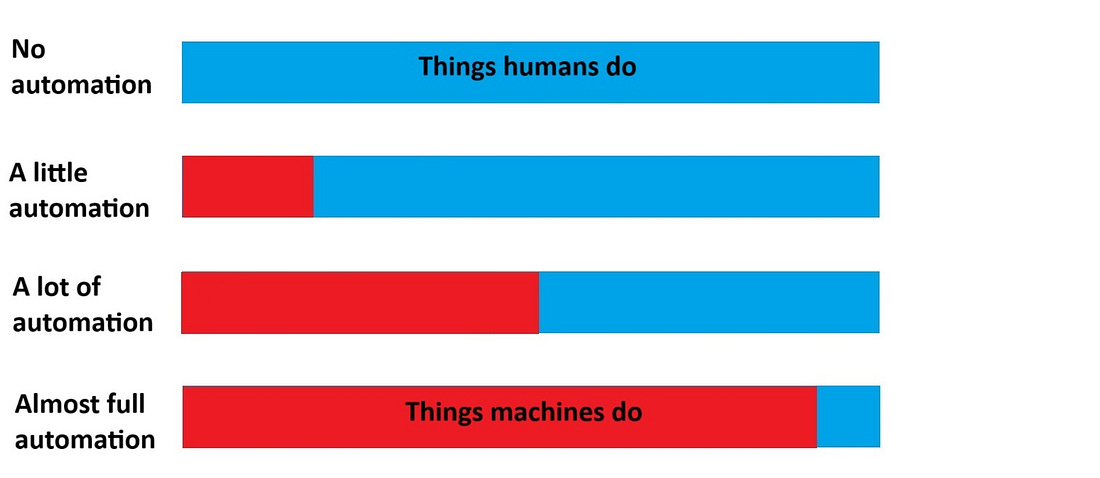 |
And this seems to fit with the history of which kind of jobs humans do. In the olden days, everyone was a farmer; in the early 20th century, a lot of people worked in factories; today, most people work in services: