| | A Kuwaiti oil tanker carrying two million barrels of oil caught fire after it was hit by an Iranian ͏ ͏ ͏ ͏ ͏ ͏ |
| |  Beijing Beijing |  Abu Dhabi Abu Dhabi | New Delhi |
 | Energy |  |
| |
|
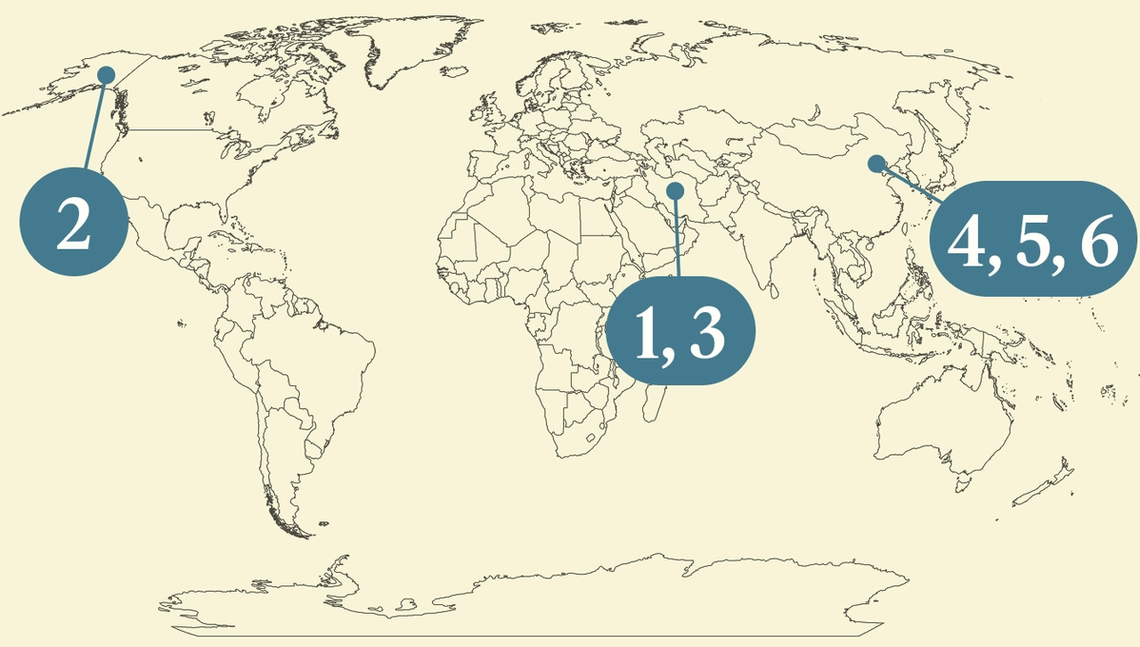 - Another tanker hit
- New LNG in the works
- Aluminum crunch
- Battery weak link
- E-trucks boom
- Electrostate strategy
 TotalEnergies makes bumper profits in March, while Italy delays plans to close coal-fired power stations. |
|
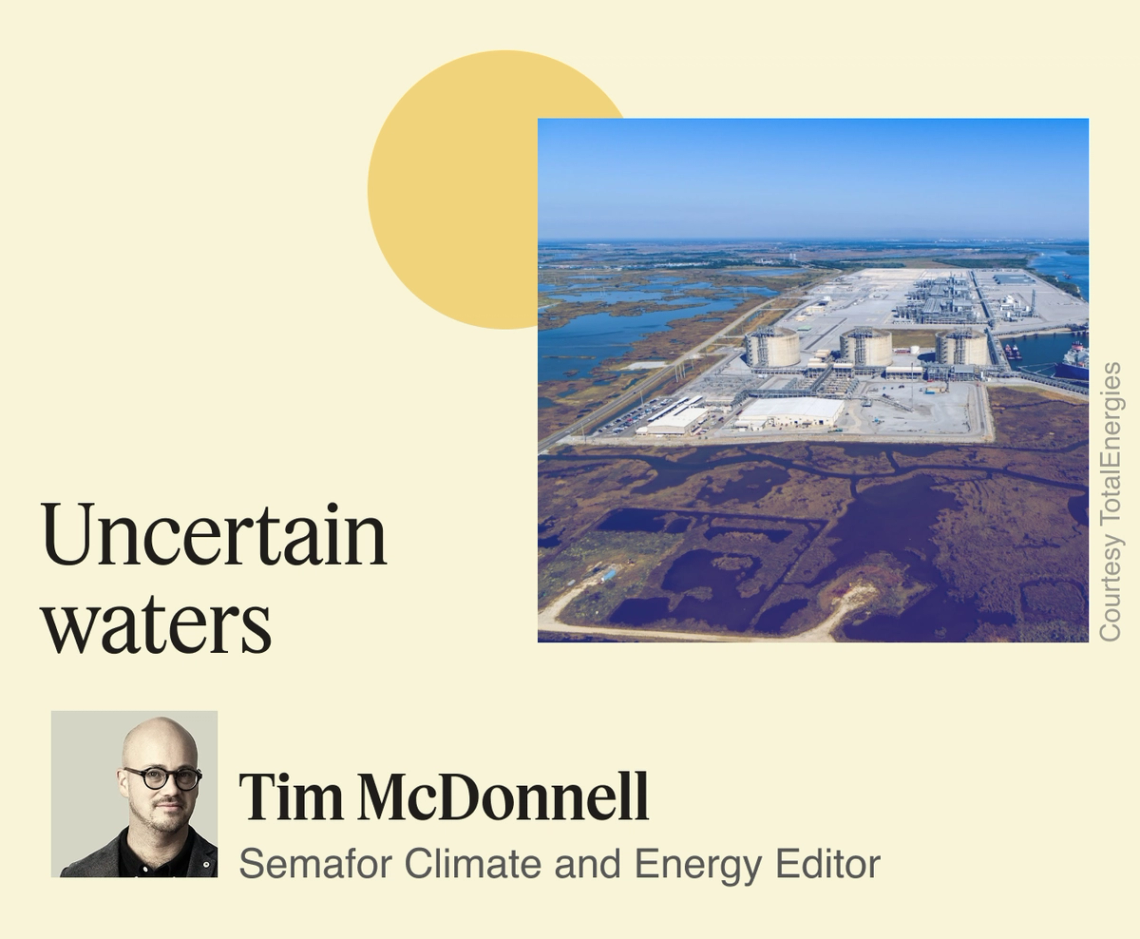 Walking through a liquefied natural gas terminal is a good way to get a sense of how challenging it will be for the US to extract much benefit from energy supply disruption in the Middle East. On Friday, as CERAWeek in Houston wound down, I joined a group of reporters on a visit to the Cameron LNG plant in Louisiana, a joint venture of TotalEnergies, Sempra, and a few other heavy industry companies. With annual exports of about 13.5 million tons, it’s actually relatively small by Gulf Coast standards. But it doesn’t feel that way. In this dense, sparkling web of pipes, tanks, and cooling towers spread over 500 acres, natural gas drawn from around the US is chilled to roughly the surface temperature of the dark side of the moon, liquefied, and pumped into tankers that carry it to the global market. On the day of our visit, the South Korean tanker SK Audace was loading cargo, hooked up to pipes so cold they were covered in a thick layer of frost despite the balmy bayou weather. As of Tuesday morning, the Audace was steaming past the Bahamas while Total’s gas trading desk fields bids from potential buyers in Europe and Asia. Cameron was already cranking at maximum capacity before the war in Iran sent prices spiraling — especially attacks on the Ras Laffan terminal in Qatar, which knocked out 20% of the world’s LNG capacity. But while workers at the Cameron plant are now redoubling efforts to eke out a few thousand more tons with the existing system, there’s been no decision to expand the plant, my Total tour guides told me. One hour at Cameron is enough to understand the scale of design work and capital spending that would be required for that undertaking. LNG might be selling at a premium these days, but so is much of the liquefaction and power-generating equipment an expansion would require. Construction firms are also overbooked, and labor in short supply. Those issues might be surmountable if energy company shareholders were confident about having a strong price signal for the foreseeable future. But they’re not, as Jack Fusco, CEO of rival exporter Cheniere Energy, observed during CERAWeek: “What you’re seeing with this type of volatility that seems to happen every four or five years, it’s just not good.” |
|
| |  | Tim McDonnell |
| |
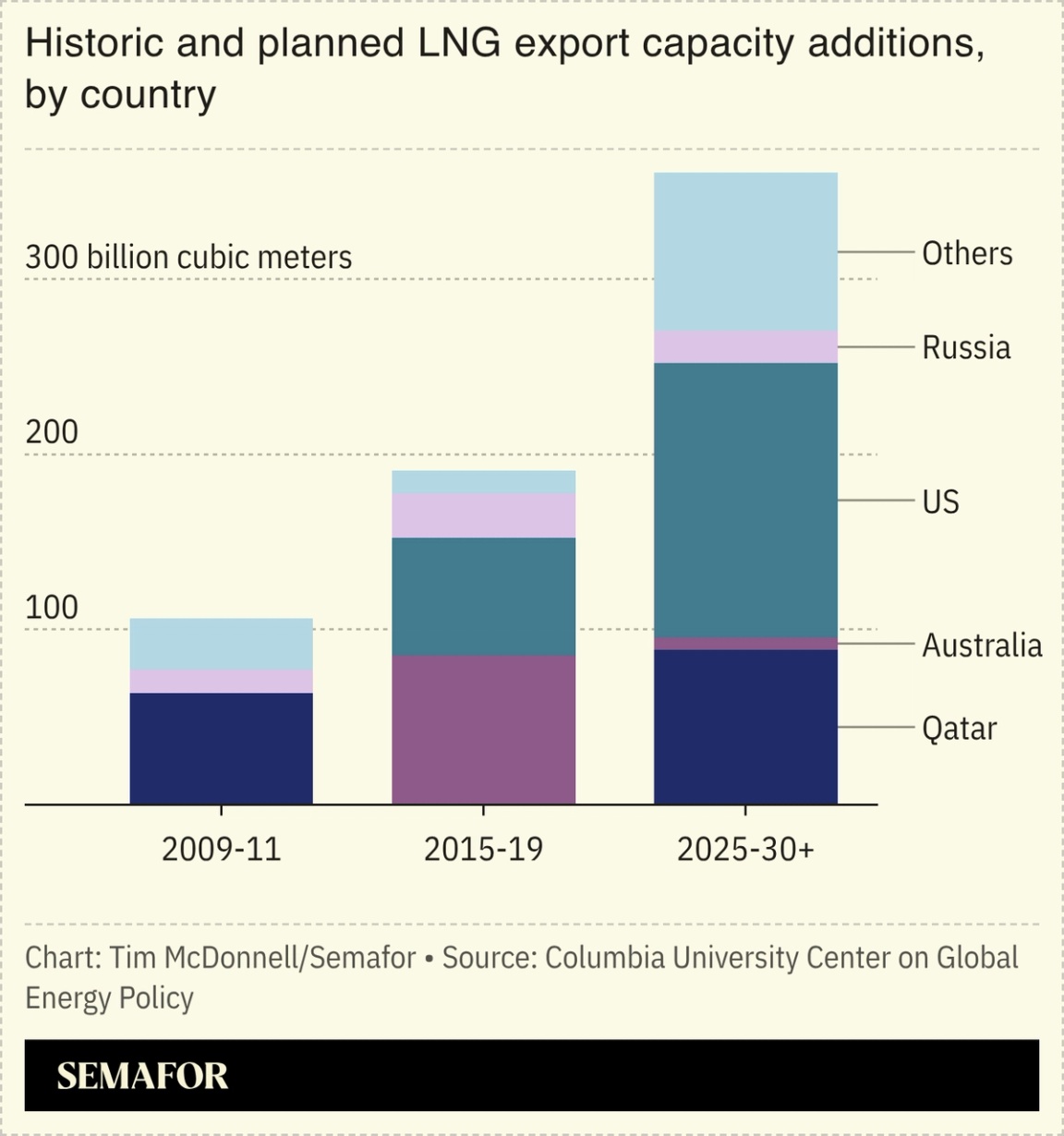 A longtime oil and gas executive with links to the Trump family plans to use equipment from a sanctioned Russian gas project to open a major new export terminal in Alaska, he told Semafor. The project, dubbed Polar LNG, will eventually require $8-9 billion in investment and aims to have a capacity of 21 million tons per year, which would rank it among the largest LNG terminals in the country, with the first exports shipping out before US President Donald Trump’s term ends, CEO Joel Riddle said. The spike in natural gas prices caused by the war in Iran, Riddle said, was generating “hurricane-force winds behind us to accelerate this project,” which would create a path for US gas to more readily reach markets in Asia. A separate project called Alaska LNG is racing ahead in parallel, but Polar LNG is angling to leapfrog it by buying LNG hardware and service ships that were originally destined for Russia’s Arctic 2 LNG terminal, which was sanctioned by the Biden administration, including equipment that is already located inside Russia. Acquiring pre-built equipment is critical for the project’s “speed to market,” Riddle said: “From a cold start, this would be impossible.” That will require permission from the Treasury Department, which Riddle said he will be “laser-focused” on obtaining in the coming months. A Treasury Department spokesperson declined to comment. One investor in the project, Riddle said, is Gentry Beach, a college friend of Trump’s son Donald Jr. who has been pursuing a wide range of global energy and mineral deals through his firm America First Global. |
|
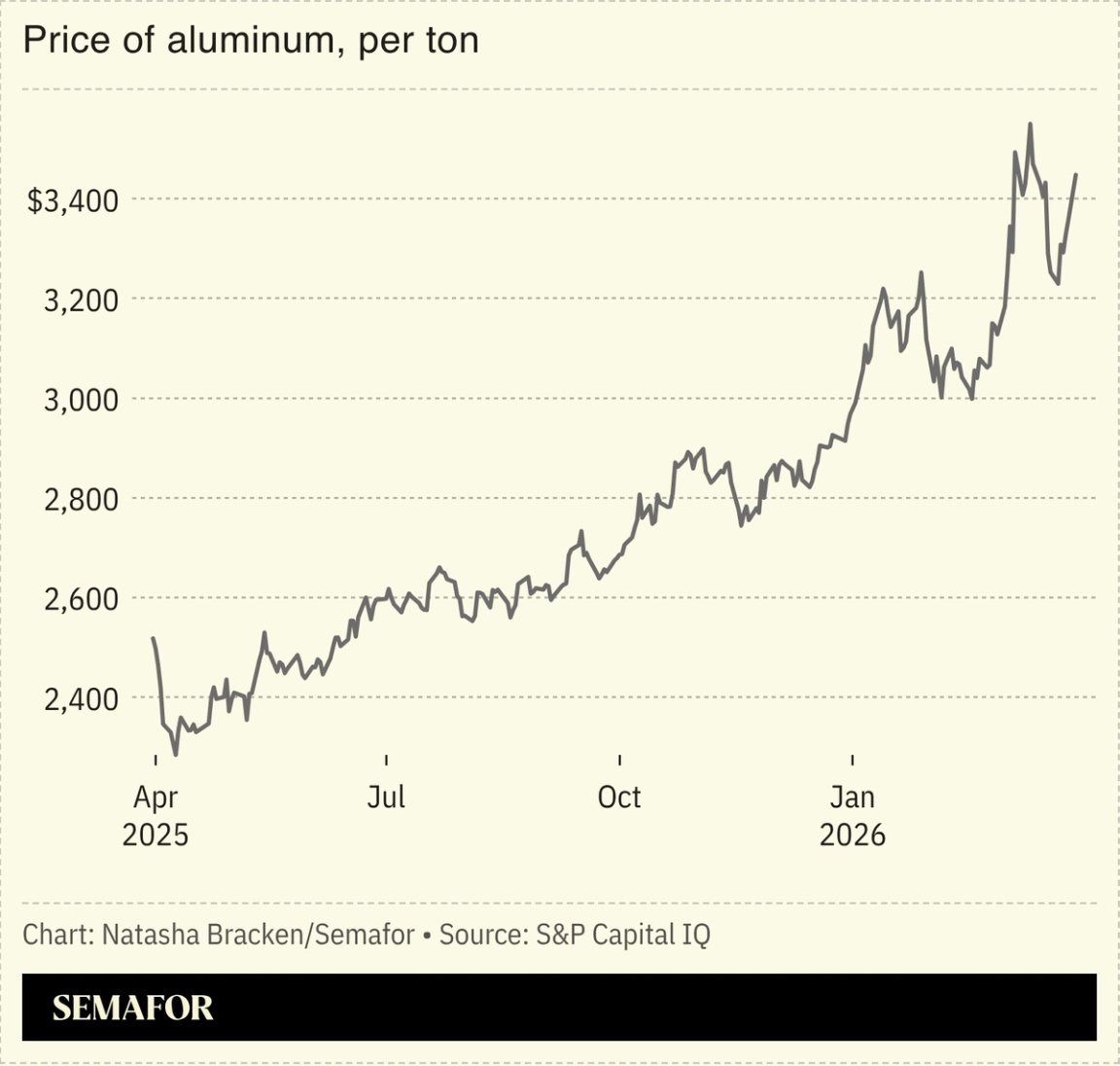 Fears of global aluminium shortages that could affect the production of clean energy technologies intensified after Iran struck two major Gulf aluminium producers, sending prices to a four-year high. The Middle East accounts for 9% of the world’s production of aluminum, which is essential to a wide range of industries from transportation, construction, and packaging, as well as the manufacture of solar panels, electrical transmission systems, wind turbines, and EVs. Export shipments to the US and Europe had already come to a halt because of the effective closure of the Strait of Hormuz, and Morgan Stanley economists singled out aluminium as carrying a high level of risk across the value chain. Andy Farida, an aluminium analyst at Fastmarkets, told Semafor that high prices would be passed on to end-users, ultimately causing demand destruction. “A prolonged shutdown (with little to no alternative supplies other than Russia and China) could cripple the supply of aluminium to support the production of clean and green technology,” he said, adding that relief could come “if governments allow some sanctioned Russian and Chinese aluminium to be imported.” |
|
 The estimated global loss in output from EV factories if battery supply exports from China were halted for a month — with facilities in the European Union accounting for over half the decline — according to analysis by the International Energy Agency. The Paris-based organization found “weak links” within battery, solar PV, wind, and heat-pump supply chains, each of which contain at least one step heavily reliant on Chinese supplies. The analysis highlighted continued vulnerability caused by the concentration of cleantech supply chains in China, despite progress in diversifying downstream capacity. On Friday, Beijing initiated two counter-probes into US measures against such concentration, which it said “hinder trade in green products” by restricting exports to the US and slowing down the deployment of new energy projects after Washington launched investigations into its trading partners, including China. |
|
 Can tiny homes — and tiny-home mortgages — solve the housing crisis? America needs millions more homes. Private-equity firms, red-tape nightmares, and homebuilders’ profit motive are all to blame. One startup, an offshoot of Airbnb, has a solution: Fully-built, crane-plopped tiny homes in your backyard. On this week’s episode of Compound Interest, presented by Amazon Business, Liz and Rohan dive into how Samara is trying to redefine what housing looks like, and whether it’s the start of a new asset class for Wall Street. Listen to the latest episode of Compound Interest now. |
|
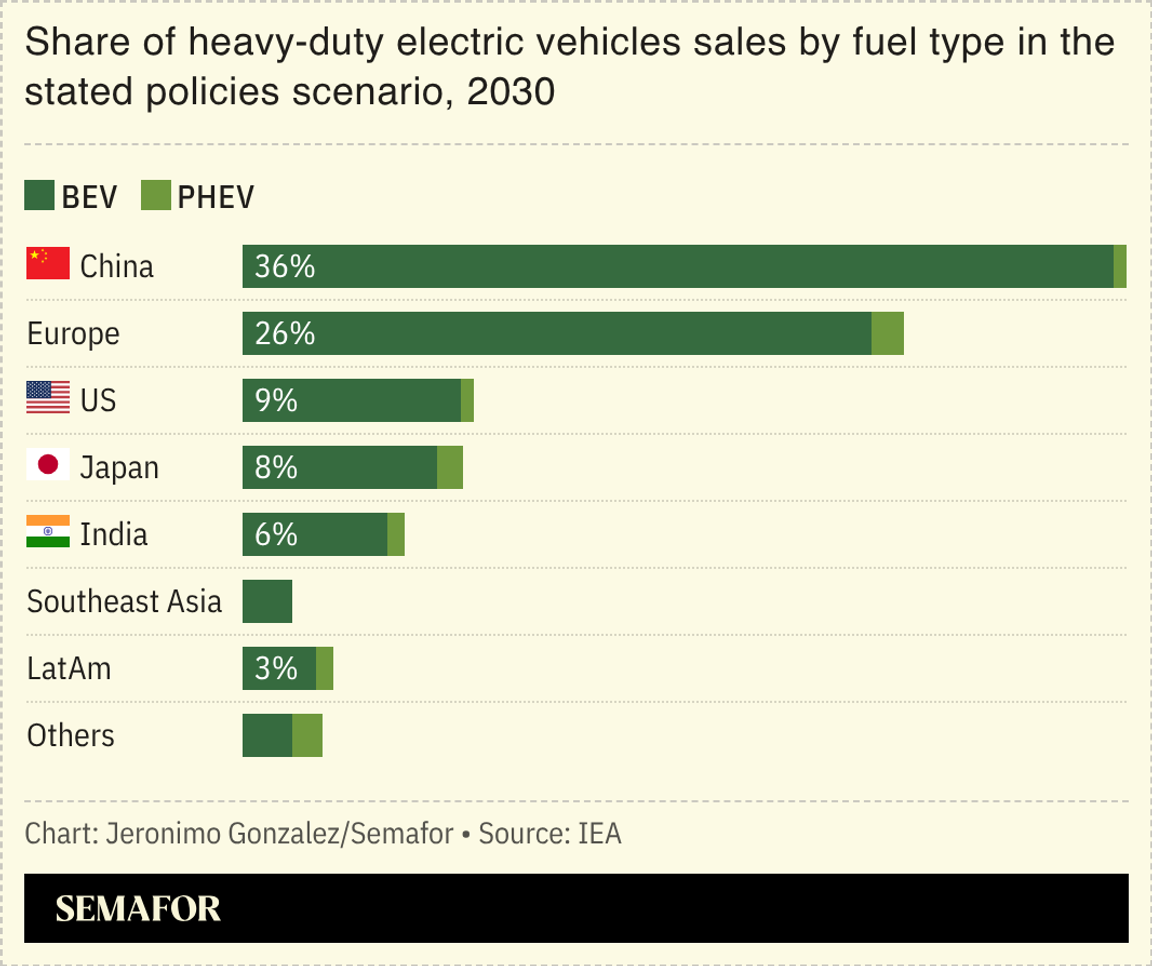 China’s e-truck boom, like its electric car industry, is having a profound domestic and global impact. Almost 30% of new heavy trucks sold in China last year were new-energy models, compared to Europe’s 4%, while sales in California — the leading US e-truck market — remains in the hundreds, according to Rystad Energy. China’s rapid adoption “leaves the rest of the world in the dust,” one expert told Semafor. Truck makers, benefiting from a huge domestic market and tight-knit supply chains, are expanding as far afield as South Africa and Europe. This shift has far-reaching consequences for China, the world’s biggest fossil fuel importer: By 2030, the rollout of e-trucks is projected to lead to a 20% drop in Chinese diesel demand. The sector’s success comes on the heels of the dominance of the Chinese EV sector, the prospects for which have been buoyed further by the Iran war driving up fuel prices. Industry behemoth BYD, for example, forecasts an uptick in its business, with its chairman telling analysts that the surging cost of energy would push the company’s sales to “another level.” It now projects annual overseas sales to hit 1.5 million this year, 15% higher than its earlier forecast. In one advert in Europe, the firm notes: “Fuel prices change, your plans don’t. Save money with a BYD.” — Xiaoying You |
|
 Tingshu Wang/Reuters Tingshu Wang/ReutersFive weeks into the Iran war — with the Strait of Hormuz still effectively shut, sending fossil fuel prices soaring, and the conflict threatening to expand rather than contract — there’s at least one clear winner: Renewables technologies such as solar, wind, and batteries. All are dominated by China, writes Semafor’s Andy Browne. Even before the war broke out, experts had characterized the global struggle for the future of energy as one between a group of “Petrostates” led by the US — the world’s largest oil and gas producer — against “Electrostates” anchored by China, which supplies more than 70% of all the world’s green hardware. The war has sharpened that contest, by showing once again how vulnerable the global economy is to shocks emanating from the Middle East. Crude prices are at multi-year highs, and threaten to surge further, raising the spectre of a global recession; natural gas supplies are also at risk, with attacks on LNG infrastructure in Qatar, a major producer. And around the industrialized economies of Asia, desperate governments are turning back to coal to fill the gaps. |
|
 The Polycrisis podcast tells the story of the new phase of the energy transition — where countries are taking control of their energy security. The first season, “Electric World Order,” explores how geopolitics is driving a revolution in clean tech, and how the energy transition is in turn reshaping world power. Listen to the first episode — out now. |
|
|


