| | In today’s edition: Gulf leaders seek de-escalation in public but maybe not in private, and planners͏ ͏ ͏ ͏ ͏ ͏ |
| |  | Gulf |  |
| |
|
 - Gulf leaders look both ways
- Appetite for Saudi debt
- Qatar credit rating at risk
- IMF sees wartime inflation
- Shifting energy logistics and…
- … Dubai’s aid hub difficulties
 Dubai apartment rents for $275,000. Per month. |
|
 A succession of firms have stepped forward in recent days to say they remain committed to investing in the Gulf. That’s despite a war that seems to lack a clear strategy or endgame, and that is wreaking havoc across the Gulf. Which begs the question: Is Wall Street overly optimistic about how this conflict plays out? The answer is nuanced. Gulf leaders and regulators have long memories. They remember who stands with them in times of trouble, and who ups sticks and leaves. Take Saudi Arabia. After the murder of the Saudi journalist Jamal Khashoggi in 2018, those CEOs that stayed with the kingdom were rewarded, even if it meant taking a lot of heat from elsewhere. Larry Fink, Jamie Dimon, and Ken Moelis all continued to appear alongside Saudi officials at events in the aftermath of the killing. It’s no coincidence that BlackRock, JPMorgan, and Moelis are some of the government’s go-to firms today. Western CEOs know that if they walk away from the region now, they may not be able to get back in for years: Citigroup sold its stake in a Saudi bank in 2004; it was not able to return until 2017, an example cited often in my conversations with bankers and officials in Riyadh. The length of the war is uncertain, as is what it will be left once it is over. That leaves Wall Street bosses facing a tough choice: Walk away and risk being shut out when the war ends, or stick around and hope the conflict ends quickly. So far, most are choosing the latter. |
|
Dual messaging from Gulf leaders |
 From left: Jordan’s King Abdullah II, Saudi Crown Prince Mohammed bin Salman, and Qatar’s Emir Sheikh Tamim. Courtesy of Saudi Press Agency. From left: Jordan’s King Abdullah II, Saudi Crown Prince Mohammed bin Salman, and Qatar’s Emir Sheikh Tamim. Courtesy of Saudi Press Agency.The US has been accused of muddled thinking in its prosecution of the Iran war, but Gulf leaders may be sending confused messages too: calling for de-escalation in public while reportedly urging the White House in private to keep hammering Iran. Officials from Bahrain, Kuwait, Saudi Arabia, and the UAE have told their US counterparts they want the conflict to continue until Tehran changes its behaviour, according to the Associated Press. If so, those same Gulf officials may welcome the recent arrival of the US Army’s elite 82nd Airborne Division — a move that could presage an assault on Iranian territory. At the same time, foreign ministers from Egypt, Saudi Arabia, and Türkiye met in Pakistan on Sunday in search of a diplomatic solution. Saudi Crown Prince Mohammed bin Salman, Qatar’s Emir Sheikh Tamim, and Jordan’s King Abdullah II then met in Jeddah yesterday, with official readouts focusing on efforts to “enhance regional security” and “joint Arab action” to deal with the war’s economic impact. Keeping pace with Washington is difficult. Yesterday, US President Donald Trump again threatened Iran with the complete obliteration of its power and desalination plants if Tehran doesn’t open the Strait of Hormuz. But he also told aides he could end the war even if the strait remained closed, according to The Wall Street Journal. — Dominic Dudley |
|
US credit lender eyes Gulf |
 David Manlowe. Courtesy of the Future Investment Initiative. David Manlowe. Courtesy of the Future Investment Initiative.Benefit Street Partners, the $92 billion private credit manager owned by Franklin Templeton, is looking to expand into the Gulf region, undeterred by conflict. The Iran war has “no impact on our excitement about going all in on the region,” BSP Chief Executive David Manlowe said in an interview with Semafor. “We’re thinking about the future in decades.” BSP is looking for potential partners in the Gulf as it plans to start lending in the region, Manlowe said. His comments are the latest sign that Wall Street firms are prepared to stick with plans to boost activity in the Gulf despite the worst conflict in the region in decades. The Gulf has become a hugely important source of capital for the world’s biggest asset managers and governments have been applying pressure on firms to do more in the region in return. Private credit firms have also been looking to boost their presence in the Gulf as they seek new markets for growth and step into a void left by regional banks that are battling tight liquidity. — Matthew Martin |
|
Ratings firms warn of impact of war |
 The Ras Laffan industrial city north of Doha. Naseem Zeitoon/Reuters. The Ras Laffan industrial city north of Doha. Naseem Zeitoon/Reuters.The Iran war is testing the resilience of Gulf energy producers, and is starting to have an impact on their credit ratings. Fitch warned on Monday that it could downgrade Qatar’s rating, citing the risk of further damage to the country’s gas facilities while adding that, even if the war ended soon, the security environment may have “permanently deteriorated.” QatarEnergy shuttered its operations, and Iranian missile strikes have taken a sixth of its LNG capacity out of commission for years. Despite that, Moody’s has affirmed the company’s Aa2 credit rating, pointing to its vast gas reserves and strong cash generation. One other bright note: Its Golden Pass LNG facility in Texas has started production. Oman’s oil and gas exports do not pass through the Strait of Hormuz, prompting a surge in the price of Omani crude. However, in a note affirming the country’s BBB- credit rating on Friday, S&P Global cut its GDP growth forecast for Oman this year to 1.4%, down from the 2.2% projected before the war, as uncertainty weighs on tourism, private investment, and trade flows. — Manal Albarakati |
|
IMF expects slower growth, inflation |
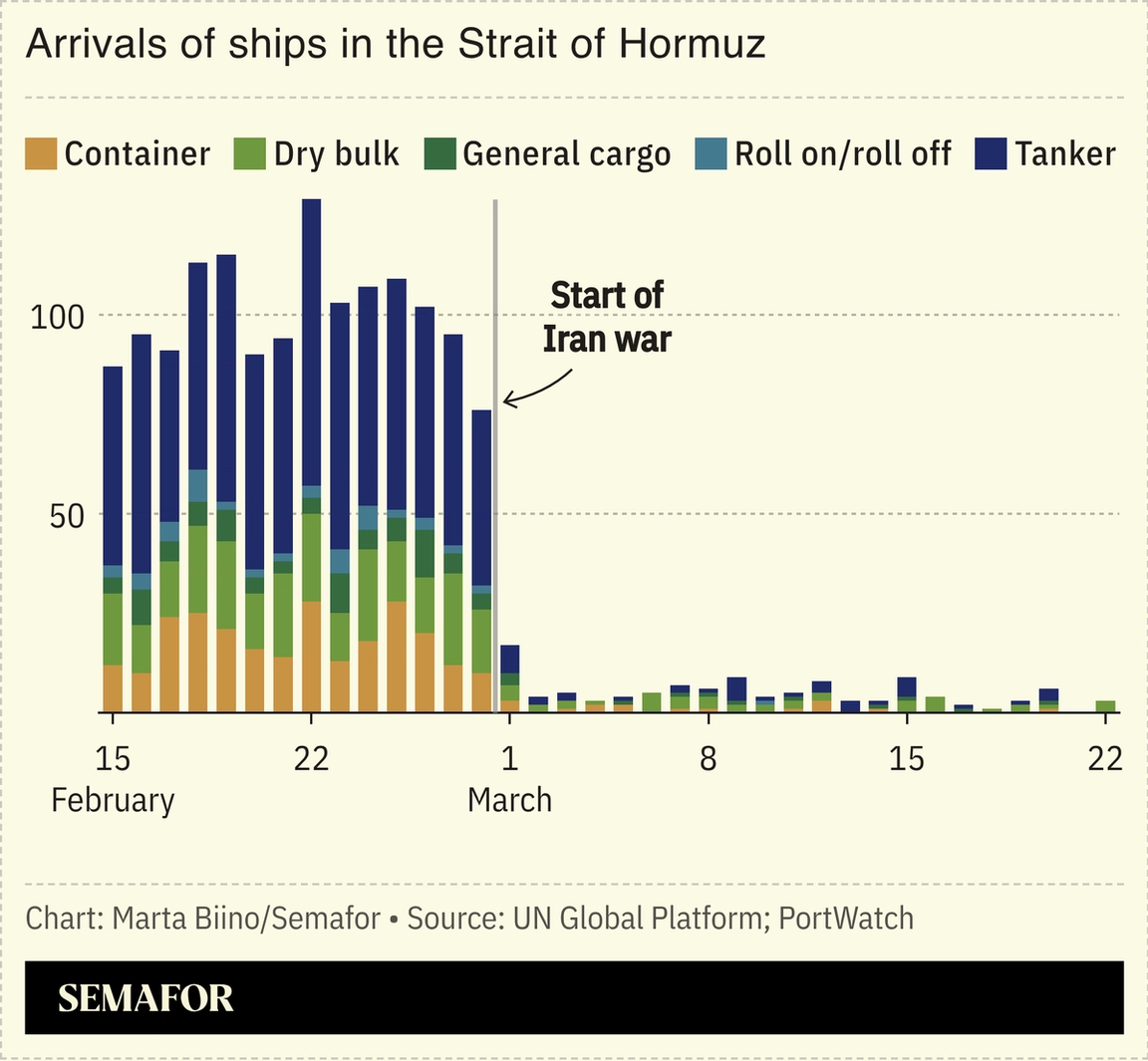 The war could reshape the global economy in many ways, but higher prices and slower growth are inevitable, according to the International Monetary Fund. The conflict is dimming the outlook for countries that had only recently begun to recover from previous crises, and it will darken the longer the conflict continues. The expected shock will be uneven. Oil-importing economies in Africa and Asia are among the biggest losers, struggling with surging prices. Poorer countries across Africa, Asia, the Middle East, and Latin America also face rising food and fertilizer costs. Many oil exporters will benefit from higher crude prices — but Gulf producers who can’t get their hydrocarbons out through the Strait of Hormuz will miss out on the bonanza. |
|
Searching for Hormuz workarounds |
 @USAMBTurkiye/X @USAMBTurkiye/XFor decades, Iran’s threats to close the Strait of Hormuz if attacked were largely ignored. Saudi Arabia and the UAE invested years ago in pipelines that allow part of their crude exports to bypass the chokepoint, but Bahrain, Kuwait, and Qatar remained trapped by geography. Now there is momentum behind new rail links and pipelines, though neither offers a quick fix. Saudi Arabia launched a 1,700-kilometer rail logistics corridor linking Dammam and Jubail ports to Jordan. The route can carry trains with more than 400 containers each, part of a broader effort to redirect trade north. Longer term, shifting trade routes for oil, gas, and other commodities will require pipelines. Tom Barrack, the US ambassador to Türkiye, said regional rivalries and security threats have long prevented cross-border energy pipelines. But in a presentation in Washington last week, he argued those obstacles could be overcome with a network through Syria, which is no longer under Iranian control. Even Israeli Prime Minister Benjamin Netanyahu wants a piece of the action, although an Israeli route may be unpalatable to many countries in the region that blame Israel for helping spark the war. — Mohammed Sergie |
|
Aid logistics stumble in Dubai |
 A Dubai Humanitarian staff in front of pallets of aid for Gaza in January 2025. Amr Alfiky/Reuters. A Dubai Humanitarian staff in front of pallets of aid for Gaza in January 2025. Amr Alfiky/Reuters.Dubai’s position as an anchor of global humanitarian relief — leveraging its sprawling aid logistics hub, tax-free port, and the world’s busiest international airport — is being crippled by the conflict with Iran. The World Food Programme is now driving some food from Dubai through seven countries, and ferrying it across the Caspian Sea, to deliver it to nutrition centers in Afghanistan, The Washington Post reported. The World Health Organization is also experiencing delays in delivering medicine to Gaza, while Sudan is facing a shortfall of crucial supplies at primary health care facilities, because of the problems in moving relief supplies out of the UAE. Dubai’s central location was an advantage in peacetime, but the hurdles now faced by aid organizations underscore that it could now “prove to be its Achilles’ heel,” Sam Vigersky, an international affairs fellow at the Council on Foreign Relations told the Post. |
|
 Can tiny homes — and tiny-home mortgages — solve the housing crisis? America needs millions more homes. Private-equity firms, red-tape nightmares, and homebuilders’ profit motive are all to blame. One startup, an offshoot of Airbnb, has a solution: Fully-built, crane-plopped tiny homes in your backyard. On this week’s episode of Compound Interest, presented by Amazon Business, Liz and Rohan dive into how Samara is trying to redefine what housing looks like, and whether it’s the start of a new asset class for Wall Street. |
|
 - Bloomberg: The Strait of Hormuz oil shock is beginning to spread beyond Asia, with traders warning shortages and price spikes will soon hit Europe as the disruption further unfolds.
- Financial Times: Iran’s most advanced missiles, including the Qassem Basir and hypersonic Fattah-2, have hardly been used in the war so far, raising questions over whether they were destroyed or are being conserved for a later phase.
|
|
|


