| | US stocks surge on renewed optimism over Iran war diplomacy, dealmaking is off to a strong start thi͏ ͏ ͏ ͏ ͏ ͏ |
| |  | Flagship |  |
| |
|
The World Today |  - Market optimism returns
- Economic costs to MidEast
- Global dealmaking boom
- Electrostates vs. Petrostates
- War disrupts daily life
- Wartime Tehran photos
- Japan ups deterrence
- AI-resistant careers
- KitKat heist is PR gold
- Eurovision Asia edition
 David Attenborough wants to bell the cats. |
|
Stocks surge over renewed optimism |
 Brendan McDermid/Reuters Brendan McDermid/ReutersUS stocks bounced back on Tuesday on reports that both Tehran and Washington may be looking to exit the month-long conflict. US President Donald Trump is willing to cease hostilities even if the Strait of Hormuz remains closed, The Wall Street Journal reported. And Iran’s president suggested the Islamic Republic is open to ending the war if certain conditions are met, according to Iranian state media. While the messages offered no indication of concrete diplomatic progress, expectations “may have hit a low enough point that any glimmer of hope” can trigger a rally, an analyst said. China and Pakistan on Tuesday also offered a plan to end the war. |
|
Global CEOs stick with the Gulf |
 Amr Alfiky/Reuters Amr Alfiky/ReutersThe Iran conflict will cost the Middle East nearly $200 billion in lost economic output, the UN projected Tuesday. A prolonged conflict could lead to an exodus of foreign workers and a drop in investment, which could drive up unemployment and poverty. Global firms, for now, say they remain committed to the Gulf, Semafor’s Saudi bureau chief wrote: “Western CEOs know that if they walk away from the region now, they may not be able to get back in for years.” The CEO of a large private credit manager that is looking to expand into the Gulf told Semafor that the war has “no impact on our excitement about going all in… We’re thinking about the future in decades.” |
|
Global dealmaking sees strong 2026 start |
 Brendan McDermid/Reuters Brendan McDermid/ReutersGlobal dealmaking had a bumper start to the year despite geopolitical turmoil. The 20% year-on-year increase in transaction values resulted in the largest first-quarter haul on record, Bloomberg reported, thanks largely to several mega mergers and acquisitions. Post-pandemic dealmaking fell after wars broke out in Ukraine and Gaza — and remained bogged down by tariff-driven volatility last year — but has picked back up in recent months. “The world is changing so fast and there’s so much disruption that not doing anything is not an option for a lot of companies,” a corporate lawyer said. A Morgan Stanley executive posited that AI-driven disruption to companies’ business models is more likely to pause corporate decision-making than the Iran war. |
|
War boosts Chinese green tech |
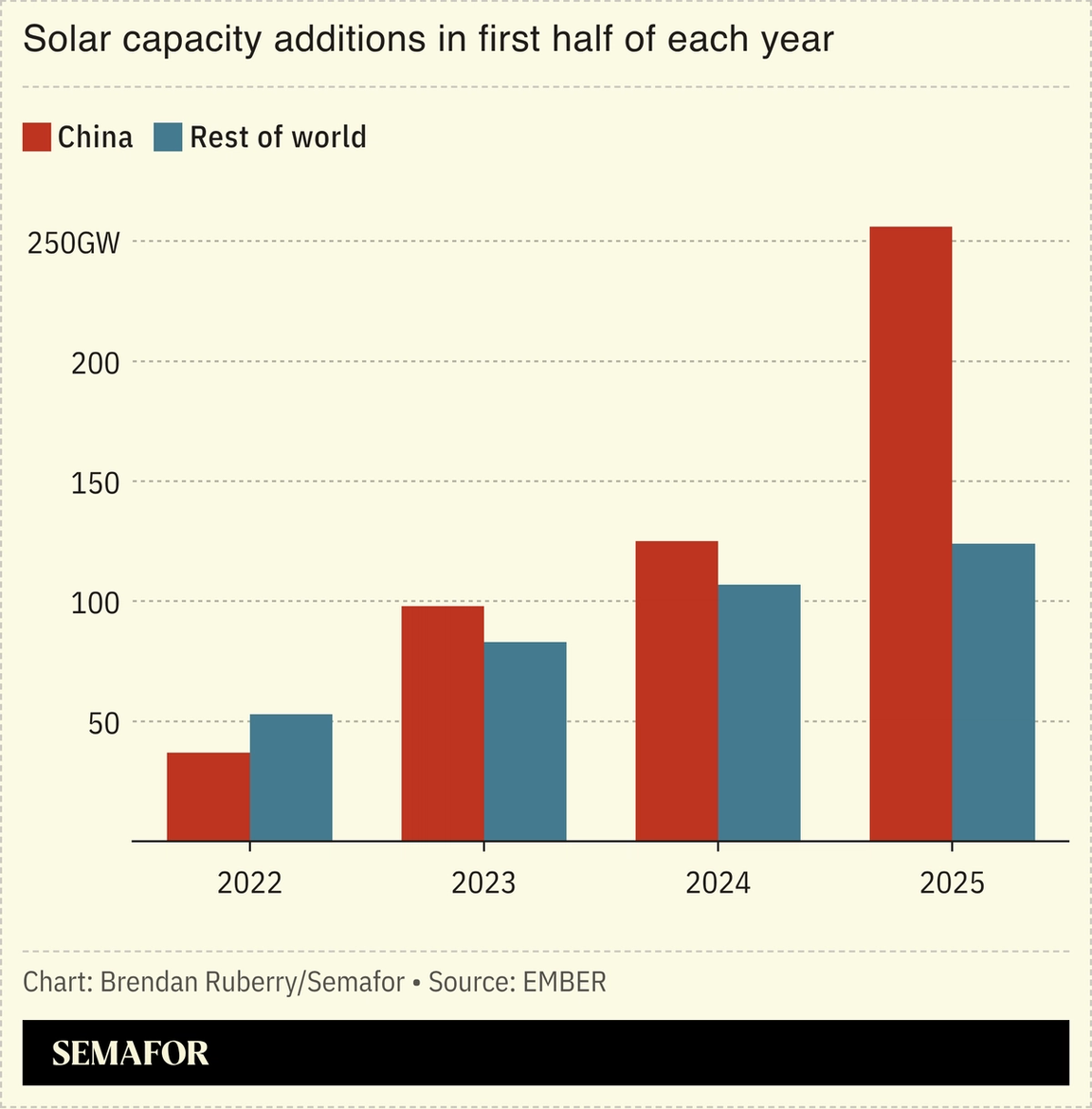 Renewable energy technologies dominated by China have emerged as a clear winner following the shock of the Iran war, analysts said. The UK chancellor this week urged G7 nations to accelerate a shift to clean energy such as solar, wind, and batteries, rather than stay “stuck on the rollercoaster of global oil and gas prices.” South Korea’s president has made a similar pitch. The conflict has sharpened the contrast between a group of “Petrostates,” led by the US, and “Electrostates” anchored by China, Semafor’s China columnist wrote. Beijing is “in position to emerge from this crisis, whenever it ends, with prospects of a stronger grip on global energy, an enhanced manufacturing base, and a world increasingly locked into Chinese supply chains.” |
|
Shorter workweeks and showers amid war |
 Ajeng Dinar Ulfiana/Reuters Ajeng Dinar Ulfiana/ReutersThe Iran war is disrupting daily life around the world as governments take action to blunt the impact of the energy crisis. The European Commission urged people to work from home and travel less. Some Asian countries have shortened their work and school weeks. South Korea encouraged quicker showers and is considering widening curbs on driving, while Egypt ordered stores and restaurants to close early. But with the last pre-war shipments of Middle East oil yet to reach their destinations, the second and third-order effects of the crisis — stunted crops and factory blackouts — have yet to hit, Semafor’s business editor argued. Those “will arrive in the same way the pandemic’s economic effects did, slowly and then all at once.” |
|
Iran wartime photos reveal fractures |
 Majid Asgaripour/WANA (West Asia News Agency) via Reuters Majid Asgaripour/WANA (West Asia News Agency) via ReutersAn anonymous Iranian photographer snuck a photo essay out from the besieged and heavily censored country. Around 99% of Iranian internet traffic is blocked: Getting the pictures out involved bypassing the restrictions with a prohibitively expensive VPN, and photographers operating clandestinely in the regime risk imprisonment or death. The photos “reveal an Iranian society more fractured than ever,” Le Monde wrote. The loyalty of regime supporters has been bolstered by the US-Israeli attacks, while opponents desperately want the government to fall. But the largest part of the population is trapped between the authoritarian leaders they reject and the devastation wrought by the attackers’ bombs. “We, the people, are the most vulnerable,” the photographer said. |
|
Japan deploys long-range missiles |
 Charly Triballeau/Pool via Reuters Charly Triballeau/Pool via ReutersJapan deployed its first long-range cruise missiles at a military camp, pushing the limits of the country’s pacifist stance. The move marks a “major turning point” in Tokyo’s military policy, a Japanese newspaper wrote: The country has long maintained a strictly defensive posture, but has steadily built up military capabilities, accelerated in part by US President Donald Trump’s push for Washington’s allies to spend more on defense. Officials said the missiles allow for a “counterstrike,” with Japan able to target far-away enemy bases. Japanese media framed the deployment as a deterrent against North Korea and China, as tensions rise between Tokyo and Beijing over a diplomatic spat related to Taiwan. |
|
 Can tiny homes — and tiny-home mortgages — solve the housing crisis? America needs millions more homes. Private-equity firms, red-tape nightmares, and homebuilders’ profit motive are all to blame. One startup, an offshoot of Airbnb, has a solution: Fully-built, crane-plopped tiny homes in your backyard. On this week’s episode of Compound Interest, presented by Amazon Business, Liz and Rohan dive into how Samara is trying to redefine what housing looks like, and whether it’s the start of a new asset class for Wall Street. |
|
Young people turn to AI-resistant jobs |
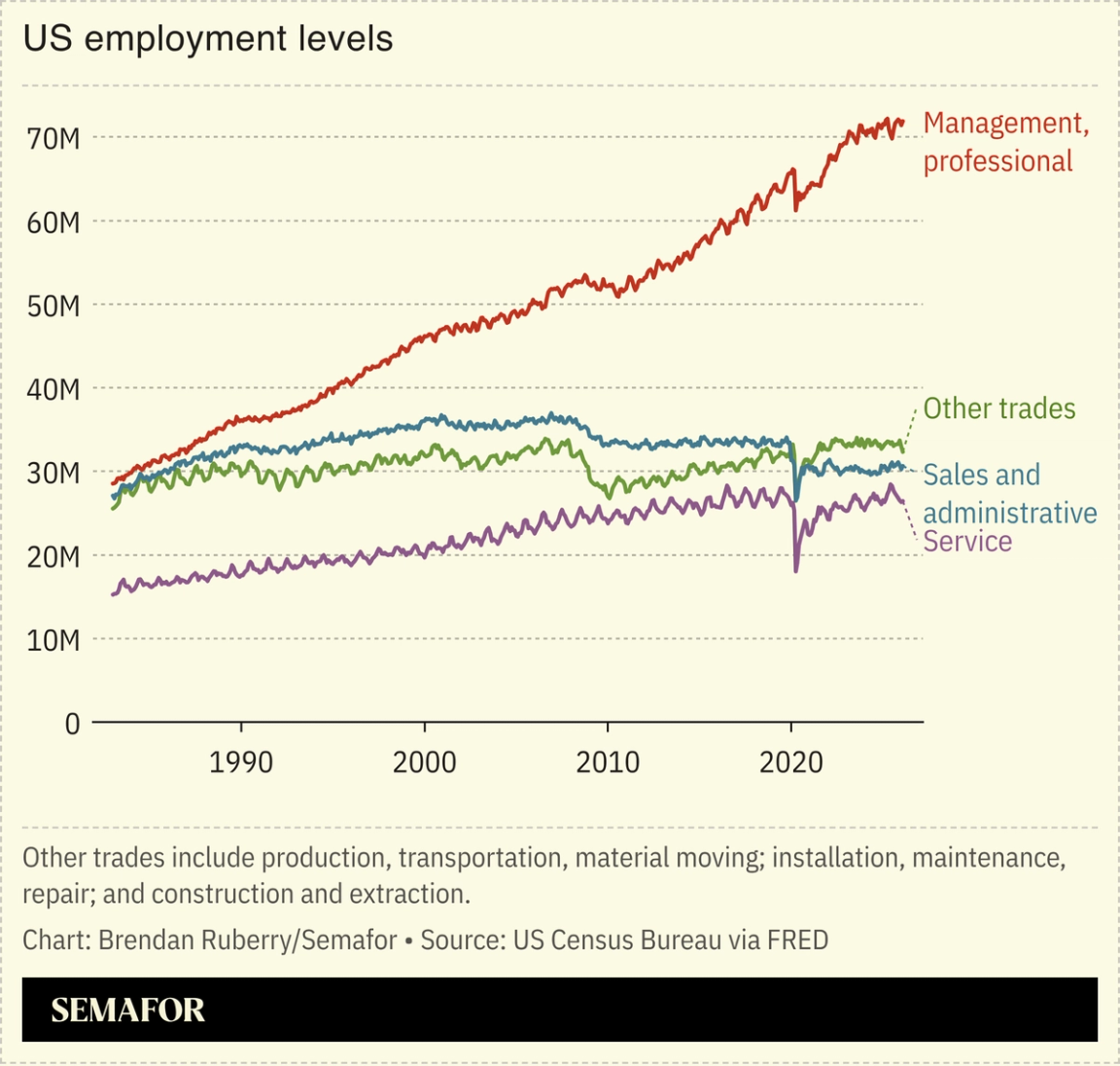 Young people are taking on vocational roles to future-proof their careers against AI. College students and junior white collar workers told The Wall Street Journal that they had quit their careers to become electricians or firefighters; enrollment at vocational schools has risen 20% since 2020, data suggests. Jobs that require in-person work, or human interaction, are expected to be more AI-resistant. But even as parents recognize that blue collar jobs are safer, they struggle to recommend them to their own children. A UK survey found just 7% would prefer their kids pursue a trade than a degree. “When politicians or commentators recommend school leavers become plumbers or electricians,” the Financial Times noted, “they are often referring to other people’s kids.” |
|
KitKat thieves make a break for it |
|
|


