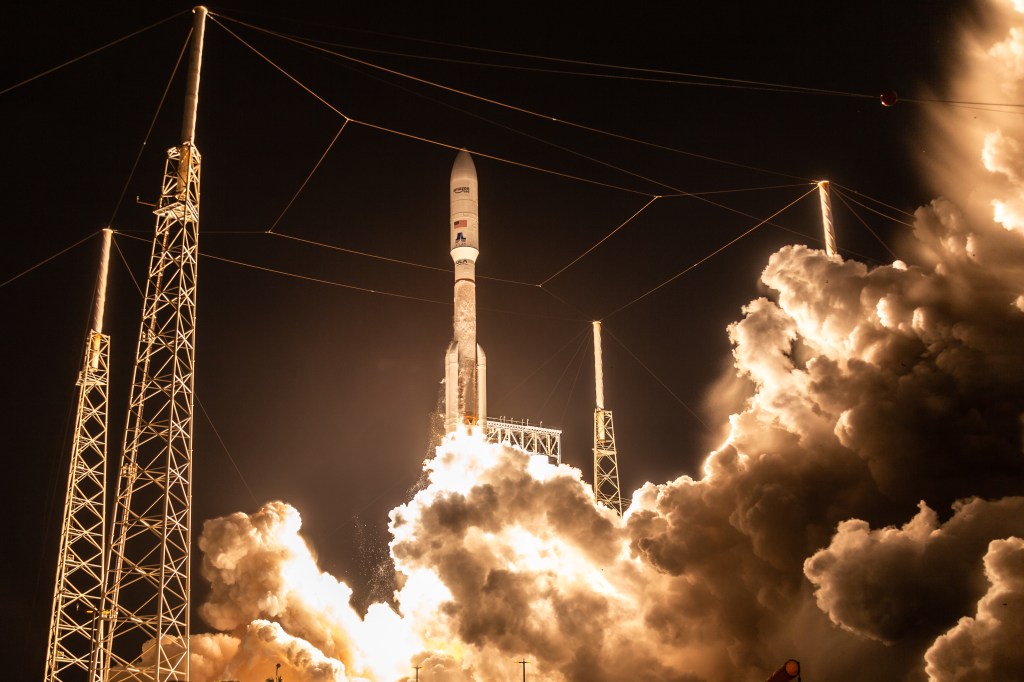
 A ULA Atlas V-551 rocket lifts off with 27 new Amazon Leo satellites from Cape Canaveral Space Force Station in Florida on December 14, 2025. Manuel Mazzanti/NurPhoto/Getty Images
Who says Starlink can have all the fun?
In a bid to prevent Elon Musk’s satellite internet interest from running away with the category, Amazon
on Tuesday announced that it would acquire satellite operator Globalstar for a reported $11.6 billion.
The plan is to add so-called direct-to-device services to Amazon’s Leo (for Low Earth Orbit) service and make it possible for smartphone users to keep their voice-text-data services operational when they roam beyond the reach of terrestrial cellular networks.
That makes for some interesting bedfellows, by the way. Apple’s emergency satellite service is currently provided by Globalstar; this deal would put Amazon on iPhones and the like.
Still, Amazon has a lot of ground (ha!) to make up. Starlink, which is owned by SpaceX, said last month that it had 10,000 satellites in orbit; Amazon, in contrast, counts more than 200—plus another two dozen with Globalstar. It hopes to deploy 3,200 satellites by 2029.
The hurdle to that, of course, is rocket launches. (There’s a reason Starlink is run by Musk’s SpaceX.) The obvious assist here is Jeff Bezos’ Blue Origin, which is working on a reusable heavy-lift rocket that would more than carry satellites. But it’s not yet launching at the frequency to match Amazon’s starry plans.
—AN